
BOSTON—Enterprises racing to deploy agentic artificial intelligence aren’t being slowed by technology, they’re being slowed by trust, according to a new report.
That’s the central takeaway from an October PYMNTS Intelligence report, “From Zero to Beta: How Agentic AI Just Entered the Enterprise Fast Lane,” which surveyed 60 chief product officers at billion-dollar U.S. companies. The report found that while enthusiasm for autonomous AI agents surged between June and August, companies’ willingness to rely on machine-driven decision-making depended largely on how comfortable they already were with automation.
According to the report, enterprise AI adoption is splitting into two speeds, and the divide has little to do with budget or compute power.
Automation Drives Momentum
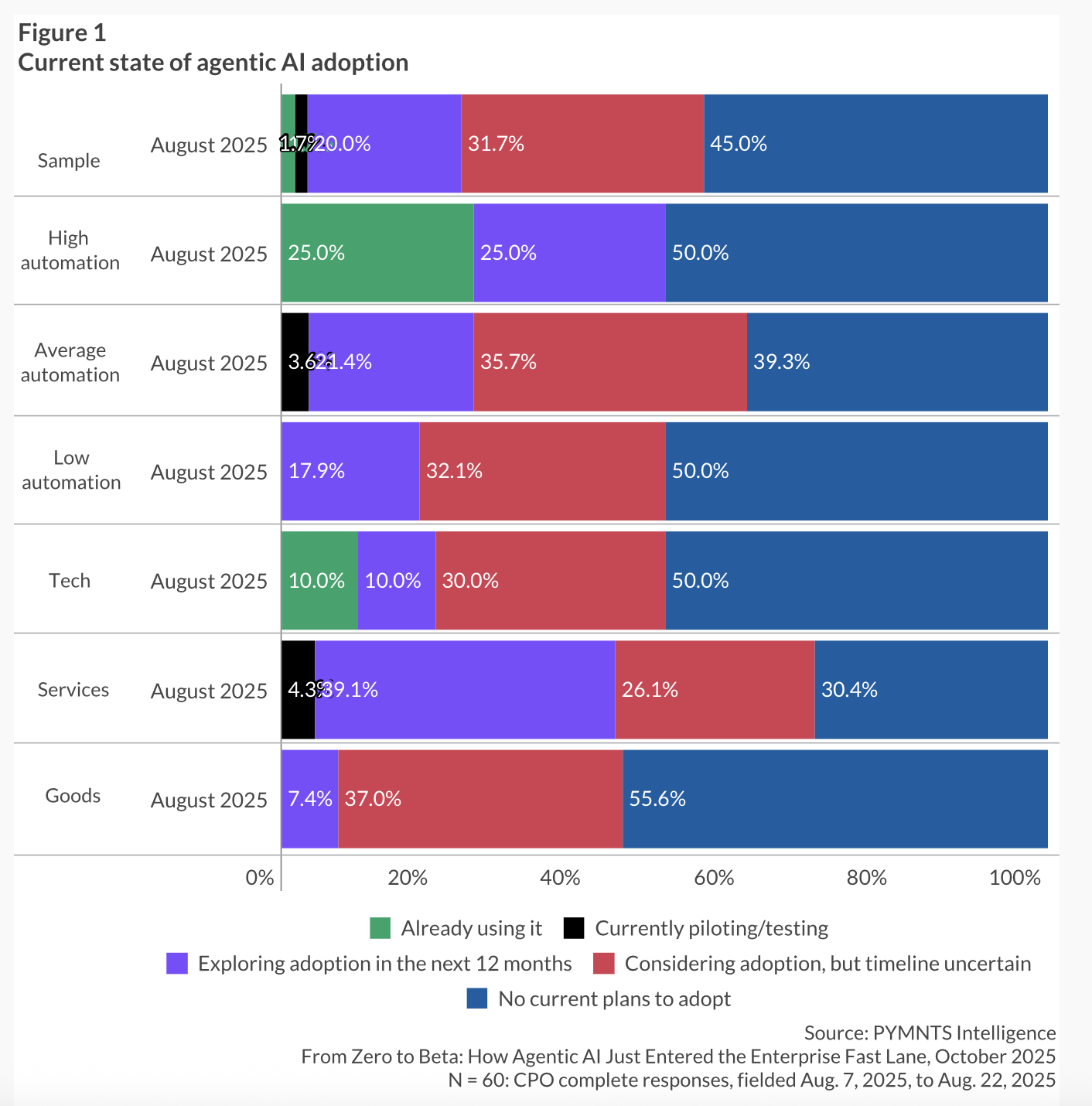
Product departments with the highest levels of internal automation were the most likely to use agentic AI, PYMNTS Intelligence found. By August, 25% of highly automated enterprises had deployed autonomous AI agents, while another 25% planned to do so within a year. None of the companies with low automation levels had adopted the technology.
PYMNTS Intelligence reported it further found sector differences were also pronounced. Twenty percent of tech companies reported either active or planned use of agentic AI, compared with 7% in the goods sector and 4% in services. Still, progress among service firms was notable: their share of companies with no plans to adopt agentic AI dropped from 100% in June to 30% in August.
Trust is the Breaking Point
Despite rising interest, 98% of product leaders told PYMNTS they were not ready to grant AI agents access to core systems. Even among highly automated companies, three-quarters cited governance and security risks as major concerns.
For enterprises already operating with automated workflows—from ERP systems to predictive analytics—agentic AI represents a natural next step, the report said. For others, delegating decisions to autonomous systems still feels too much like taking their hands off the wheel, PYMNTS added.
Outside Expertise Takes Center Stage
The study also highlighted the limits of internal development. More than 90% of product leaders said they rely on third-party vendors or consultants to explore agentic AI PYMNTS Intelligence reported. Service-sector firms were the most dependent on outside partners, while roughly a quarter of tech companies were training staff to build agentic AI capabilities in-house—a strategy that may increase control but raises cost and compliance considerations.
Different Industries, Different Aims
According to the study:
- Tech firms were most likely to use agentic AI for user testing and product-lifecycle management
- Goods manufacturers favored competitive-analysis applications, including scanning rivals’ pricing and product launches.
- Across sectors, adoption patterns reflected each industry’s data maturity and its tolerance for machine-driven decisions.
A Human Hurdle
PYMNTS Intelligence concluded that the biggest obstacle to adoption isn’t innovation but conviction. The technology, the report said, is ready for primetime. The people who must trust it are not.