WASHINGTON–While some in the banking community have been taking something of a victory lap over their input into recent legislation and White House executive orders, the credit union trade groups said they have also played an influential role in the same, even as they acknowledge ongoing education on Capitol Hill about the role credit unions play will need to continue.
The credit union trade groups have in their public statements, media interviews and letters to the Hill called on Congress to ensure “parity” with community banks in legislative relief that is being proposed and in legislation that is being passed, and have scored some victories in the process.
But credit unions have been disappointed in some respects with the progress being made on certain pieces of favored legislation, such as the Board Modernization Act and bills related to veterans and MBLs, and NCUA’s Central Liquidity Facility. All that comes at the same time some of the nation’s community bankers have been patting themselves on the back over their successes in both Congress and in the White House.
‘Even Pairing’
Jason Stverak, chief advocacy officer with the Defense Credit Union Council, noted during a call with the media that the trade group has been pressing Congress to ensure much of the legislation it is considering benefits both community banks and credit unions equally, especially when “one-third of our country is a member of a credit union.”
“I think it’s important that as bureaucrats in the executive branch be given a directive and our regulators are given the directive through an executive order that credit unions are on equal pairing with community banks throughout this process,” said Stverak. “We’ve seen…numerous instances of bill after bill specific to banks (where) we’re supportive of those efforts, but that there needs to be an equal treatment for credit unions in this process; that credit unions are not at the end of the line; that we are at the front of the line with every other community financial institution.
‘Closely Involved’
Community bankers have indicated they have been closely involved in legislation and executive orders coming out of Washington,
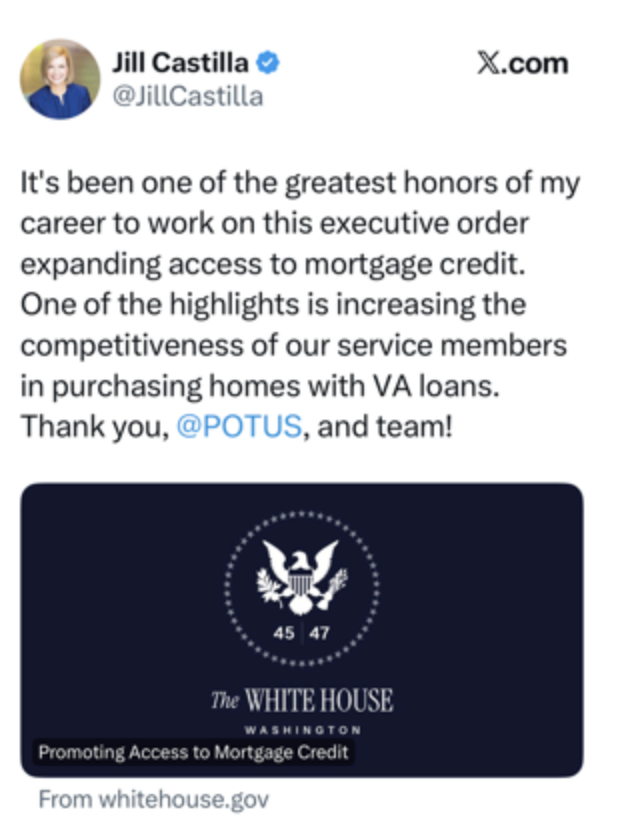
Following Friday’s EO by President Trump related to mortgage credit, Jill Castilla, chairman, president and CEO of Citizens Bank of Edmond in Oklahoma said in a post on LinkedIn, “It’s been one of the greatest honors of my career to work on this executive order expanding access to mortgage credit. One of the highlights is increasing the competitiveness of our service members in purchasing homes with VA loans. Thank you, @POTUS, and team.”
Asked by the CU Daily why the community bankers are having the influence they are having on legislation and executive orders, Stverak said the bankers have had good success at getting “in the room” where legislation and orders are being crafted, although America’s Credit Unions noted CU reps have been in many of those same rooms.
Former Banker Chairs Committee
Stverak also noted that Rep, French Hill (R-AR), who chairs the House Financial Services Committee, is a former community banker, having founded and served as CEO of Delta Trust & Banking Corp in Little Rock, Ark.
“I think he understands that industry and rightly so, but I think that as we are talking about the issues facing community financial institutions, many of the same issues faced by banks are faced by credit unions,” Stverak said. “We’re just trying to raise the profile to ensure that credit unions are considered and thought of equally as we’re moving forward…We just need to…continue our efforts and help educate the administration members of Congress, their staff, and all regulators on the importance of credit unions and the vital role that we play.”
‘No Particular Bias’
When asked the same question about the voice of community bankers on Capitol Hill, Greg Mesack, senior VP-advocacy with America’s Credit Unions, added, “Chairman Hill certainly has, just from his experience, a little more sympathy towards community banks and I do think that they’ve done a very good job of making themselves a sympathetic audience…Certainly, community banks got more than we did and that’s something working on. But I don’t think it’s any specific particular bias…against credit unions. I think maybe just from his personal experience he’s even more sympathetic and has a better understanding of the community bank space. So, it’s incumbent on all of us to go out there and tell our story and do that education so we can you know raise awareness.”

Under the Same Umbrella
And while some bankers may be taking a victory lap in social media, Scott Simpson, president of America’s Credit Unions stressed that executive orders coming out of the White House have referred to “depository institutions,” which includes credit unions as well as banks.
“We weren’t mentioned specifically, but the impact of that is as across the entire category of federal insured depository institutions, so I feel like the executive orders were parity,” Simpson said. “They don’t get to claim any greater victory than what credit unions had, other than the cosmetic reference of the entire category described as banks.”
America’s credit unions also emphasized that as the White House and policy leaders were hashing out the language in the two most recent executive orders “that the trade group “had a seat at the table and was very involved in conversation.”
Complicating the Agenda
Also complicating matters is the fact much of Congress’ attention this week will be focused on the Safeguard American Voter Eligibility Act, also known as the SAVE Act, which seeks to amend the National Voter Registration Act of 1993 to require “documentary proof of United States citizenship” to register to vote, as well as the ongoing dispute over funding the Department of Homeland Security (DHS).