


SACRAMENTO, Calif.— A member of SAFE Credit Union who has publicly opposed the proposed merger between that credit union and Seattle-based BECU said a recent meeting with SAFE President and CEO Faye Nabhani revealed ongoing disagreements over transparency, governance and the potential impact of the deal on members and the Sacramento community.
In response, SAFE Credit Union told the CU Daly it “deeply believes” in listening to its members.
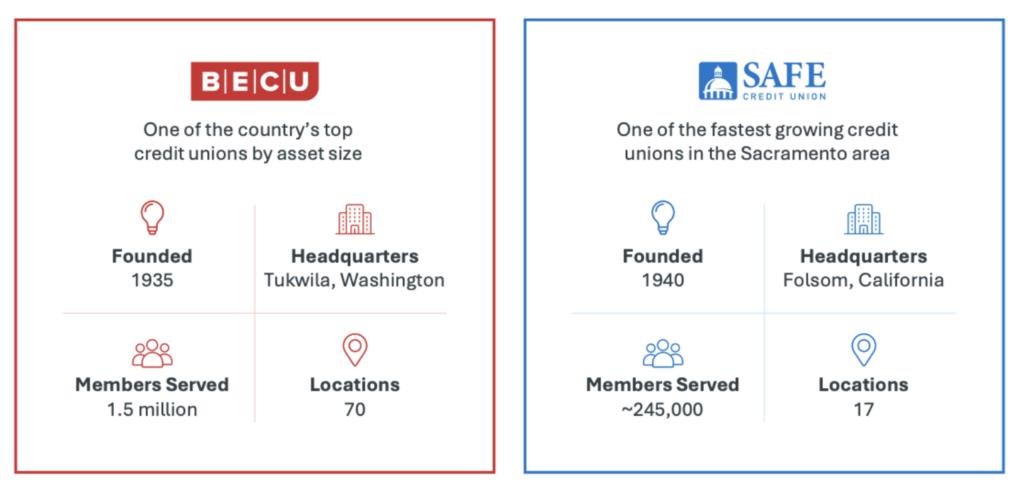
The $4.3-billion SAFE Credit Union asking its members to vote in favor of a merger in the $29-billion BECU. SAFE has nearly 700 employees and about 244,000 members, while BECU employs roughly 3,200 people and serves more than 1.5 million members.
As the CU Daily reported has reported, most recently here, SAFE CU member Scott Rose has published a letter to the editor in the Sacramento Bee and met with local state and congressional representatives to voice his objections to the combination, which include his contention the transaction would result in the termination of SAFE’s charter and the transfer of approximately $4.31 billion in assets — including about $345 million in member equity — to BECU without direct compensation to SAFE’s members.
In a detailed account of the April 7 meeting shared with the CU Daily, Rose said the two held a 2.5-hour discussion that at times became contentious as he pressed his objections to the proposed acquisition by BECU.
Rose said he questioned the strategic rationale for the combination, arguing that SAFE, which he described as a “thriving institution,” would be absorbed by a credit union roughly seven times its size. He said also raised concerns about BECU CEO Beverly Anderson, suggesting her background in commercial banking with Wells Fargo could conflict with credit union principles.
Pushing Back
According to Rose’s account, Nabhani pushed back, saying her experience working with Anderson indicates support for the credit union philosophy of “people helping people,” and expressing confidence that BECU would act in the best interests of the Sacramento region.
A central point of dispute during the meeting was the issue of transparency. Rose alleged Nabhani acknowledged that merger discussions were conducted confidentially and were not disclosed to members prior to the public announcement, including omission from a prior annual meeting agenda.
Nabhani defended that approach, Rose said, arguing that early disclosure could have triggered employee departures and member withdrawals, potentially creating instability.
Rose characterized the decision as a breach of fiduciary duty, asserting that withholding information from members—particularly regarding what he described as a “definitive” agreement—undermined the board’s obligation to act in members’ best interests.
Governance Issues
According to Rose’s account, the discussion also turned to governance issues, with Rose alleging that SAFE’s board nomination process has limited member participation. He claimed that some board candidates were not members until shortly before their nomination, which he said circumvented the intent of the credit union’s bylaws.
According to Rose, Nabhani maintained that the process complies with legal requirements, but acknowledged concerns about whether it aligns with the “spirit of those rules.”
Safe Credit Union’s online listing of its board members indicates its chairman, Rick Blumenfield, has been a SAFE member since 2014, the same year he joined the board. Overall, it indicates nine of the 12 board members become members in the same year they joined the board.
Additional Issues Discussed
According to Rose’s account, additional issues discussed included:
Local Impact
Rose said he further raised concerns about the long-term local impact of the merger, including the future of philanthropic efforts and naming rights tied to SAFE’s presence in Sacramento. He argued that community investment typically follows a company’s headquarters location, suggesting those commitments could diminish under out-of-state ownership.
According to Rose, Nabhani responded that contractual obligations would require BECU to honor existing commitments, though Rose said she acknowledged that some long-term details, including naming rights, remain unresolved.
Employment
Employment was another major focus. Rose said Nabhani indicated the agreement includes an 18-month no-layoff provision for SAFE’s more than 700 employees, but he argued that timeframe is insufficient and called for longer-term protections and severance guarantees.
Commitment to Market
Rose said he also questioned BECU’s long-term commitment to the Sacramento market, suggesting BECU could eventually reduce its local footprint if performance expectations are not met. Nabhani disputed that view but acknowledged there are no explicit guarantees preventing such an outcome, according to Rose’s account.
Regulatory Review
The two also discussed the pending regulatory review, including oversight by California’s Department of Financial Protection and Innovation. Rose said he is seeking to block the transaction before approvals are granted, arguing that a later member vote could be influenced by incomplete information.
Nabhani, he said, maintained that members would have an opportunity to hear opposing viewpoints during the voting process and rejected the notion that the outcome would be predetermined.

No Capital at Risk
Rose additionally raised concerns over what he characterized as a lack of visible capital at risk from BECU in the transaction, warning that the acquiring institution could exit the market with limited downside if the expansion proves unsuccessful.
In response, Nabhani pointed to planned investments by BECU in areas such as improved services, lower rates and reduced fees, though Rose said details have not been publicly disclosed.
Despite sharp disagreements, Rose said he acknowledged SAFE’s strong financial condition, citing its most recent audited financial statements and credited Nabhani’s leadership for the organization’s performance. He reiterated, however, that he believes the merger is unnecessary and poses risks that outweigh potential benefits to members and the broader community.
SAFE Credit Union Responds
In response to a request from the CU Daily for a response, SAFE CU said it is its standard practice to not share details from individual conversations with members. But in a statement,VP Communications and Government Relations Micah Grant said, “As leaders of a member-owned cooperative, SAFE’s board of directors and management deeply believe in listening to our members. We are committed to being available to meet with members who have questions, concerns, or need more information and our CEO feels a strong personal commitment to connecting directly with people and hearing their perspectives. That commitment continues as we move through this process.”




31 Responses
The 18 month no layoff should be little assurance. BECU needs those employees until they get on the same system. After they do, and when the SAFE CEO leaves at 18 months, there won’t be local leadership and no one to protect the local employees and community. Since BECU’s expense issue is so severe, there will be a lot of job reductions in CA.
Performative at best.
Glad these conversations are happening and that he’s asking the right questions—he’s pushing in the way more people should.
What’s becoming clear, though, is that the credit unions don’t really have strong answers—they just have strong PR. BECU, in particular, is very good at managing perception.
Underneath that, the leadership approach feels far more like a traditional bank than a credit union. The new CEO comes across as performative at best—saying the right things publicly, but not reflecting that same philosophy behind closed doors.
Internally, employees have described leadership as political and calculated—always saying the right thing publicly, but the moment anyone questions it, they’re pushed out, fired, or laid off.
BECU isn’t new to working the layoff systems with minimal NDA’s and severance packages. Last April, several employees were let go, and shortly after, nearly identical roles were reposted and filled—often through existing networks or familiar circles. All while moving forward with a costly (millions!) and terribly structured naming rights deal.
You can’t claim credit union values while operating like that.
100% a wolf in sheep’s clothing. Just because you “meet them and they said all the right thungs” doesn’t mean they are not well coach and performative AF. What that leadership teams says in public and what they do behind thr scenes are two very different things.
Do not for profit credit unions have revenue goals?
Someone should from SAFE should ask why BECU’s General Counsel, Chief Auditor, Chief Risk Officer, Chief Impact Officer, and Chief Business Officer all decided to leave, more or less at once. Nothing normal about that.
Don’t forget the ENTIRE executive team that left within months of the new CEO coming on. It’s a revolving door in the C-Suite for a reason.
Most of the employees at BECU were very excited with this hire even knowing the CEO came from Wells Fargo, she seemed to say all the right things, talk about the movement, the members first philosophy, actually we all felt a little inspired and then reality hit.
3.5 years later BECU is a shell of what it was and there is no stewardship towards the CU movement AT ALL behind closed doors, it’s 100% toxic and performative. They have pushed out so many of the employees and leaders that made that place special.
So I am so glad Faye liked her and that Bev said “all the right things” but it is shallow and performative just like others have mentioned. She is a very very good actor in public, she very much slips up behind closed doors. To having the table slammed in front of you while profanities were flying to lying about how she was “listening” to employees with “listening sessions” but behind closed doors was saying “Gotta go pretend that I care about what they say” (jaw dropping really….) to being shushed in meetings for no reason, to tearing people up because they got one thing wrong in a speech she was giving. The executive team is no longer local to Seattle, they live in Atlanta, New York, and LA – flying in on the companies dime with no connection to the region or any care about moving the community forward. Yes, they EMT and Board are being incentivized for a merger, so they chose a “SAFE” merger (pun intended) to get their bonuses and show they increased they asset size, cause their net growth is not great.
Good someone is asking the right questions. Fact is, Bev Anderson and her cadre of big bank execs she brought on Talk the Talk but don’t Walk the Walk when it comes to credit union values. She gutted the original EMT and slowly but surely pushed every exec who challenged what new operating values and the way people are treated out the door. As another commenter said here, she’s amazing in public but behind closed doors treats people terribly. There is a verb in use at BECU now that you’ve “been Bev’d”, and that means she cursed at you, yelled threw a tantrum and most likely in front of your peers or even subordinates. Very inappropriate. Not to mention the Wells Fargo and Equifax background, hiring of other execs who have not clue about what Coops mean and ongoing performative gymnastics. It’s sad what BECU has become over the past few years. The board should be ashamed of themselves.
Stop using a public forum to take down a woman of color CEO. Just stop. Not to mention the inaccuracies and inequities you’re spreading.
Its not about a race and you shouldn’t try and make it so. If you think it’s inaccurate and want more opinions, go read our Glassdoor ratings about what’s happened to our culture under the new leadership.
this has nothing to do with race.
If the truth makes something look bad, it’s not the truth that needs adjusting.
I shared my real truth and lived experience here and have heard the same stories from others. I was forced to sign an NDA otherwise these stories would be public.
Companies don’t have you sign an NDA if the truth wouldn’t expose them.
We can respect identity and still take concerns about treatment seriously.
Both can be true.
Being part of an underrepresented group doesn’t remove the need for accountability in how leadership shows up or how people are treated.
People should be able to share their experiences without being dismissed because of who the leader is.
We can respect identity and still take concerns about treatment seriously.
Both can be true.
Being part of an underrepresented group doesn’t remove the need for accountability in how leadership shows up or how people are treated.
People should be able to share their experiences without being dismissed because of who the leader is
We can respect identity and still take concerns about treatment seriously.
Both can be true.
Being part of an underrepresented group doesn’t remove the need for accountability in how leadership shows up or how people are treated.
People should be able to share their experiences without being dismissed because of who the leader is.
We can respect identity and still take concerns about treatment seriously.
Both can be true.
Being part of an underrepresented group doesn’t remove the need for accountability in how leadership shows up or how people are treated in the company they lead.
People should be able to share their experiences without being dismissed just because of who the leader is.
On a public forum? When there are so many internal channels that can be used? Nope.
what internal channels? The employee survey they took away? (that they didn’t listen to anyway) The whistleblower “line” (online form) that goes directly to the EMT member in charge. There is no accountability, anywhere.
To be fair, it’s not just her she has a knack for hiring these types.
The temper tantrums I have seen Jason throw you would think they have a contest on who can throw the biggest tantrum.
Not that the comments here suggest the defense of a named person will be received well however I work very closely with Jason and have NEVER seen him exhibit ‘tantrums’.
He is direct, fair and highly accountable to the BECU mission and what the cooperative movement stands for. His past USAA experience and how he leads is aligned to all the great things that the credit union movement is about. He is one of the best and brightest people I have worked with in my career.
The behavior is toxic, no matter the skin color. Should we not hold all leaders accountable? In Washington, D.C., the whistleblowing on the toxic workplace has reached the NCUA. Apparently, the state regulators are torn on how to deal with it, and the BECU board had drafted an executive correction, but was afraid it could be seen as racist- to do a correction that any other CEO would have. At the same time, I hear directly from existing executives that they hide when the CEO is in the building. A release of one of the most. experienced and tenured executives when Bev arrived was in a fit of fury. While screaming, she said, “Maybe you should leave.” He said, “Yes, I will.” She went back to ask him to remain, and he said absolutely not. This is not about color. No employee deserves to work in a toxic workplace, and no exceptional executive will stay in one. BECU didn’t grow through mergers before for a reason. Former CEOs believed in organic growth. When you take care of the people in Washington state, everyone will want to join. Growth for growth’s sake just increases executive salaries. That’s a banker. In the past, BECU would provide loaned executives to struggling credit unions. It wouldn’t even merge them in. Its goal was to save every credit union charter. There is no loyalty to the credit union cooperative mission. It’s not even a credit union anymore.
As someone who is also part of an underrepresented community, no, that does not give anyone a free pass to mistreat or abuse people.
Everyone I spoke to internally was complicit in what I experienced, to the point that I had to involve a lawyer just to navigate it. When people tried to raise concerns, they were shut down. HR actively discouraged them from speaking up.
Internal forums were not safe. If you spoke out, you were pushed out, excluded, or let go.
When dozens of people are required to sign NDAs and are prevented from sharing their experiences, this is what happens. The conversation moves outside.
If this had been handled appropriately internally, people would not be here sharing their stories now.
Anonymous?
When you’ve signed an NDA that prohibits saying anything deemed “disparaging,” and you’ve seen others risk or lose their jobs for speaking up, anonymity becomes the only safe option to share your experience. Again, had it been properly taken care of internally we wouldn’t be here would we.
You are also posting anonymous, so what’s your point?
Ahh you were in the inner circle. Lucky you! Those of us that stood up or challenged him were seen as a threat and targeted. Dozens and dozens of us.
Ahh you were in the inner circle. Lucky you! Those of us that stood up or challenged him were seen as a threat and targeted.
What’s said here about Bev Anderson and Jason Rudman is 100% accurate. They are masters of disguise and the perfect public performers. Authenticity is not their game. Since Bevs arrival all senior executives have “left” and replaced by those with her like minded mentality. And most all are related to one another professionally coming from high profit focused companies. BECU is now highly focused on PROFIT and employees are pushed to work extra hours to meet the highest expectations. Departments are under staffed, and all of the heart and soul that was BECU IS GONE. Bev is very polished and convincing that she cares, but in fact she is a bulldog and no one is “SAFE”.
This is obviously a key question. Also just the number of NDAs issued by current executive management and aggregate dollars of buyouts is astronomical. HR executive should be questioned about the volume and content of verifiable complaints from exited executives and others. The Chairperson of the Board should be questioned about the complaints issued by highly respected executives and senior staff validating the toxic environment facilitated by the CEO, that they have swept under the rug. Also question the excessive cost and timeline overruns on key projects where the CEO accepts zero accountability. The only way this merger makes sense is if they make Faye Nabhani the CEO at closure.
All good points except the last one. The SAFE CEO is willing to give up on a perfectly healthy credit union, sellout to what is effectively a bank, hang around for 18 months for optics, and the collect a big check. Is really who the BECU board wants running their credit union?
So why do you think the BECU board continues to ignore or tolerate this? Do they not know?
It’s Seattle with a high cancel culture. The board drafted a corrective action letter and decided not to deliver it, fearing they would be accused of racism. State regulators are aware, and it has reached even the NCUA in DC. The board of directors’ lack of courage to stand up for employees is something the BECU staff could take to a law firm for a class action lawsuit. They could do a records request for the board-drafted corrective action that was never delivered. Many people across the country know just how bad this is. The best course of action, since the board won’t deal with it, really is a collective action that protects all employees.
What’s being said about Bev Anderson and Jason Rudman here is true. They present themselves as highly polished, effective public figures, supported by strong communications teams that carefully shape their image. Authenticity, however, does not seem to be a priority. Bev, in particular, comes across as composed and convincing, but operates like a bulldog, uncompromising and no one feels “SAFE.”
Since Bev’s arrival at BECU, there has been significant “turnover” among senior executives, many of whom have been replaced by leaders who share similar perspectives and backgrounds, often coming from profit-driven organizations and, in some cases, having prior professional ties to one another.
BECU’s direction now IS heavily focused on profitability. Employees are under increasing pressure to meet high expectations, often working unreasonable extended hours at the expense of work-life balance. New processes and ways of operating have been introduced with limited consideration for how they affect employees’ day-to-day responsibilities. Many departments remain understaffed, with leadership emphasizing “just get it done”.
BECU now operates like a traditional bank, with a top-down approach driven by the Board of Directors and executive leadership. The culture that once defined the organization feels fundamentally changed. The old BECU IS GONE. They used to be about “People Over Profit” and now they are “Profit Over People.”
I am 110% leaving SAFECU in early 2027 if and when this becomes an officer “merger”
Which bank or credit union ill go to I have no clue.
This is backstabbing and against member interest. Who is getting paid for this and how much? Thats what I want to know. Because we sure aren’t.
As directed by SAFE CU staff, I have filled out an online request for information about the merger. I have not received a response. What is SAFE’s management hiding? Is this merger financially rewarding management? BECU compensates their Board members…will the SAFE board members be compensated after the merger?
As a SAFE member, I requested a copy of the merger agreement. So far, I have received nothing in response to my request.
Jeanine Morse