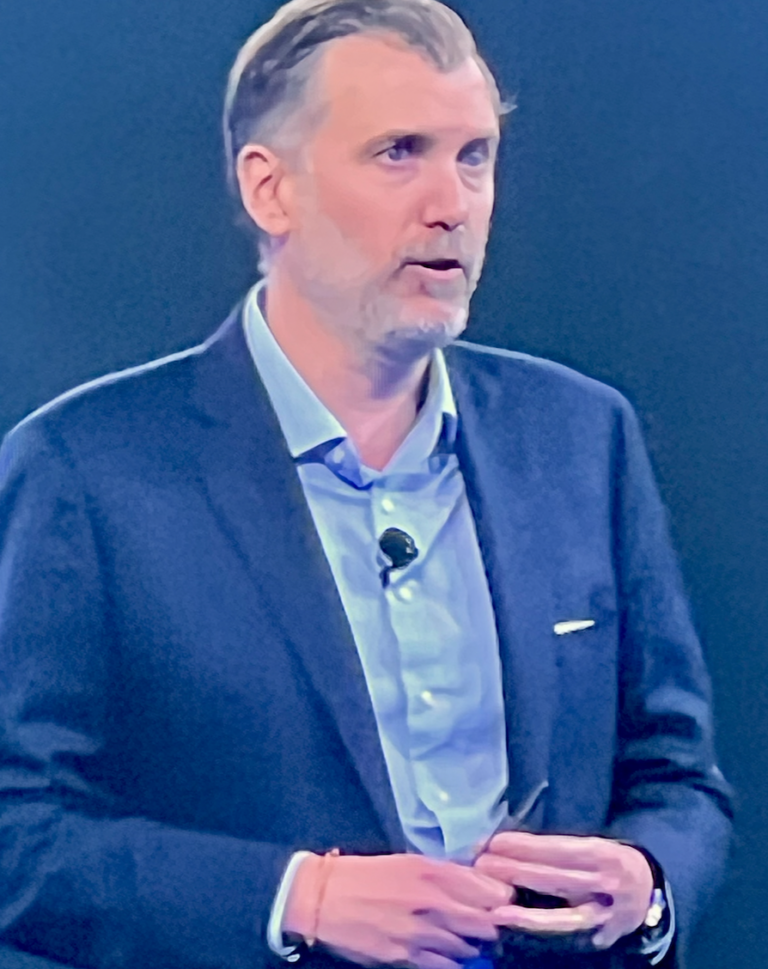
ORLANDO, Fla.—Brendan Tansill, CEO of Candescent, told attendees at the company’s AXIS Conference that the Atlanta-based digital banking provider has completed its transition to full independence and is now focused on advancing a unified platform strategy centered on what it calls “Intelligent Banking.”
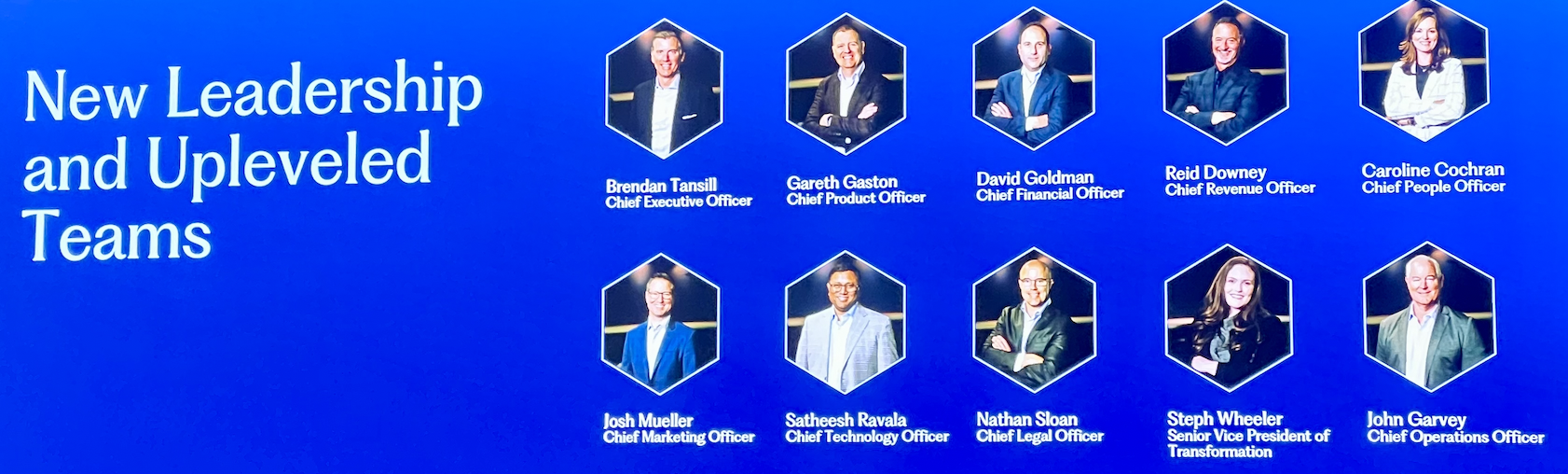
Delivering extended remarks that reflected on the company’s past year while outlining its forward strategy, Tansill said the gathering was designed to both assess progress and align clients around what comes next. Tansill is part of a management team that has expanded rapidly in the last two years.
A common theme throughout Tansill’s remarks, as well of those of other Candescent executives who addressed the meeting, is that “digital banking is about access. Intelligent banking is about experience.”
“We’re going to use the days of this meeting to define our position, our strategy, what we’ve been doing over the last period of time and then, equally importantly, where we’re going moving forward,” Tansill said. “It’s an opportunity for us to step back and reflect, but also to look forward together. We play a really important role for everyone in this room. We represent (your) brand, and a lot of the ways your clients interact with you are largely through our technology. Trust is important, and we recognize that. So today it’s about getting you confidence—it’s about where we are and where we’re going together. We’re going to talk a lot about our leadership, our strategy, our platform and then the partnership model.”
Company Formed in 2024
Candescent was formed in 2024 after Veritas Capital acquired NCR Voyix Corp.’s digital banking business for $2.45 billion, bringing together long-established platforms including Digital Insight, D3 Banking Technology and Terafina. The company now serves more than 1,300 financial institutions and more than 30 million registered users, positioning it among the largest independent digital banking platforms in the United States.
Reflecting on the company’s first year of independence, Tansill recalled that at the prior AXIS conference in New Orleans, the organization was newly separated and facing questions about whether it could convert independence into momentum.
“At AXIS last year we were in New Orleans, and I remember we were newly independent. We had just separated from our former parent company. We had very big initiatives which we were articulating loudly, and there was considerable change,” he said. “The question that I think was permeating the room at that point was: could we turn independence into momentum, and how quickly and effectively could we do it? Over the course of the last year, we’ve answered that question through proven execution.”
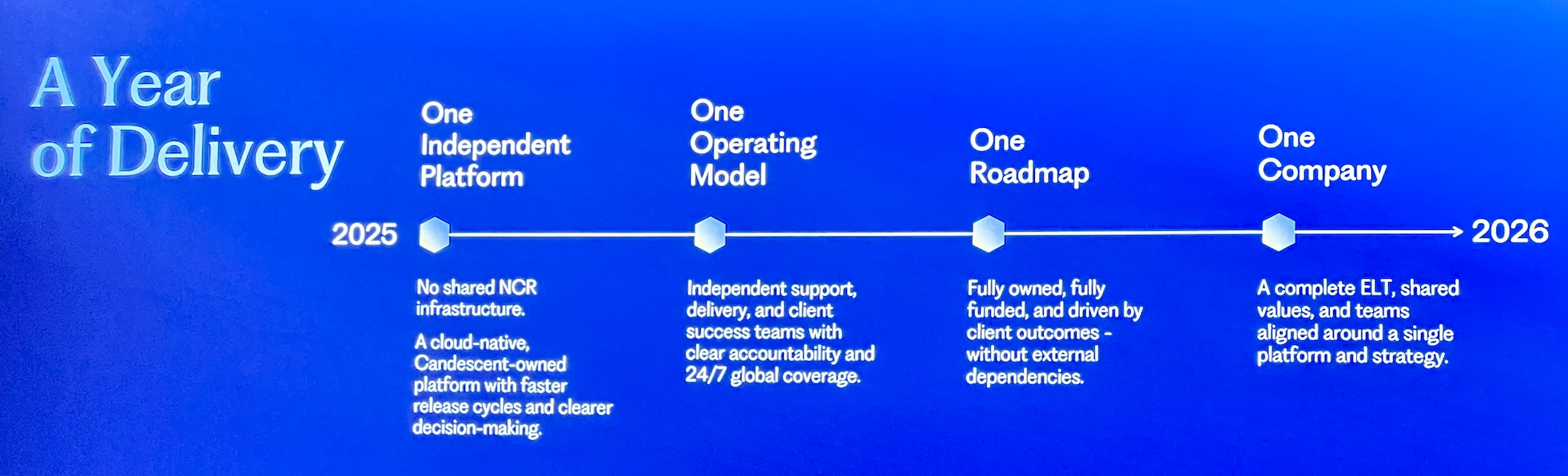
Tansill said the company achieved full operational separation from NCR Voyix and completed its final system cutover, eliminating reliance on legacy services.
More Than 500 People Hired
“Last year we acted with focus, discipline and intent and achieved full separation from NCR. Last week we ran our first build run—that was the final step. As I sit here in front of you today, we consume no services from NCR,” he said. “We’ve unified our technology, our platform, our teams, our clients around a single strategy. We’ve migrated roughly 75% of this room to our next-gen user interface. We’ve deployed more than $120 million into R&D, and we’ve added significant talent across the organization with more than 500 new team members.”
He added that key performance indicators are trending positively, with strong sales, bookings and operational activity levels.
“Our growth, our sales performance, our bookings exceeded forecasts in the fourth quarter and the first quarter,” Tansill said. “We’ve got, I think, last count about 1,200 projects and 2,200 tickets open, and we’re watching every single one. I’m telling you the KPIs are looking incredibly positive.”
Now Looking to Future
With the integration phase complete, Tansill said the company is now positioned to invest more aggressively in product, platform and talent.
“So today the cutover is complete. The foundation is there. We’re now fully independent, fully integrated and are operating as a single Candescent-owned platform with our shareholders,” he told the meeting. “We’re investing for the future. We’re investing to grow and compete and lead, and we’re enabling decisive investment in product, platform and teams. All of this is allowing us to prioritize client outcomes over short-term trade-offs, providing the ability to build and operate with confidence while others face constraint.”
Tansill emphasized that a collaborative culture and clearly defined corporate values underpin the company’s strategy.
“We have a big focus on a collaboration culture,” he said. “What’s in it for you? Deeper expertise, greater consistency, faster execution and greater confidence that we can plan, invest and grow.”
Five Core Values
He outlined five core values guiding the organization:
- Client centricity
- Reliability
- Innovation
- Agility
- Transparency
“Our values are client centricity, reliability, innovation, agility and transparency. The ethos of the company are these values,” Tansill said. “We have a presence in six countries. Each has a unique culture, but the culture of Candescent is ubiquitous. Happy clients build great companies. And for me, the definition of client centricity is quite simple: do what’s right, not what’s easy.”
He added that reliability applies both to technology and organizational behavior.
“Reliability speaks to both technology and to how we behave. I want to do exactly what we say we’re going to do and when we say we’re going to do it,” he said.
On innovation, Tansill said the company must continue to lead as a technology provider.
“Innovation—we’re a technology company. It’s incumbent upon us to innovate. We want to be thought leaders, and we have a lot of creative minds in the room,” he said.
He also highlighted agility, both in operations and mindset.
“We are embracing agile ways of working. That has enormous benefits for us. It’s led to much greater predictability. We have much greater clarity today as to what we can do and when,” Tansill said. “But it also speaks to the mindset of the company. We’re not set in our ways. If the facts change, we’re going to change our mind immediately—and that’s important because the world is changing quickly.”
Personal Hot-Button
Transparency, he added, is a personal “hot-button issue.”
“I like to know what’s happening across the company, but I want you to know that you can expect the same with me,” Tansill said. “When the news is good, I’m going to shout from the rafters, and when the news is bad, I’m going to tell you exactly what happened, why and what we’re doing to fix it quickly.”
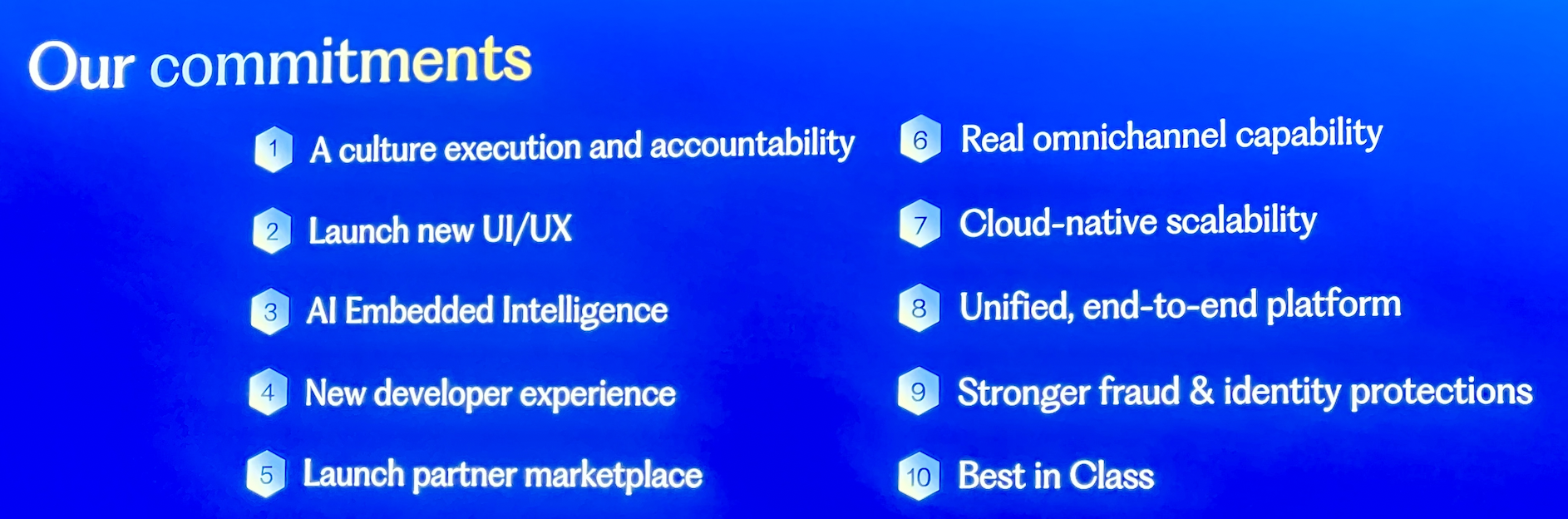
Turning to product strategy, Tansill said the company is transitioning from multiple discrete offerings to a single, unified platform.
“We have a deliberate strategy to move from four separate products to a more unified approach—a shift from products to a single platform,” he said. “This is what enables what comes next in intelligence. It’s built in from the start, not bolted on.”
He said this approach supports a substantial portion of the financial services industry, including both banks and credit unions.
“Our investment supports a substantial portion of the financial services market across banks and credit unions. We serve hundreds of billions in assets through our platform,” Tansill said. “Our collective footprint and client base rivals the scale of the world’s largest financial institutions. Our financial system is stronger when community banks and credit unions thrive, and America is better served.”
The Next Phase
Tansill framed the company’s next phase as a shift beyond traditional digital banking.
“Last year AXIS was about standing up the company. This year is about what comes next—from building the foundation to defining the next era. The integration is behind us. Now, it’s intent,” he said.
He argued that the industry baseline has fundamentally changed.
“For years, digital banking was the focus—expanding access, adding channels, democratizing financial services, making banking easier to reach and use. That work matters,” Tansill said. “But today digital banking is no longer a differentiator. It’s the expectation. It’s table stakes. The question is no longer how digital you are—it’s how intelligently you serve the people that trust you.”
Tansill described “intelligent banking” as the convergence of human understanding and data intelligence to create secure, personalized and purposeful experiences.
Putting it Into Words
“We’ve tried to put words to this, and this is what we’ve come up with: a new standard where human understanding and data intelligence come together to create experiences that are secure, personal and purposeful,” he said.
Initial use cases include:
- Contextual summaries
- Actionable insights
- Proactive intelligence
“Intelligent banking acts when it matters most. It flows with a customer’s or member’s financial life, and it improves at every interaction. It learns and adapts, and it gets more relevant over time,” Tansill said. “It’s not more features. It’s not better dashboards. It’s real-time relevance.”
He said the company is delivering this through a cloud-native foundation and an ecosystem-driven model.
“How are we delivering on all this? Through a unified cloud-native foundation, through intelligence that is built in—not bolted on—and through an ecosystem that brings value,” he said.
The Goals
The goals of the strategy, he added, include:
- Faster and more efficient growth
- Competitive primacy driven by relevance rather than size
- Deeper and more durable trust
“The question was never whether banking would get digital. It could, and it did,” Tansill said. “The question was whether it could get smarter and more useful and understand context in real time and improve with every interaction. When you experience it, it doesn’t feel like a better interface—it’s a fundamentally better model. It’s a system that helps you move forward. It is trust earned in every interaction. It’s not theoretical. This is intelligent banking.”