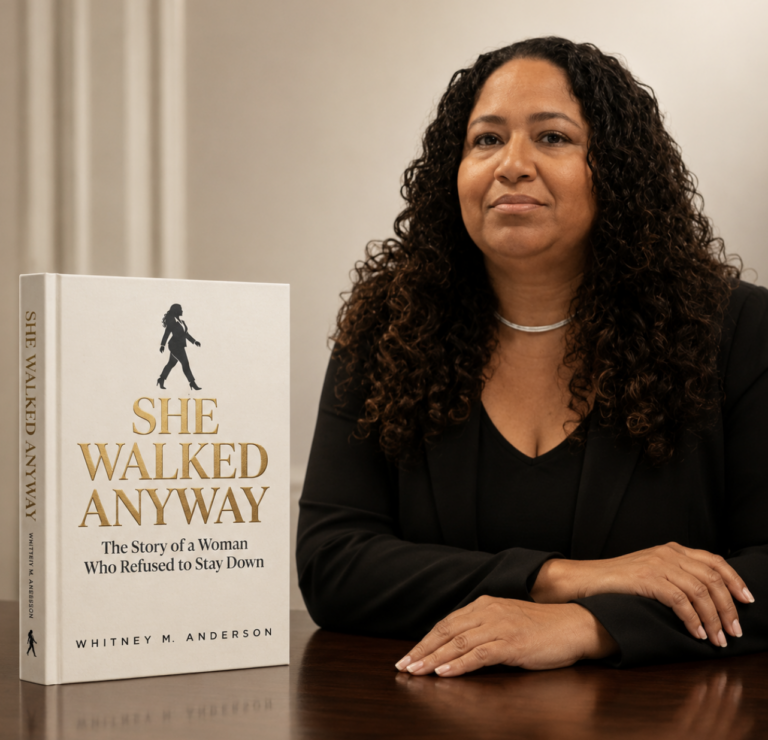
PALM DESERT, Calif.—A former credit union CEO who went from her dream job to having to resign after being told she would never walk again is sharing her extraordinary story.
During the Women’s Leadership Luncheon held in conjunction with Origence’sLending Tech LIVE meeting, Whitney Anderson, the former CEO of Elements Financial Credit Union in Indianapolis, shared her personal and highly inspiring story of reaching the top only be struck down by a rare disease that turned her life upside-down in a very short period of time.
Anderson has also documented her journey in a new book, “She Walked Away: The Story of a Woman Who Refused to Stay Down.”
Anderson told her audience she has had a long history in credit unions, including being the first intern at Lansing Automakers FCU when she was in high school, and then going to work for MSUFCU in Michigan after earning an undergrad degree at MSU and an MBA at Wake Forest. She would spend 13 years at MSUFCU, and still recalls her second day on the job when she was wearing the credit union’s logo wear and a person on the street gave her a hug and while crying said, “”You changed my life. You gave me a mortgage when no one else would.”

“The credit union stuff has been in my blood,” Anderson said.
Anderson credited MSUFCU President and CEO April Clobes with not just bringing her back into credit unions—she held a number of positions at other companies, including Kraft Heinz– as vice president of sales–but also for her management style.
‘Opened My Eyes’
“It’s difficult to find leaders who let you be your true, authentic self,” Anderson stated, praising those “leaders who let you do things the way you want to do them. So many times, that is not the case. Having that experience at MSUFCU really opened my eyes to see that I wanted to run a credit union.”
While at MSUFCU Anderson served in a number of roles, including as executive director of the credit union’s Desk Drawer Fund (now known as the Desk Drawer Foundation—so named because eight MSU faculty members formed the CU in 1937 and it operated from a desk drawer).
Chance Occurrence Leads to CEO Job
While doing a public speaking event, a recruiter happened to be in the audience who was seeking a new CEO for the $2.5-billion Elements Financial Credit Union. That would lead the job Anderson said she had dreamed of and she was named to the top post in February of 2022.
“I was the third Black CEO of a large credit union. The pressure was real,” Anderson said. “I felt like I was carrying a heavy load, and I had so much responsibility, not just at the credit union, but as a woman and a Black woman. At the time, I was on the board of the (African American Credit Union Coalition) and had just been elected to NAFCU’s board. I was the first Black woman on that board. I was really feeling that weight of, ‘Can I walk into these rooms and have these conversations?’ It was an amazing experience. I had so many great mentors who helped me understand I can do this, and I am in the right room, and I belong.”
She urged other women to understand that by talking about the pressures they feel it helps to normalize and lessen the pressure.
“I was living my best life, loving the organization. I had two children who were young. I was thinking, ‘I can do it all’,” Anderson shared. “Of course, you can’t do it all.”
The Best-Laid Plans
And then her life began changing, first slowly, and then quickly.
On her second day as CEO, she discovered her husband of 17 years was having an affair, which she described as a “dagger to the heart.” As hard as it was, she said she chose to keep her chin up and keep going.
In her second year on the job, with things “rolling along” at the credit union but while still going through the divorce process, she shared that on the day after Thanksgiving she began to feel “weirdly exhausted.” Anderson did a visit with a tele-doc, explaining her arms and legs felt weak. He urged a visit to the ER, which she declined. Later, at 4 a.m., she told her mother, “We are going to the E.R.”
She returned home, but her condition worsened until “by Monday, I was completely paralyzed. I could only move my head, and I could breathe. It was terrifying.”
The diagnosis: Guillain-Barré Syndrome, which strikes less than .001% of people. Guillain-Barré Syndrome is a virus in which the immune system attacks the nervous system as if it were the virus. “It’s unimaginable pain and a complete loss of independence,” Anderson told the group of mostly female credit union leaders. “My body felt like it was on fire.”
‘You are Going to be in a Wheelchair Now’
After spending several weeks in intensive care, Anderson said one neurologist told her, “You are going to be in a wheelchair now and you need to get used to this.”
Her response: “No, I don’t.”
Particularly painful, she said, was that her two little daughters were not able to see her for months—and she was still going through the divorce.
At the time the executive team at Elements Financial were making trips to the hospital on a weekly basis to make decisions related to the credit union.
“I started thinking that I needed to make some tough decisions. I needed to be there for my girls and family. I needed to do something women often don’t do, and that is think about themselves,” Anderson said. “This was my life goal. This was one of the toughest choices of my life, to step away from something I had worked so hard to get to and not knowing the future. I made the tough decision to step away from being CEO and I took a year off.”
Anderson exited the job in November of 2023.
‘The Will to Fight’
The next year would be spent in and out of the hospital, with routine tasks such as brushing her teeth having to be done by others. But she did not give up.
“I didn’t see my daughters for a total of five months. Seeing my daughters gave me the will to fight, and I had all these people cheering me on. I said, ‘I’m going to walk’.”
While in the hospital, Anderson said she began to do voice recordings of what she was going through every day.
“It just made me realize things can change in an instant and that every day is so valuable,” Anderson told her audience. “It’s so cliché that we think we will do it tomorrow or next week, but the reality is things can change in the blink of an eye. We only get one go-around in this life. Are we making it our best? Are we doing things that we really want to do in life? Are we making the most of it?”
Leaving a Legacy
Anderson is now endeavoring to indeed make the most of it. As everyone who saw her take to the stage at the luncheon witnessed—she acknowledged the stairs can still be tricky—Anderson has learned to walk again, despite what the doctor had said. She launched Anderson Growth Advisors, wrote her book, began consulting with credit unions, and also started a foundation, Legacy 21.
“I want to leave a legacy, and 21 was the number of days before I started thinking I would need to step away from something I had worked so hard for,” Anderson said. “I encourage all of you, if you have the moments, to dig in and think about it. Sometimes the hardest decision is the right one. Sometimes, it’s not.”
When Anderson asked her audience who was dealing with something no one else knows about, nearly all hands were raised.
She reassured everyone: “We are not alone.”
“We choose happiness in life, and it has to be a choice we make, no matter what,” she said. “You can do what you want to do. Other people don’t define what your life is going to be.”
Anderson said she has now been able to walk without a walker for a full year and recently, she even ran in a 5k.
Why Credit Unions are Here
Anderson said she has also begun meeting with hospitals and doctors about the power of their words. She had shared that early on one doctor had told her matter of factly there was an 85% chance she would live.
“Talking to people about hope and perseverance has become important to me,” Anderson said. “And making an impact on people is why we are all here as credit unions.”
Anderson’s book can be found on Amazon here,