
ST. PAUL, Minn. — Rising living costs, economic uncertainty and concerns about financial resilience are prompting many Americans to shift their focus from achieving financial goals to protecting what they already have, according to Securian Financial’s third annual lending environment study.
The survey of 1,003 current and prospective borrowers, conducted April 2-16, found that many consumers remain financially vulnerable and ill-prepared to withstand a sudden loss of income.
According to Securian Financial, half of borrowers with active loans said they could continue making payments for three months or less if their income suddenly stopped. Nearly one in five borrowers, or 19%, said they would struggle to make loan payments in less than one month after losing their income.
Broader Signs of Strain
The findings come as broader signs of financial strain continue to emerge. Reuters reported in February that data from the Federal Reserve Bank of New York showed household credit conditions worsened at the end of 2025, with delinquencies increasing across several categories of consumer debt.
“Consumers today are navigating an environment marked by higher living costs, uncertainty about future income and growing concerns about their financial security,” Alexia Johnson, partner development leader for Affinity Solutions-U.S. at Securian Financial, said in a statement. “What we’re seeing is a shift from financial offense to financial defense.”
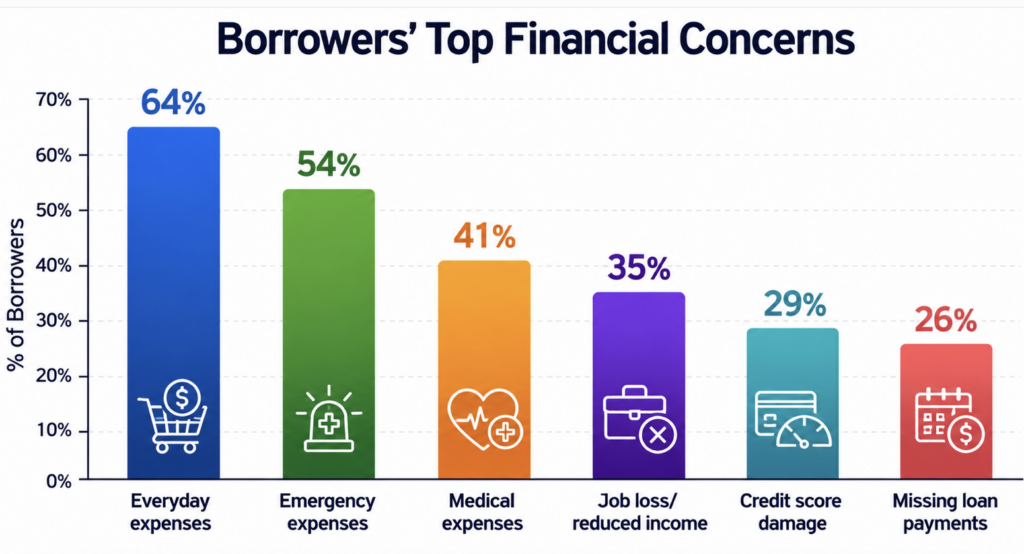
Borrowers’ Top Financial Concerns
The study found that borrowers’ leading concerns center on affordability and unexpected financial shocks:
- 64% cited rising everyday expenses.
- 54% cited emergency expenses.
- 41% cited medical expenses.
- 35% cited job loss or reduced income.
- 29% worried about damage to their credit scores.
- 26% worried about missing or falling behind on loan payments.
The report also found a disconnect between confidence and preparedness among younger consumers. While members of Generation Z and Millennials were more likely than older borrowers to say they feel financially prepared for unexpected events, they were among the least capable of sustaining loan payments after an income disruption.
Protection Products Viewed Favorably, But Adoption Lags
Securian Financial said it found that many borrowers recognize the value of loan payment protection products, including debt protection and credit insurance programs that can cover loan payments during events such as unemployment, disability, critical illness or death.
However, adoption rates remain relatively low.
Among the findings:
- Only 22% of borrowers reported purchasing a loan payment protection product from a lender.
- 77% said such products provide valuable financial security.
- 74% said they help consumers stay on track financially.
- 71% said responsible borrowers should consider them.
At the same time, skepticism remains widespread:
- 48% believe loan payment protection primarily serves as a revenue source for lenders.
- 33% said such products can feel like a “junk fee.”
Johnson said lenders face a challenge in helping consumers understand the role of protection products.
“Loan payment protection isn’t a silver bullet, nor should it be positioned that way,” Johnson said. “But when consumers are worried about how they would manage their financial obligations after a job loss, disability or other unexpected hardship, these products can provide an important layer of protection.”

Trust Becomes Critical During Hardship
The study found that consumers increasingly evaluate financial institutions based on how they support borrowers during difficult financial periods.
According to respondents:
- 90% said they would be likely to remain with a financial institution long term if a loan payment protection product helped them through a hardship.
- 85% said financial institutions should help borrowers prepare for unexpected financial difficulties.
- 85% said their trust in a lender would increase if the institution helped cover loan payments through a protection product during a hardship.
- 85% said they would be likely to recommend that institution to others.
The factors most likely to influence trust in lenders offering payment protection products were:
- Cost of the protection product (52%).
- Clear explanations of how the product works (40%).
- Coverage details (38%).
- Transparency regarding loan terms (37%).
Generational Differences Emerge
The survey found significant differences among generations in their attitudes toward loan payment protection products.
- Gen Z borrowers were the most likely to purchase loan payment protection products, with 31% reporting participation.
- Gen Z respondents also reported the highest familiarity with such products but were also the most likely to find them confusing.
- Baby Boomers were the least likely to purchase protection products, at 15%.
- More than half of Boomers, 51%, said they believe the products primarily generate revenue for lenders.
Securian Financial said the findings suggest lenders may need different communication and trust-building strategies for different age groups, combining digital tools and education for younger borrowers with transparency, proof of value and real-world examples for older consumers.
Recommendations for Lenders
Based on the study’s findings, Securian Financial recommended that lenders:
- Use plain-language communications that explain products through real-life scenarios.
- Help borrowers better understand their financial vulnerabilities.
- Position protection products as part of a broader support system that includes hardship assistance, payment flexibility and financial wellness resources.
- Offer digital convenience while maintaining access to human guidance.
- Tailor communications to the needs and preferences of different generations.
- Share real-world examples demonstrating how support programs have helped borrowers navigate financial hardships.
The study was based on a quantitative survey of 1,003 current and prospective borrowers nationwide conducted between April 2 and April 16, 2026, according to Securian Financial.