
SYDNEY, Australia —To meet the challenge of remaining relevant in today’s markets and to future generations, credit unions globally must adapt to rapid technological, regulatory and competitive changes while remaining rooted in their cooperative mission, World Council of Credit Unions President and CEO Paul Treinen told attendees at the World Credit Union Conference.
Treinen said the World Council now represents credit unions and financial cooperatives in 95 countries serving more than 420 million members with more than $3.9 trillion in assets. But he said the movement’s strength lies not in its size, but in the principles that unite it.
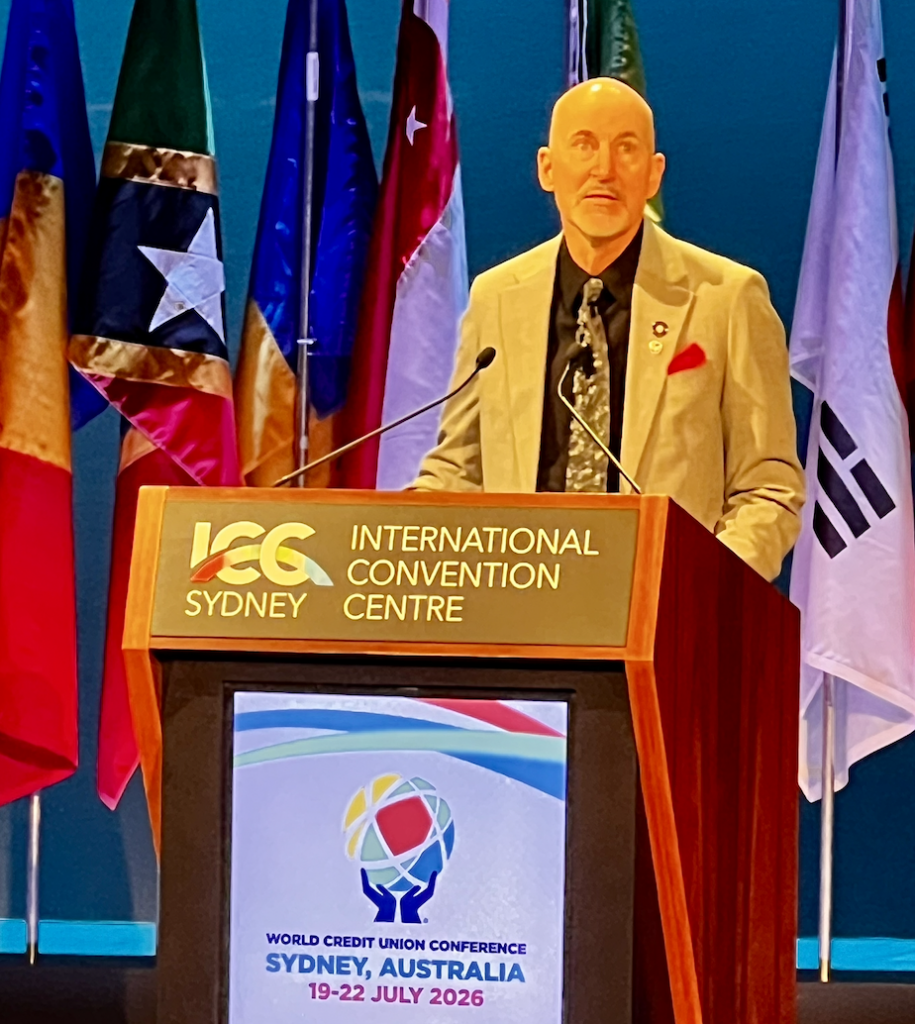
“Scale alone is not what makes this movement strong,” Treinen said. “What makes it powerful is what connects us: trust, community, member ownership and the belief that financial services can be both sustainable and people-centered.”
Although credit unions operate under different regulatory systems, technologies and market conditions around the world, Treinen said they share a common purpose of “people helping people.”
Examples from a Travelogue
Drawing on travels during the past year, Treinen said credit union leaders around the world are confronting many of the same challenges despite operating in different environments.
Among the issues discussed at conferences and meetings across the globe were:
- Philippines: Government relations, digital innovation, leadership development, and attracting more women and younger people to the movement.
- United States: Advocacy on legislative and regulatory issues affecting credit unions and reinforcing the cooperative difference with policymakers.
- Kenya: Building stronger networks, improving governance, pursuing proportional regulation, addressing climate issues and expanding financial inclusion.
- Canada: Responding to aging memberships, rising technology costs, growing fraud and cybersecurity threats, and increasing demand for digital services.
- Costa Rica: Strengthening advocacy, improving regulation, enhancing collaboration and using data to better demonstrate the value of financial cooperatives.
- South Korea and Japan: Creating regulatory frameworks that allow credit unions to compete while sharing global best practices in governance, technology and demographic challenges.
- Australia: Competing in an era shaped by artificial intelligence while managing third- and fourth-party risk, liquidity and fraud.
Different Names, Same Mission
“Different regions, different systems, different names,” Treinen said, noting institutions may be known as credit unions, cooperatives, SACCOs, customer-owned banks or other names depending on the country. “But the same general theme kept coming through: How do we remain relevant in a world that is changing so fast?”
Treinen said the answer will determine whether financial cooperatives can continue growing, attracting younger members and delivering value to their communities.
“The challenge before us is not simply to preserve what we have built,” he said. “It is to adapt, strengthen and prove again why the cooperative financial model matters.”
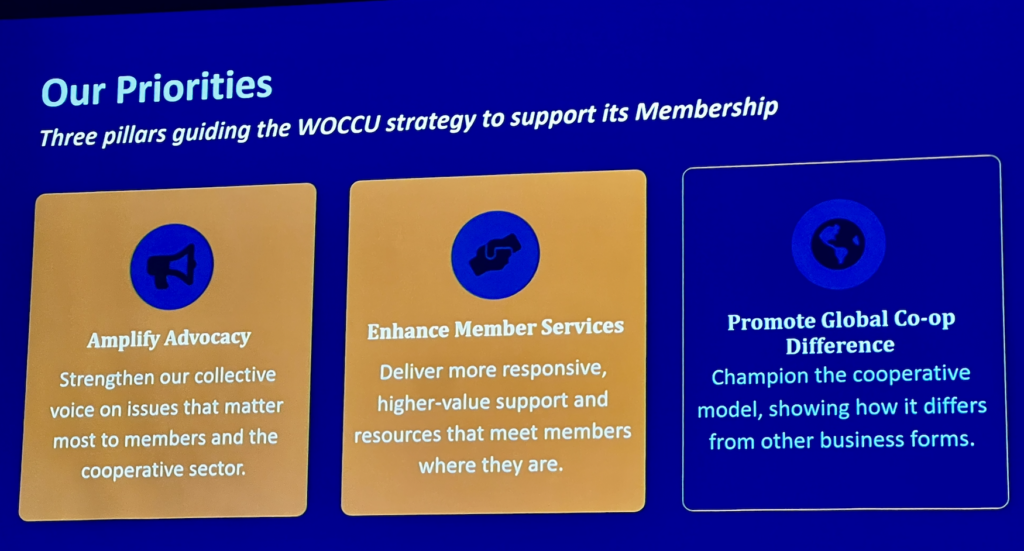
Three Priorities
He said the World Council has reshaped its strategy around three priorities: stronger advocacy, stronger governance and stronger member outreach, with global advocacy remaining its top priority.
Treinen argued that many of the regulatory issues affecting credit unions originate long before they reach national regulators.
“Many of the rules that affect you begin in international forums,” he said, citing policy discussions in Basel, Paris and Brussels that often evolve into international standards.
The World Council’s role, he said, is to ensure the cooperative finance perspective is represented before global standards are finalized.
“We push for requirements that are practical, proportional and based on actual risk, not simply copied from those being designed for the world’s largest commercial banks,” Treinen said.
He noted the organization’s advocacy team regularly meets with international standard-setting bodies and policymakers, maintains a permanent presence in the European Union through its European Network of Credit Unions office, and works to influence global financial policy on behalf of member organizations.

‘Global Distribution Matters’
“Individual credit unions or even national associations rarely have access to these international standard setters,” Treinen said. “That is why global representation matters.”
Treinen concluded by urging delegates to support the World Council’s advocacy efforts, saying the future of the global cooperative financial movement will depend on its ability to adapt while remaining faithful to its founding mission of serving member-owners.
Below, the International Conference Center in Sydney, which is hosting the World CU Conference.