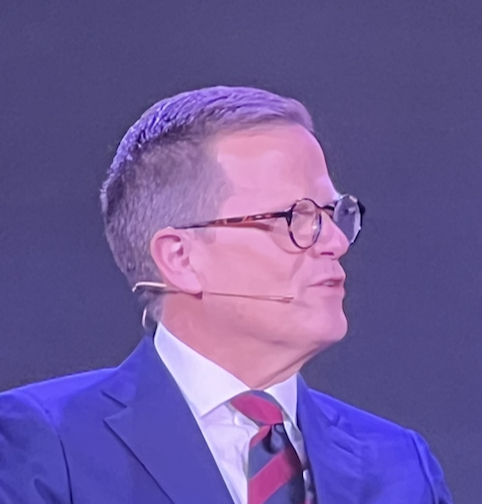
AVENTURA, Fla.–The leader of the country’s largest credit union trade group said it was an event that he witnessed in junior high school that has inspired him in the role, and told CUs gathered here that it is multiple things he is witnessing now that needs to inspire them to act.
Scott Simpson, president and CEO of America’s Credit Unions, participated in a Q&A interview here during the Defense Credit Union Council’s annual conference, and offered views on everything from being a former “dork” to “the big lie” in Washington and state capitols that credit unions find themselves responding to.
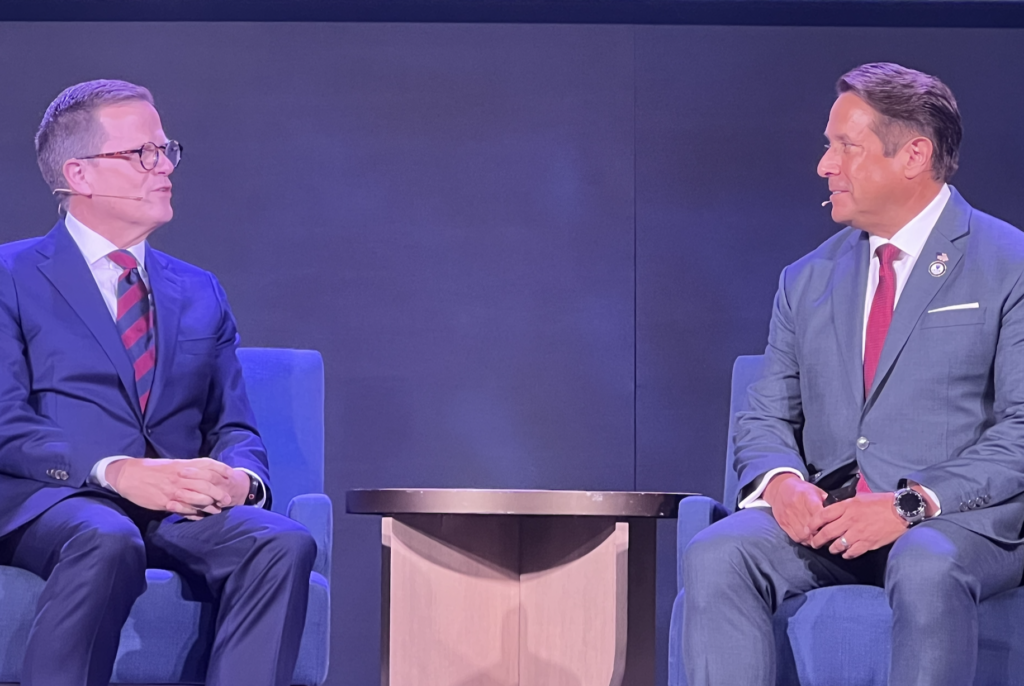
Asking the questions in the Q&A was Tony Hernandez, president and CEO of DCUC. Here’s what was discussed:
Hernandez: What were you like in high school?
Simpson: I was a dork. I was a drummer, a musician. In Utah, I skied. I grew up in a small farm community. I think I was reasonably social, but I was kind of a nerd. I started to get the bug for politics in 1982 when I was in junior high school and Sen. Orrin Hatch was kind of in trouble. He was an early Ronald Reagan supporter. Reagan came to Utah to support Hatch and that’s when I first realized (the pull of politics).
There was a picnic in my hometown, which at the time had maybe 2,000 people in the whole town. This picnic had probably 25,000 people that came into this park to watch Ronald Reagan. Something happened to me in that moment. Everyone came to watch President Reagan. There was the Secret Service in my town, helicopters and the whole thing. That’s when I began to go down this road.
Hernandez: You’re now president and CEO of the largest CU trade association. What has that upbringing done to prepare you for this role?
Simpson: I grew up in the community that has the highest concentration of credit union membership of any community in America. That’s the environment I grew up in. I was from a struggling middle class family. My wife’s father was a machinist in the repair depot at Hill AFB. There were all sorts of struggles to afford life. It was just clear in that community that the ability to have access to affordable credit was a requirement. And then watching the banks locally attack the existence of these credit unions and being pulled into the middle of that fight. When blood starts to hit the floor in a political fight, the passion starts to get deep. So, it’s DNA level passion for me.
There was a transformational experience in my life. My grandmother was a Rosie the Riveter at a defense contractor. My grandfather died and she became a widow. It was credit unions that allowed her to afford life. That’s all I need to touch and feel and remember.
Hernandez: What do you see our industry going? How will it evolve, what are the longer-term challenges?
Simpson: I’m an evangelist for credit unions. Our country’s been around for 250 years. credit unions have been operating here for half of that time. In spite of having 120 years of this and–you know our math is aggressive–but we have 146-million members. That’s one-third of the population…and we have 9% market share. Right now, we are a minority component in the retail financial services space in America. I believe that one of the fundamental pursuits of happiness in this country…is economic freedom. We get political freedom and religious freedom, but economic freedom is a complement. I’ve got this sort of manifest destiny view on this pathway to economic freedom.
In the present state, the worries are we have marketplace realities, some of which we should celebrate, like having more people in a credit union today than ever before in history. We are delivering more on the promise of cooperative finance today than we have before. But one of the biggest risks is too many policymakers are in a position to make a cosmetic observation about the success of credit unions and miss the humanity of the work credit unions are doing. There are too many parroting the criticisms and statements of banks. One of the biggest challenges is we have to go at The Big Lie that credit union growth, growth by the movement, is not a departure from the foundational underpinnings of being a cooperative financial institution. That’s a lie and we have to go at it as directly as we can.
I have heard more in the last year in Congress about those banker arguments about credit unions than I heard in the 22 years before that. That’s what I’m trying to lean into.
Hernandez: Let’s talk collaboration. How can we collaborate together to tackle those issues?
Simpson: The defense credit union voice has always been a huge component of the credit union family and always has been. That ability to articulate the requirement for financial readiness that that forward-deployed soldier, sailor, airmen, and that family requirement back home is huge.
One thing I worry about is we have these credit unions that have for 70 or 90 years served soldiers, sailors, airman and their families that are now getting larger, and I worry about certain policymakers–I don’t want to name names but it starts with an E and ends with Lizabeth Warren–who are willing to take shots at credit unions that serve that serve this mission-readiness, this vital role in the defense of our country, just because those credit unions are getting big. We must capture and retell the human story, the things that make us different beyond the cosmetic observations.
The other component that makes us critical is that we also have a whole sea of people who have served and sacrificed and we owe it to them to honor their service. There is this aging population of veterans. From my perspective, (DCUC) has a rich history of capturing and articulating expertise in the delivery of our business model. That fight requires alignment.
People ask, ‘Aren’t banks and credit unions getting along better?’ Banks are like cats. A cat may let you pet it. They may even purr. But every cat would kill its owner if it could.
Hernandez: What’s coming from the back and the side? The rise of fintechs and AI? Mergers and consolidations? What keeps you up?
Simpson: You just listed them. I came from hostility at the state level in Utah, kind of an institutional Republican version of the attacks. But we also have a growing component on the left. I also worked in Sacramento, California. In Sacramento they were enduring identical attacks from the left based on consumer protections. You have these consumer organizations that rely on government-induced revenue from the banking industry, and they are looking at us as a revenue-diversification play. That pressure is coming for you. They are attacking overdraft protection, CRA, interchange.
There is also another component to the left side of the aisle that the government should be providing banking services. That is growing, that socialist, big government solution to everything is something we will have to contend with more in the future.
In the fintech space, our PAC is going to spend $8 million of hard-earned credit union money defending lawmakers that have defended us in the tax exemption fight, as an example. We’re spending up to million bucks to defend (Rep.) Young Kim (R-CA). The crypto industry just stood up a $128 million PAC in just one month. In Washington, the ABA’s spend is twice as much as ours and that’s before the fintechs come along. It’s perfectly rational for credit unions to say we’re smaller, that makes sense. The challenge with that is that Washington, D.C. and Congress do not give us a coupon for being smaller. Asymmetric warfare is what we have. Your brand equity in your markets is what we need to call on. It’s the only way we can compete.