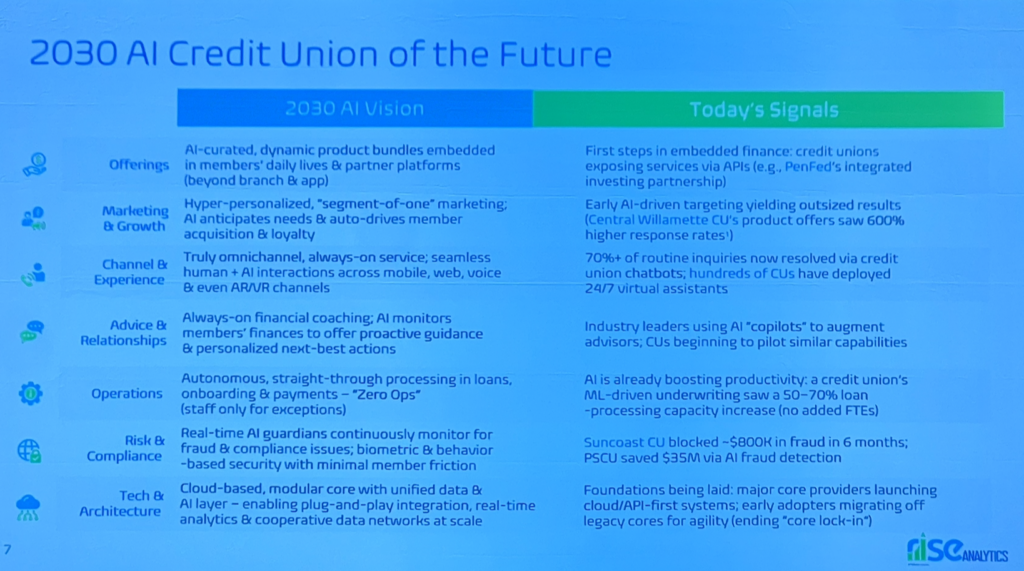
AVENTURA, Fla. — Artificial intelligence has become “table stakes” for credit unions, but success will depend less on the technology itself than on how well institutions manage, govern and protect their data, according to a speaker at the Defense Credit Union Council’s Annual Conference.
James Gukelsen, director of leagues and advocacy with Trellance, told attendees during a session titled “Turning Data into Growth” that data has become one of credit unions’ most valuable strategic assets as financial institutions, technology companies and other third parties increasingly seek to collect and monetize consumer information.

“Everyone wants your members’ data,” Gukelsen said. “Everyone is organizing it so they can monetize it. You should be doing the same thing for the benefit of your members.”
Gukelsen urged credit unions to closely examine how third-party vendors use member data and to understand why it is being collected. “Everything is a data point now,” he said.
He also argued that one of the most important leadership positions emerging in financial services is that of a “chief trust officer.”
“Trust, once broken, cannot be gotten back,” Gukelsen said. “In this evolving ecosystem you’re going to have to allow your members to bring in third-party agents, such as a virtual financial planner. It’s no longer about top-of-wallet, it’s about top-of-phone.”
AI Should Enhance Employees, Not Replace Them
Gukelsen said artificial intelligence should automate routine work so employees can focus on higher-value activities rather than replace staff.
He said predictive analytics should provide months of advance notice of opportunities or risks, not just a few hours.
“If a model is providing you three hours lead time, not good,” he said.
The effectiveness of AI, he added, depends entirely on the quality of the underlying data.
“It doesn’t matter how many AI bots are behind something, it’s still garbage in, garbage out,” Gukelsen said. “You have to have good, clean data that is well organized to provide good results so your front office and staff can take action.”
He also emphasized that predictive models should be built using localized data rather than relying solely on national trends.
“What’s happening in Pennsylvania can be vastly different than what’s happening in Arizona,” Gukelsen said. “It needs to be specific to get good, actionable insights.”
Governance remains critical
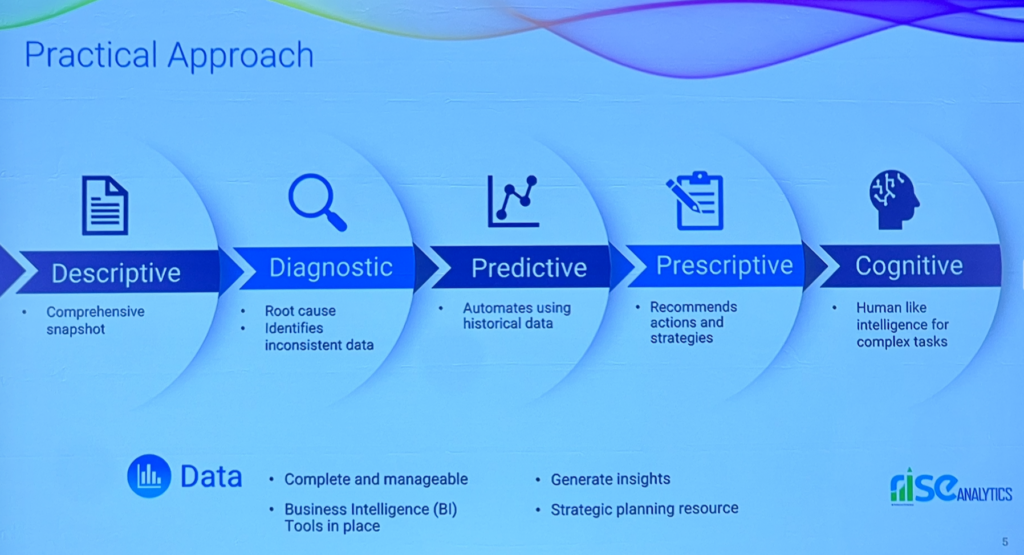
Gukelsen outlined what he described as a practical framework for managing data, stressing the importance of clearly defining the responsibilities of data owners and data custodians.
He said effective data governance includes establishing business rules, identifying and correcting data quality issues, automating governance processes and integrating workflows across the organization.
He also urged credit unions to remain current with auditor and regulatory expectations by training employees on AI use, emerging fraud trends and documentation requirements.
Data quality, he said, requires continuous attention.
“There is no finish line,” Gukelsen said. “It’s a constant process where you and your team must be consistent in exercising good data governance.”
He added that member errors, partner mistakes and changing regulations make ongoing communication across departments essential.
“Your members, your partners, they will screw up,” he said. “Some regulator will announce some insane regulation you’re not ready for. Make sure everybody understands what everybody else is doing.”
AI carries real costs
While AI tools are becoming increasingly accessible, Gukelsen cautioned that they are far from free.
“There is a backend cost to using that,” he said. “This begins with training on how to put in a good prompt. Otherwise, you’re just wasting money.”
He warned credit unions to establish appropriate governance and usage controls so AI-related expenses do not outweigh productivity gains.
“Make sure you have the right controls in place so you don’t have to lay off two or three people because you have these new AI invoices,” Gukelsen said. “Tokens cost.”
Competition accelerating
Gukelsen also predicted that credit union products and services will continue to evolve as member expectations and competition change.
He contrasted the pace of innovation across the financial services industry, saying a decision that takes a credit union five months may take a bank five weeks and a fintech company just five days.
As takeaways, he encouraged credit unions to assess where they are in their data maturity journey, establish measurable performance metrics, clearly define ownership and responsibilities for data-related functions, and recognize the limits imposed by available time and budget.
“If you are not measuring, it doesn’t exist,” Gukelsen said.