BOSTON — Small and midsized businesses are looking to credit unions for practical artificial intelligence-powered financial guidance rather than fully automated banking, creating an opportunity for institutions to adopt AI incrementally, according to new research from PYMNTS Intelligence conducted in collaboration with Velera.
The report, ““The Practical AI Opportunity: Why SMBs Want Guidance Before Automation,“ found that business owners are more interested in AI tools that help manage finances than in technology that replaces day-to-day decision-making.
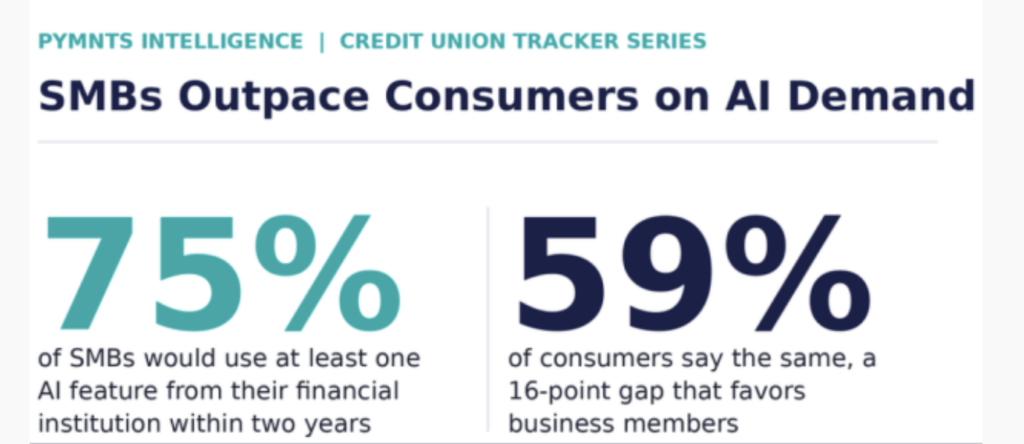
According to the research, 75% of SMBs said they would use at least one AI feature offered by their financial institution within the next two years, compared with 59% of consumers who expressed similar interest.
How Credit Unions Can Benefit
The findings suggest credit unions can benefit by introducing conversational AI and financial advisory tools before pursuing broader AI transformations, allowing them to deliver immediate value while expanding capabilities over time.
The report also found that 49% of credit unions already view AI and conversational assistants as a strategy for attracting new members, although AI agents rank only ninth among 13 innovation priorities for the institutions.
Separately, the report cited data from Cornerstone Advisors showing chatbot adoption among credit unions has increased significantly, with 46% now using the technology, up from just 3% in 2019.
Addition Findings
Demand for AI-enabled financial services was strongest among larger businesses. According to the survey, 83% of SMBs generating more than $1 million in annual revenue expressed interest in AI-powered financial services.
Rather than seeking automation of their operations, business owners said they want tools to help monitor expenses, manage cash flow and compare financial products, the report found.
Cody Banks of Velera said in a statement credit unions should approach AI implementation strategically, describing the preferred method as using “a chisel versus a sledgehammer” by making targeted technology upgrades that improve service without requiring institutions to replace existing systems.