
TROY, Mich. — The financial health of U.S. credit card customers is deteriorating even as card spending increases, creating a widening divide between financially secure consumers taking advantage of rewards and financially vulnerable borrowers struggling with debt and fees, according to a new J.D. Power study.
The share of credit card customers classified as financially unhealthy increased to 60% from 56% a year earlier, according to the J.D. Power 2026 U.S. Credit Card Satisfaction Study released Thursday.
At the same time, average monthly credit card spending across all cardholders surveyed increased by $109 from a year earlier to $1,167.
J.D. Power said the findings illustrate an increasingly “K-shaped” divide among cardholders. Financially healthy consumers are benefiting from rewards and lifestyle perks, while financially vulnerable customers are experiencing greater pressure from debt and rising fees and becoming less confident about card security.
‘Widening Gap’
“The widening gap in financial health means value perception with credit cards is tilted toward debt-free rewards hunters,” said John Cabell, managing director of payments intelligence at J.D. Power.
Cabell said issuers face the challenge of providing premium benefits to customers positioned to use them while increasing support for consumers under greater financial pressure.
“At the same time, strong, effective fraud protection is a must before customers start looking elsewhere,” he said.
Premium Cards Outperform Basic Products
Overall credit card satisfaction was 613 on J.D. Power’s 1,000-point scale.
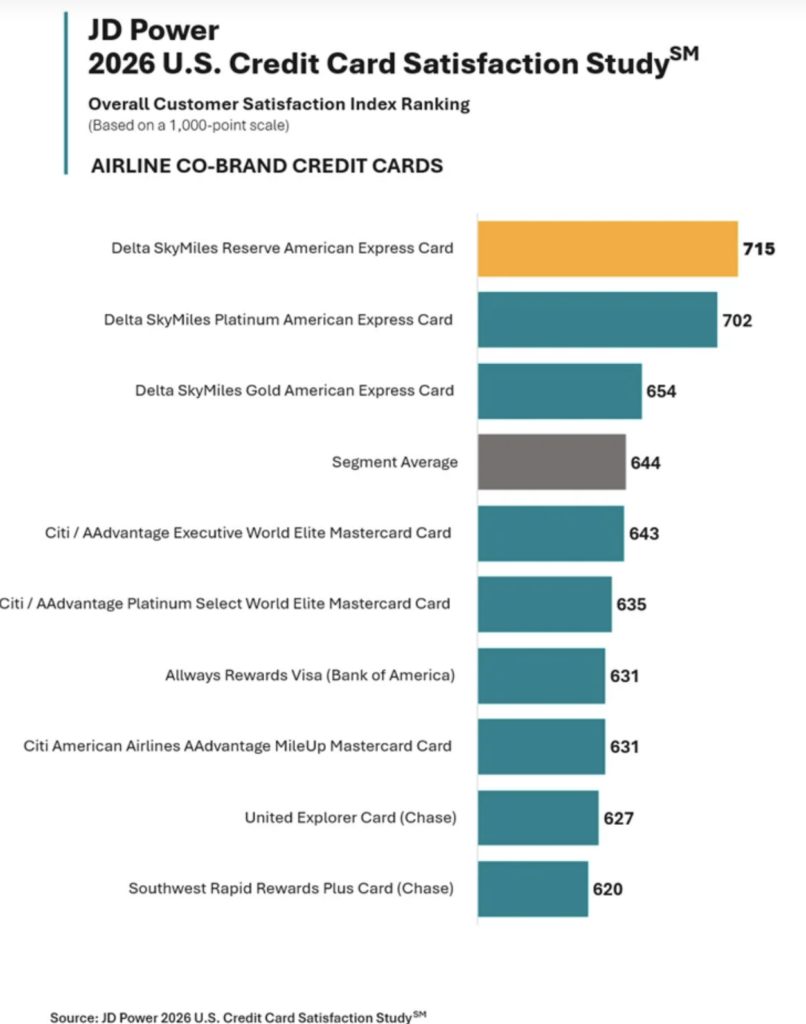
Airline co-branded cards recorded the highest satisfaction at 641, with J.D. Power attributing the results to travel benefits and exclusive experiences in addition to rewards.
Customers with premium cards carrying annual fees of $300 or more reported increased satisfaction with their cards’ value despite recent annual fee increases. J.D. Power said that suggests high-end cardholders continue to believe premium rewards and benefits justify their costs.
By comparison, satisfaction among consumers whose cards offer no rewards and charge no annual fee was 573, well below the overall average.
J.D. Power said the results illustrate the K-shaped divide in card satisfaction, with premium, benefit-heavy products outperforming basic cards.
Debt and Fees Pressure Consumers
Despite worsening perceptions of the economy and declining financial health, consumers’ reliance on credit remained relatively steady.
Among the study’s findings:
- 52% of cardholders carry a credit card balance, compared with 53% a year earlier.
- Among customers carrying balances, 30% owe $2,500 or more.
- 59% of cardholders sometimes abandon a purchase when a merchant imposes a credit card surcharge, with the behavior most common among financially strained consumers.
- More than one-third of financially strained cardholders said they would be more inclined to carry debt if their credit card interest rate were capped at 10%.
J.D. Power said financially vulnerable and overextended consumers reported the greatest difficulty meeting basic needs and were more sensitive to costs and fees.
Consumers Use Fewer Card Benefits
Card value — which J.D. Power defines as the combined effect of a card’s terms, benefits and rewards — became a more important factor in overall satisfaction compared with last year.
Although consumers reported that card benefits were becoming easier to understand, they were using fewer of them. The average number of benefits used declined to 2.3 from 2.5 a year earlier.
J.D. Power also found rewards programs becoming more restrictive, with fewer customers reporting that their cards had no annual earning cap or rewards expiration.
Only 29% of consumers said they use their cards in ways that maximize their rewards earnings.
J.D. Power said that finding suggests issuers may have an opportunity to help customers extract more value from their cards.
Fraud Increases as Confidence Declines
Consumers are increasingly using digital channels for new accounts, account management and customer service, with satisfaction generally higher among customers using digital services.
But the increased digital engagement has been accompanied by declining confidence in security.
J.D. Power found:
- Fraud incidence increased to 13%.
- Proactive outreach from card issuers to identify fraud declined to 38% from 42% a year earlier.
- Just 37% of consumers expressed confidence in the security of their identity and financial information, a decline of 5 percentage points.
- Security confidence declined among consumers who prefer physical cards as well as those using digital wallets.
American Express Leads Issuer Rankings
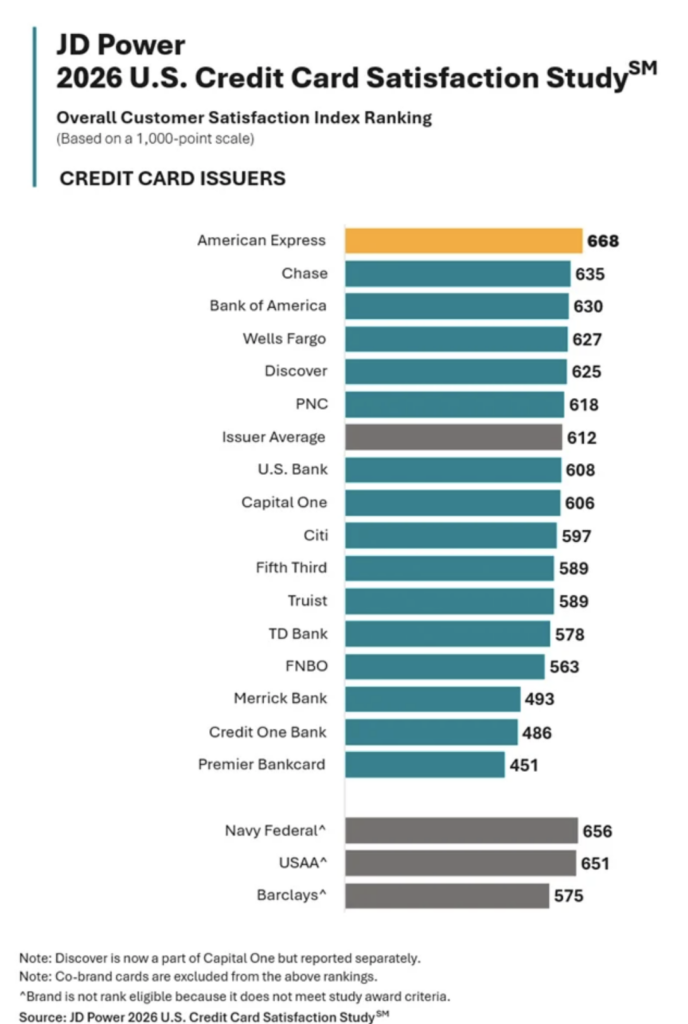
American Express ranked highest in overall credit card issuer satisfaction for the seventh consecutive year with a score of 668. Chase ranked second at 635, followed by Bank of America at 630.
J.D. Power also ranked individual cards across five categories:
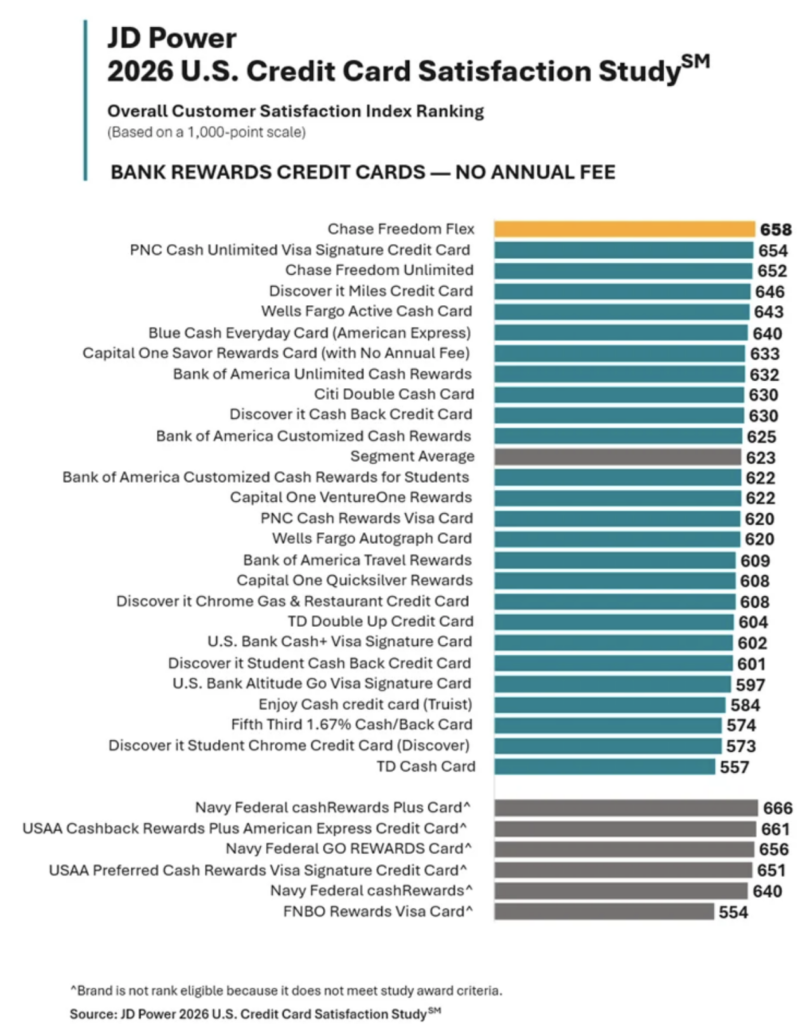
- Bank rewards cards with no annual fee: Chase Freedom Flex ranked first with 658, followed by PNC Cash Unlimited Visa Signature Credit Card at 654 and Chase Freedom Unlimited at 652.
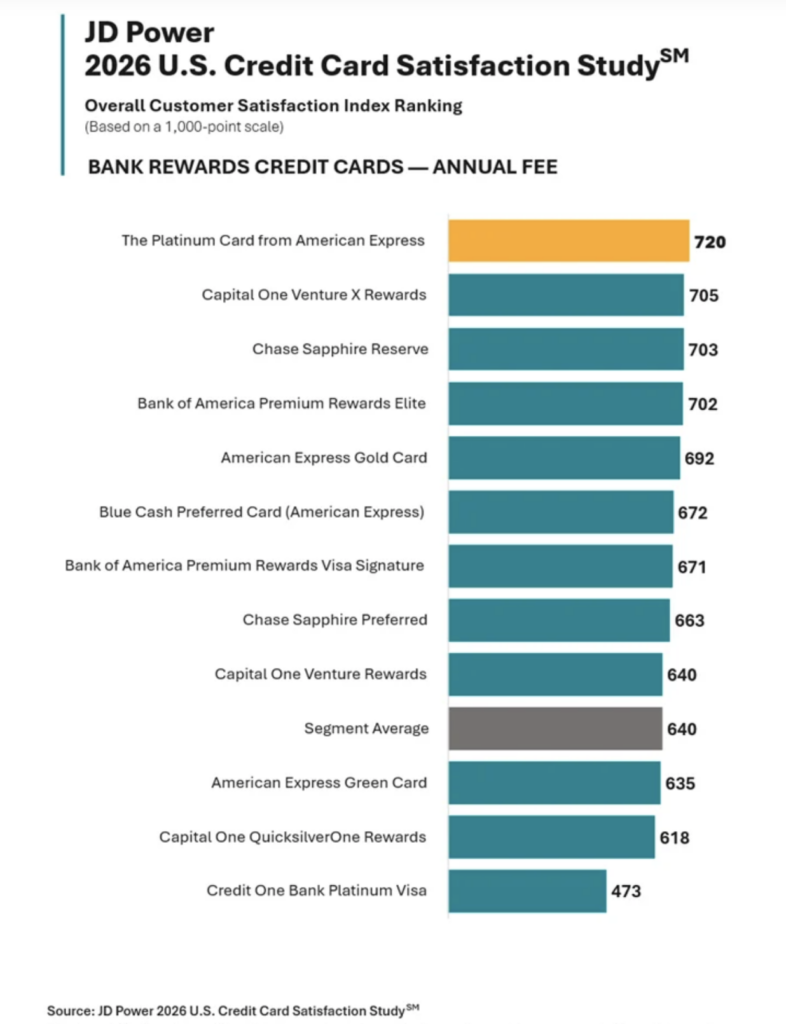
- Bank rewards cards with an annual fee: The Platinum Card from American Express ranked first for the second consecutive year at 720, followed by Capital One Venture X Rewards at 705 and Chase Sapphire Reserve at 703.
- Bank cards with no rewards or annual fee: BankAmericard ranked first at 586, followed by Capital One Platinum Mastercard at 576.
- Airline co-branded cards: Delta SkyMiles Reserve American Express Card led with 715, followed by Delta SkyMiles Platinum American Express Card at 702 and Delta SkyMiles Gold American Express Card at 654.
- Co-branded cards with no annual fee: Hilton Honors American Express Card ranked first for a second consecutive year with 669, followed by NHL Discover it Credit Card at 646 and Costco Anywhere Visa by Citi at 643.
Now in its 20th year, the U.S. Credit Card Satisfaction Study measures customer satisfaction with consumers’ primary credit cards across seven areas: account management, benefits, customer service, new accounts, rewards earning, rewards redemption and terms.
The 2026 study is based on responses from 40,386 credit card customers collected between June 2025 and May 2026.