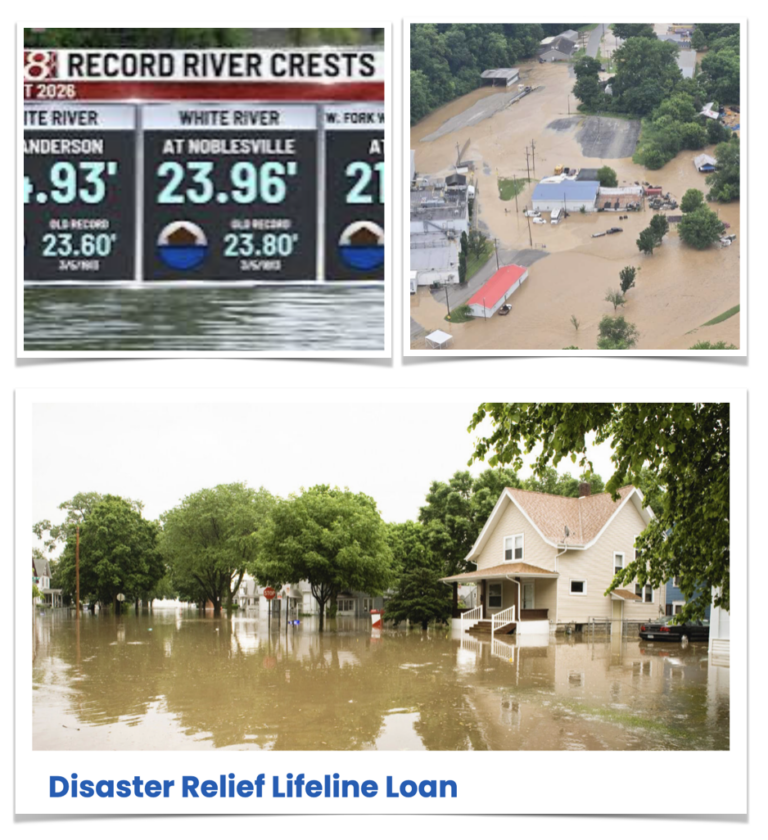
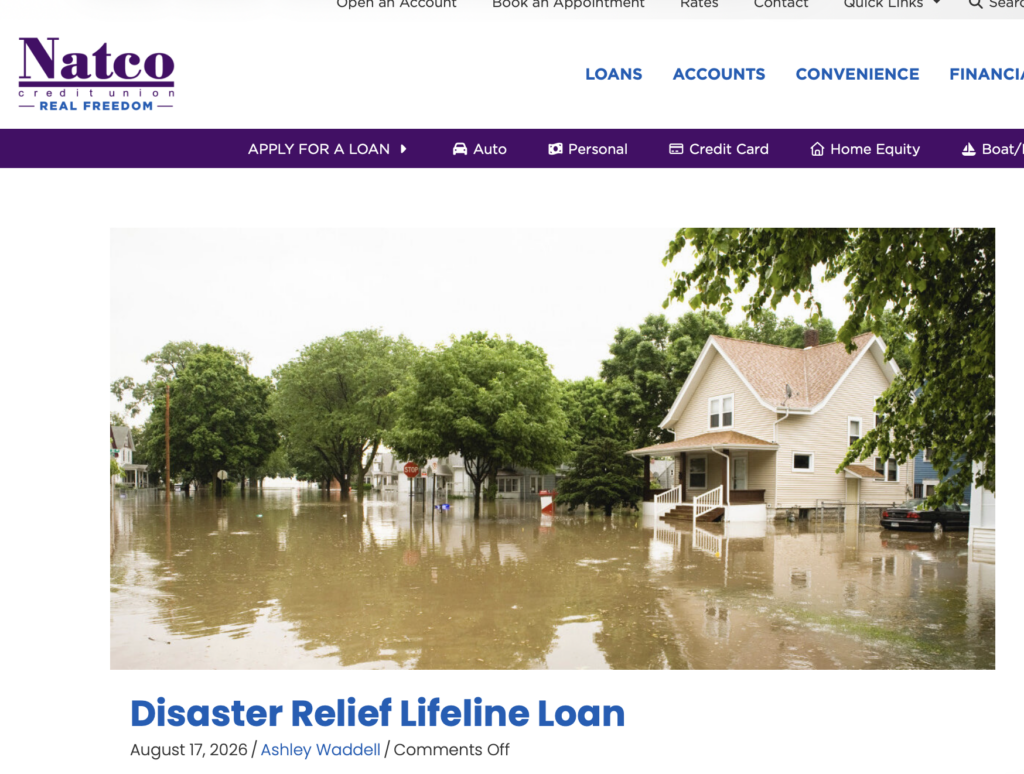
RICHMOND, Ind. — Natco Credit Union has rolled out emergency loans, payment extensions and other assistance for members affected by catastrophic flooding in eastern Indiana, where some families and businesses face a lengthy recovery after rainfall overwhelmed rivers, creeks and communities.
The $153.6 million credit union, which serves about 18,000 members across seven counties, said all seven counties in its service area were affected by the storms and flooding.
“We have a lot of members who have been impacted either personally or through their family or business,” said Karen Houser, marketing director at Natco Credit Union. “One city official has said this recovery is going to be more like a marathon than a sprint, and it’s going to take a long time for people to recover. That is absolutely true.”
A Damaging Weather Year
Indiana has experienced an unusually active and damaging weather year in 2026, with multiple episodes of tornadoes, destructive winds, torrential rainfall and flooding.
The latest severe weather struck Aug. 11-16, when portions of the state received 6 to 9 inches of rain in 24 hours and at least one location recorded 11.23 inches. Some areas received as much as 12 inches over 72 hours.
The White River reached record levels at Anderson and Noblesville, exceeding marks dating to 1913. State officials have reported eight deaths, at least 44 structures destroyed and more than 950 sustaining major damage.
Wayne County declared a local disaster emergency and imposed a Level III travel warning prohibiting nonemergency travel on many local roads. An Indiana Department of Homeland Security analysis estimated 1,341 of Wayne County’s 24,699 residential parcels, or about 5.4%, intersected areas modeled as having more than 2 feet of flood inundation.
President Donald Trump approved an emergency declaration Aug. 15 covering 53 Indiana counties, including Wayne and Fayette, allowing the Federal Emergency Management Agency to provide direct federal assistance for such needs as search and rescue, emergency road clearance and temporary power and communications support.
Some communities have endured multiple flooding events.
‘Nothing We’ve Seen in Our Lifetime’
Natco operates two branches in Richmond, near the Ohio border. Houser said Richmond experienced flooding but escaped some of the more severe damage suffered in surrounding communities.
“Some of the most hard hit were in flood plains, others were not,” Houser said. “The storms and the flooding caught people quite by surprise. It was like nothing we’ve seen in our lifetime.”
Rather than one brief deluge, Houser said persistent rainfall eventually overwhelmed waterways.
“It was just consistent, steady rainfall that caused local creeks and lakes and rivers to flood,” she said. “We had it in places that we didn’t expect.”
Homes and businesses flooded in areas where residents had never experienced such conditions before, she said.
“This is just not something that in this part of Indiana we had seen before,” Houser said.
Most affected communities have moved into the cleanup phase, with residents removing debris and damaged belongings and opening walls to dry homes before mold develops.
Just the Beginning
But cleanup is only the beginning.
“As far as getting past that and moving on to the steps of being able to move back in, that’s going to take some time,” Houser said.
Businesses also have been displaced. Houser pointed to the Western Wayne News in downtown Cambridge City, which lost equipment and office space and temporarily relocated.
Families whose homes took on inches or feet of water face similar challenges.
“They’re just trying to find temporary housing until they can get their stuff figured out, move back in, deal with insurance claims, all that stuff that comes with it,” Houser said. “There’s been talk about FEMA coming in, but we don’t really know what that looks like for everybody.”
Natco Employee Loses Home
The disaster also directly affected Natco’s staff.
Houser said one employee’s home was considered a total loss. Because the employee had been working remotely, Natco brought her back into the office while she deals with the aftermath.
“She’s trying to navigate a lot right now with the loss of her home and the repairs, if it’s repairable,” Houser said.
The employee was eventually able to reenter the home to remove belongings that could not be salvaged, open walls and begin using fans and dehumidifiers to dry the structure, Houser said.
Credit Union Revives Lifeline Loan
Natco responded by reviving a loan program it originally created during the COVID-19 pandemic.
“As soon as we could, we immediately reviewed that and relaunched our Lifeline Loan to help members who have been impacted,” Houser said. “We try really hard to find solutions and help people get past difficult times.”
The Disaster Relief Lifeline Loan offers $500 to $2,000, with repayment terms of up to 24 months. The first payment can be deferred for 90 days to give borrowers additional time to recover.
The loans are not credit-based and carry a fixed annual percentage rate as low as 10.962%, although borrowers must meet certain qualifications.
Applications are being accepted through Sept. 30.
During the first week, Natco received 10 applications and funded six loans totaling $9,200. It made a counteroffer to one of the four applicants whose original requests could not be funded.
Additional Assistance
The credit union also is assisting borrowers who already have loans with Natco and may have difficulty making payments because of the disaster.
Houser said Natco’s solutions team had completed 18 loan extension agreements, offering affected borrowers payment delays of up to 45 days. Most borrowers requested about a one-month extension.
“They just want a little bit of breathing room,” Houser said.
Job Losses Also Affect Borrowers
The flooding’s economic effects extend beyond physical damage to homes and businesses.
Houser said Natco recently made changes related to involuntary unemployment coverage, and two borrowers have filed claims because their employers or businesses were affected by the flooding and they are temporarily unable to work.
Those borrowers’ loans are being covered under the involuntary unemployment provisions, she said.
Natco does not expect to make major changes to its disaster response strategy because of the flooding, but Houser said the experience has demonstrated that the Lifeline Loan can be quickly adapted to future emergencies.
“We know we can revitalize the Lifeline Loan,” she said. “We are now calling it a Disaster Relief Lifeline Loan so we can look at it and reapply it, spin it up and offer it to members at any time.”
The credit union also is exploring grant assistance that could provide money directly to affected members. Houser said Natco is working within the requirements of an approved grant program.
Employees Volunteer 176 Hours
Natco’s response also has extended beyond financial assistance.
As a community credit union, Natco provides employees two hours each quarter during work time to volunteer and encourages staff members to contribute additional time in their communities.
An informal survey conducted after the flooding found Natco employees had already contributed 176 volunteer hours to community recovery and other efforts, Houser said. More volunteer work is scheduled.
For many of the credit union’s members, however, the immediate focus remains on clearing damaged possessions, drying out buildings, finding temporary places to live or operate businesses and determining what insurance or government assistance may be available.
The longer process of rebuilding has barely begun.
“We have a lot of members who have been impacted,” Houser said. “It’s going to take a long time for people to recover.”