BOULDER CITY, Nev. — Credit unions that continue treating artificial intelligence primarily as an experiment or technology project risk falling behind competitors as AI increasingly reshapes operations, staffing, data analysis and member expectations, industry leaders said during the first installment of a new seven-part webinar series.
“The AI Imperative: Understanding the New Operating Environment,” hosted by The CU Daily and Mitchell Stankovic and Associates, examined how credit unions are already deploying AI and why institutions of all sizes may need to accelerate their strategies.
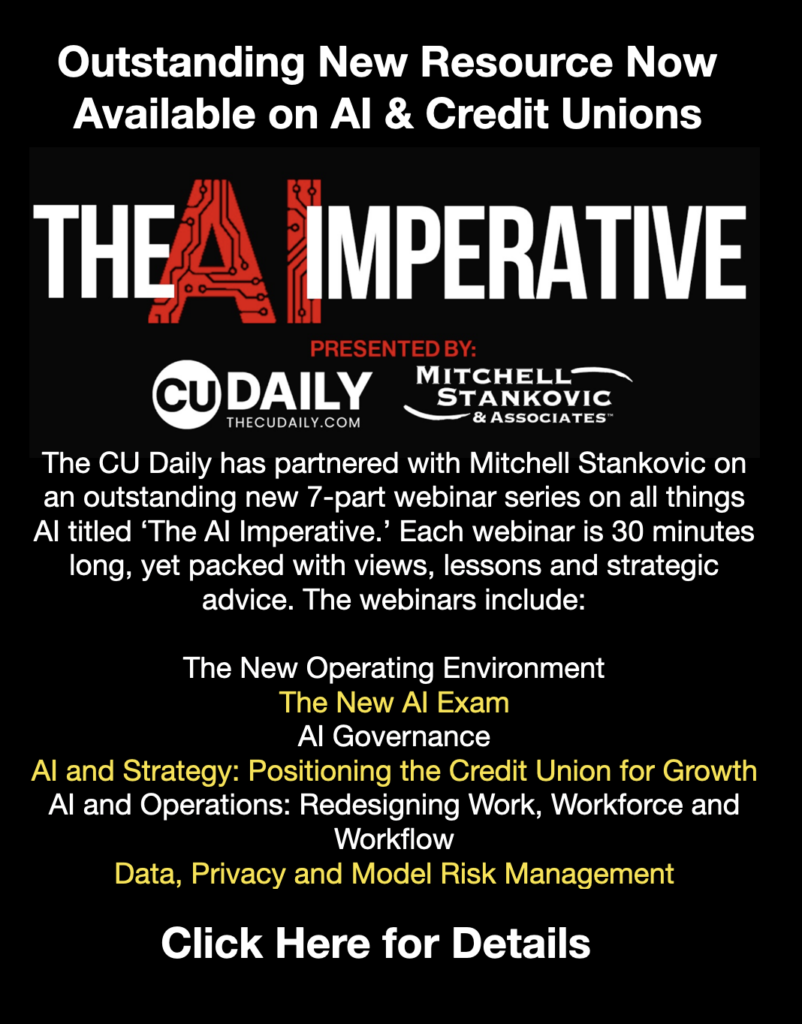
Mitchell Stankovic and the CU Daily recently announced that in response to credit unions’ requests, pricing on the webinar series now includes everyone at the same credit union, or, separately, everyone on the board.
Tyler Valentine, CEO of $130-million Stage Point Federal Credit Union in Wyoming, said his credit union has moved beyond experimentation and is using AI extensively in its back office.
“I think that credit unions that don’t do it are at a strategic risk that maybe we’ve never seen,” Valentine said.
Michael Morin, CEO of the Coeus Institute, said AI’s value isn’t in replacing executives and employees but in helping them make better decisions while eliminating repetitive work.
“AI doesn’t replace decision makers,” Morin said. “It should embolden and enforce decision makers, not replace them.”
Small CU Puts AI to Work
Valentine said Stage Point purchased a business license for Anthropic’s Claude and built an internal intranet that began as a way for him to automate some of his responsibilities as CEO of a small institution.
The system has since expanded to approximately 50 modules covering functions including IT ticketing, human resources, employee onboarding and offboarding and job descriptions.
Stage Point is also exploring AI applications in accounting, including reconciling transaction files. Instead of employees manually searching transactions to determine why totals don’t match, Valentine said AI can compare reports line by line and quickly identify discrepancies.
“Accounting is one of the areas operationally that AI can make a huge difference quickly,” Valentine said.
The credit union also has used AI-assisted underwriting for more than two years. Valentine said reviews comparing troubled loans approved by humans with those decisioned using AI showed the AI system did a better job assessing and calibrating risk.
Turning Data Into Decisions
Morin said credit unions already possess enormous amounts of data but often struggle to turn it into useful information.
“Collecting data is the easy part,” he said.
Information may be spread across core systems, mortgage platforms and vendors, while extracting meaningful insights traditionally has required data teams, consultants or data scientists.
Morin said the Coeus Institute has developed AI tools intended to help address that problem. OmniCU analyzes a credit union’s internal data to identify trends and potential actions, while Omni53 analyzes NCUA Call Report information to help institutions compare performance with peers and industry medians.
Such capabilities could be particularly important for smaller credit unions that historically couldn’t afford sophisticated analytics, he said.
Members Expect More
Valentine said Stage Point’s next challenge is extending AI capabilities to members, including eventually providing real-time insights about their spending and finances.
Consumer expectations are also changing quickly.
“Everything, everywhere, all at once,” Valentine said, describing members’ expectations that their financial institutions quickly support widely adopted services and technologies.
AI is also beginning to influence how consumers choose financial institutions. Instead of relying solely on recommendations from friends and family, consumers can now ask AI assistants where they should bank.
Valentine said he tested that by asking ChatGPT to recommend a credit union in Laramie, Wyoming. Stage Point ranked second, with the AI apparently favoring a larger institution partly because of its size and technological capabilities.
That makes credit unions’ digital reputations increasingly important, he said.
Risk of Waiting
Valentine said credit unions that successfully deploy AI could reduce costs, improve employee retention and strengthen member relationships by freeing staff from repetitive tasks.
Institutions that wait for the technology to mature, however, could discover competitors and members have already moved ahead.
For more information on the webinar series, go here.