MADISON, Wis. — Credit unions and financial cooperatives worldwide now serve nearly 420 million members and hold almost $4 trillion in assets, but a new global survey shows the movement is confronting mounting pressure from regulation, digital competition, artificial intelligence and cybersecurity.
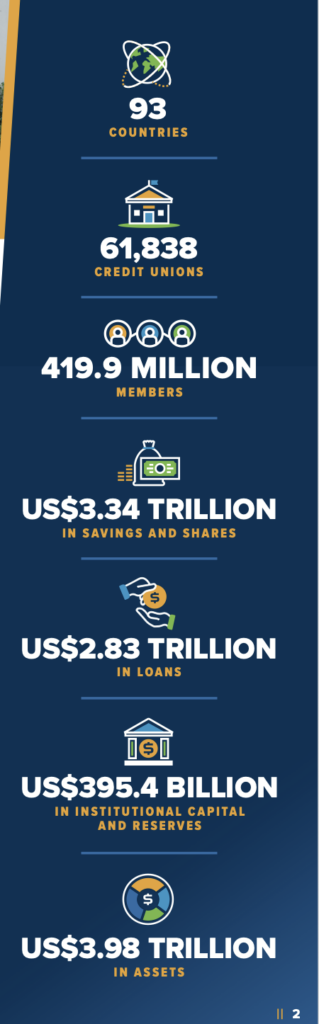
The World Council of Credit Unions’ 2025 Statistical Report identifies 61,838 credit unions and financial cooperatives across 93 countries, serving 419.9 million members. Those institutions reported $3.98 trillion in assets, $3.34 trillion in savings and shares and $2.83 trillion in loans. Institutional capital and reserves totaled $395.4 billion.
WOCCU said the report represents its best available picture of the global cooperative financial system and draws on information from national and regional credit union associations, regulators, central banks and other sources.
North America Dominates Assets
The report highlights significant differences in the size and structure of credit union systems around the world.
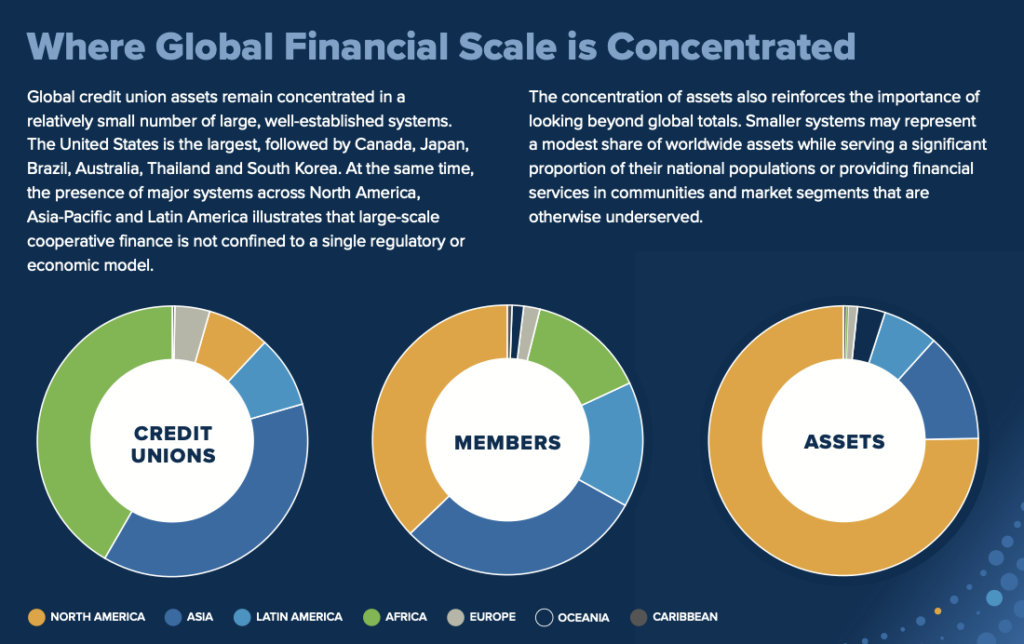
North America accounts for about three-quarters of global credit union assets, largely because of the size of the U.S. and Canadian systems. But Asia, Latin America and Africa account for substantial portions of global membership, illustrating how the cooperative model operates across widely different economies.
Regional totals include:
- North America: 4,653 credit unions, 156.2 million members and $2.99 trillion in assets.
- Asia: 23,347 institutions, 124.1 million members and $523 billion in assets.
- Latin America: 5,454 institutions, 63.3 million members and $265.6 billion in assets.
- Africa: 25,609 institutions, 58.9 million members and $19.6 billion in assets.
- Europe: 2,501 institutions, 8.9 million members and $42.4 billion in assets.
- Oceania: 55 institutions, 5.5 million members and $130.5 billion in assets.
- Caribbean: 219 institutions, nearly 3 million members and $11.2 billion in assets.
The United States remains by far the world’s largest credit union market, with 4,287 credit unions, 144.8 million members and $2.43 trillion in assets. Canada follows with $557 billion in assets.
WOCCU said global assets are concentrated in a relatively small number of large systems, led by the United States, Canada, Japan, Brazil, Australia, Thailand and South Korea.
But the organization cautioned that assets alone can understate the significance of smaller cooperative systems that may serve large portions of their countries’ populations or communities underserved by other financial institutions.
Regulation, Digital Competition Seen Reshaping Industry
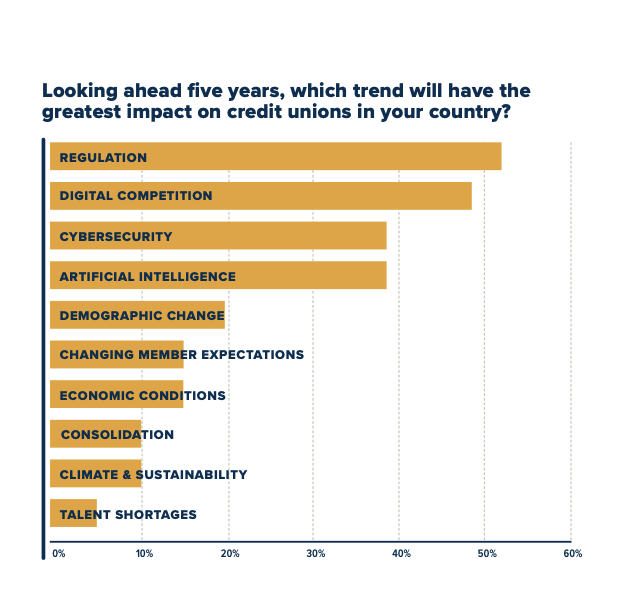
Beyond measuring the size of the movement, WOCCU surveyed national and regional member organizations about the issues they expect to shape credit unions during the next five years.
More than half of respondents identified regulation as a major force, while nearly half cited digital competition. More than one-third identified both artificial intelligence and cybersecurity.
Other issues included demographic changes, shifting member expectations, economic conditions, consolidation, climate and sustainability, and talent shortages.
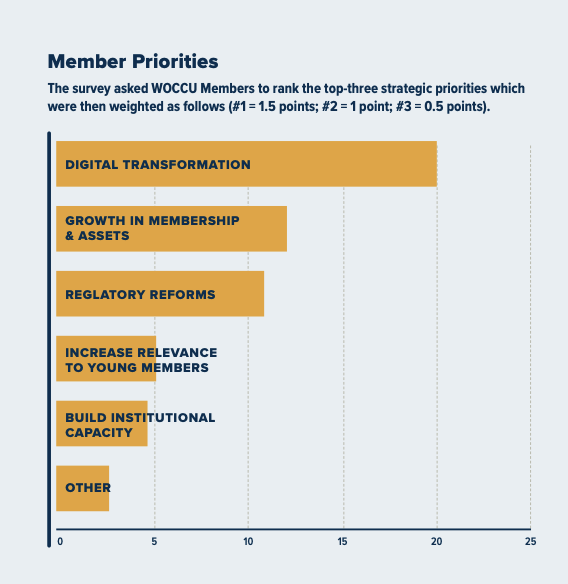
When respondents ranked their top three strategic priorities, digital transformation finished well ahead of the other choices. Growth in membership and assets ranked second, followed by regulatory reform and increasing relevance among younger members.
Technology Tops Risk List
Technology also emerged as the leading strategic risk when respondents’ top three selections were weighted, followed closely by regulation and governance.
Credit risk, personnel challenges and crime — including fraud and cybercrime — were also prominent.
WOCCU said the results indicate risks are increasingly interconnected rather than isolated. Technology creates operational and competitive pressures, regulation can affect institutions’ ability to adapt, and governance influences how successfully credit unions respond.
AI Use Growing, But Expertise Is a Barrier
Artificial intelligence is already moving beyond discussion at many credit union organizations, although the report found adoption remains relatively early.
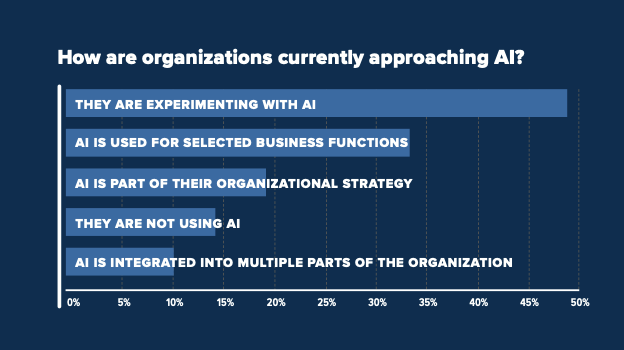
Nearly half of respondents said their organizations are experimenting with AI, while one-third said it is already being used for selected business functions. Smaller percentages said AI is incorporated into organizational strategy or integrated across multiple areas.
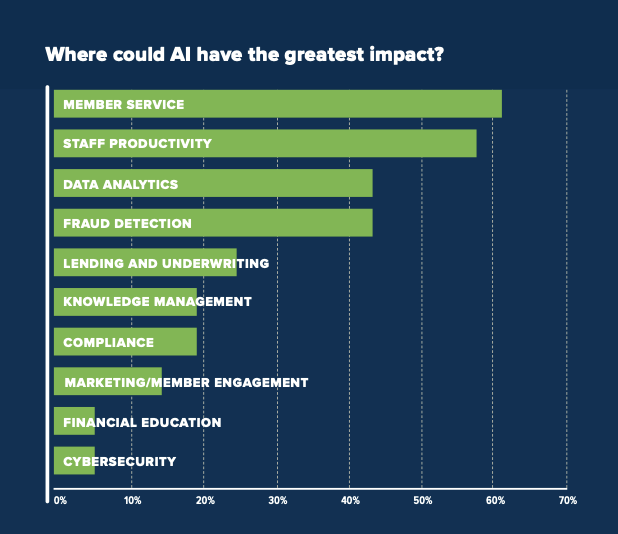
Respondents identified several areas where they believe AI could have the greatest impact:
- Member service: 62%.
- Staff productivity: 57%.
- Data analytics: 43%.
- Fraud detection: 43%.
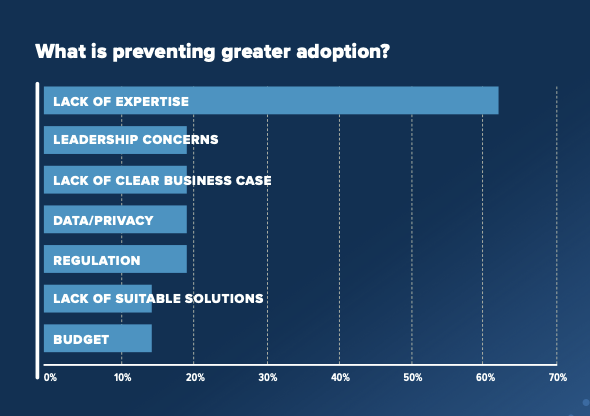
But nearly two-thirds identified a lack of expertise as the greatest obstacle to broader adoption, ranking it well ahead of concerns involving budgets, regulation, privacy, leadership or the availability of appropriate technology.
WOCCU said the challenge increasingly is not whether credit unions will use AI, but whether they can convert experimentation into practical applications while developing the expertise and institutional capabilities needed to use the technology responsibly.
Boards Confront Expanding Agenda
Digital transformation was also the most frequently identified governance challenge, with cybersecurity, risk oversight and attracting younger directors close behind.
WOCCU said regulation and AI are expected to become even more important board issues over the next five years.
Yet the report found governance policies governing AI have not kept pace with experimentation.
Just 23% of respondents said they have an approved AI policy, while 45% reported having no formal AI governance. Another 23% said their boards have discussed AI but have not adopted a policy, and 9% said they are developing one.
The report also examined gender representation among WOCCU member organizations for the first time. Among 39 organizations for which complete board composition could be verified, women held about 28% of 406 board seats. Women represented about 27% of board chairs and 22% of CEOs in the broader sample where those leadership positions could be identified.
WOCCU Cautions Against Year-to-Year Comparisons
WOCCU cautioned that the 2025 figures should not necessarily be compared directly with previous reports to measure industry growth or contraction.
The organization said it undertook a significant methodological review, seeking more authoritative country-level sources and expanding reporting beyond affiliated institutions where reliable data were available.
WOCCU also removed outdated or unverifiable data and corrected methodological inconsistencies. As a result, changes in individual country or global totals can reflect better classification and broader coverage rather than actual changes in the number or size of credit unions.
The organization said the year-end 2025 picture is one of a credit union movement with considerable global scale but also one undergoing significant transition.
“Credit unions serve approximately 420 million members and manage nearly US$4 trillion in assets, even as the environment around them changes rapidly,” the report said.
WOCCU said digital transformation, regulation, AI, governance and competition are becoming increasingly interconnected, making the industry’s ability to adapt, strengthen leadership and collaborate across borders increasingly important to its future.