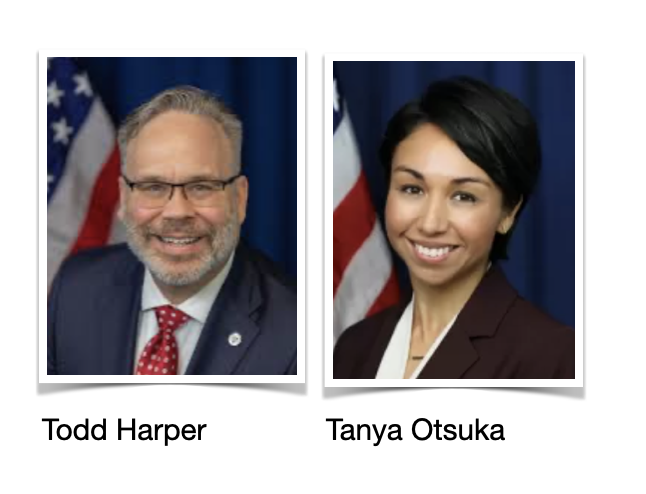
WASHINGTON — Former National Credit Union Administration Board members Todd M. Harper and Tanya F. Otsuka are asking a federal appeals court to uphold a ruling that President Donald Trump unlawfully fired them, arguing that two recent Supreme Court decisions strengthen their case that NCUA board members are protected from removal without cause.
In a 71-page brief filed Friday with the U.S. Court of Appeals for the District of Columbia Circuit, attorneys for Harper and Otsuka said the Supreme Court’s 2026 decisions in Trump v. Slaughter and Trump v. Cook support treating the NCUA similarly to the Federal Reserve when determining the president’s authority to remove officials.
“The district court was correct, and the Supreme Court’s decisions in Slaughter and Trump v. Cook confirm the soundness of its decision,” their attorneys wrote.
Ongoing Legal Battle
As the CU Daily has been reporting, the filing marks the latest development in the legal battle over Trump’s April 2025 removal of the two Democratic NCUA board membersand could determine whether presidents have broad authority to dismiss NCUA board members before their terms expire.
Harper and Otsuka contend the NCUA falls within a historically recognized category of financial regulators that Congress may insulate from direct presidential control.
Their attorneys said the Supreme Court in Slaughter recognized that the president may not have unlimited removal authority over entities following the historical tradition of the First and Second Banks of the United States, specifically citing the Federal Reserve.
In Cook, the court upheld for-cause removal protections for Federal Reserve officials and recognized a court’s ability to reinstate an improperly removed official through an injunction, according to the filing.
‘Same Principles Apply’
Harper and Otsuka argue the same principles apply to the NCUA because Congress deliberately modeled the agency on independent financial regulators such as the Fed.
“The NCUA’s independence, like the Federal Reserve’s independence, falls squarely on the side of constitutionality,” their attorneys wrote.
They said Congress intended to place credit union supervision on par with bank regulators and later used the Federal Reserve as a model when restructuring the NCUA.
NCUA Called ‘Central Bank’ for Credit Unions
A significant portion of the brief seeks to establish parallels between the NCUA and Federal Reserve.
The filing argues the NCUA performs many of the same functions for credit unions that the Fed performs for banks, including supervision, interest-rate regulation and liquidity support.
The NCUA also oversees the Central Liquidity Facility, which Congress created because credit unions lacked access to a liquidity backstop comparable to the Federal Reserve’s discount window, the filing noted. Harper and Otsuka describe the CLF as effectively serving as “a central bank to the credit union movement.”
Congress’ 1978 Restructuring Central to Case
Harper and Otsuka also rely heavily on the history of Congress’ 1978 restructuring of the NCUA.
Before that change, the agency was led by a single administrator who explicitly served “at the pleasure of the President.” Congress replaced that structure with the current bipartisan, three-member board whose members serve fixed, staggered six-year terms.
The filing argues Congress deliberately eliminated the language allowing the president to remove the NCUA administrator at will because lawmakers wanted to strengthen the agency’s independence and prevent its supervision of credit unions from becoming politicized.
Although the current Federal Credit Union Act does not explicitly state that board members can be removed only for cause, Harper and Otsuka contend the statutory structure and congressional history establish that protection.
Their brief says Congress’ decision to provide fixed terms while eliminating explicit presidential removal authority “unmistakably indicate[s] that Congress protected Board members from at-will removal.”
Trump Gave No Cause for Firings
Harper and Otsuka were fired in April 2025 through emails from the White House Presidential Personnel Office informing each that their NCUA positions were “terminated, effective immediately.”
The administration did not provide a reason for either dismissal, a point the government has conceded in the litigation.
As the CU Daily reported, Harper and Otsuka sued April 28, 2025.
U.S. District Judge Amir H. Ali subsequently ruled in their favor and ordered them reinstated, finding that Congress had protected NCUA board members against at-will removal and that those protections were constitutional. The court also found that the NCUA functions much like the Federal Reserve and FDIC, but regulates credit unions instead of banks.
The Trump administration appealed.
The D.C. Circuit stayed the district court ruling in August 2025 and later placed the case on hold while the Supreme Court considered Slaughter. The appeals court returned the case to its active docket Aug. 5 following the Supreme Court’s decision.
Filing Criticizes Administration’s Position
Harper and Otsuka’s attorneys sharply criticized the administration for choosing to rely on an appellate brief it filed before the Supreme Court decided Slaughter and Cook.
“Remarkably, the Government opted to stand on its opening brief, which it filed before Slaughter and Cook — and which fails to mention the Federal Reserve at all,” they wrote.
They contend the administration’s argument that there are only limited exceptions to a president’s removal power cannot be reconciled with Cook, which recognized that Congress may restrict presidential removal authority for agencies consistent with the historical principles underlying the First and Second Banks and the Federal Reserve.
The attorneys also reject the administration’s argument that courts lack authority to reinstate removed officials, pointing to the Supreme Court’s decision in Cook allowing preliminary reinstatement of a Federal Reserve official.
Even if an injunction were unavailable, they argue, the district court’s order could be treated as a writ of mandamus providing essentially the same relief.
Harper and Otsuka are asking the D.C. Circuit to affirm the district court ruling and their reinstatement to the NCUA Board.