NEW YORK — Americans carrying substantial unsecured debt are increasingly using credit cards and other borrowed money to pay for groceries and other necessities, with two surveys finding everyday expenses are a major contributor to consumers’ credit card balances.
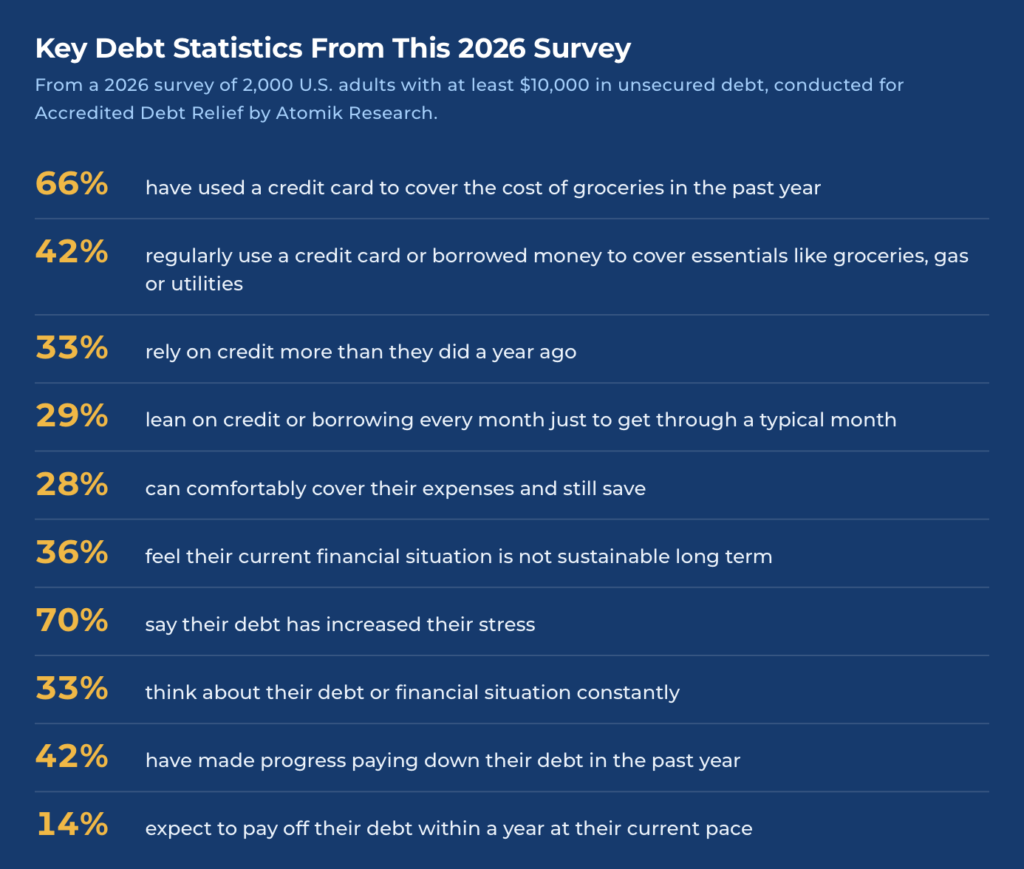
A 2026 survey conducted by Atomik Research for Accredited Debt Relief found 66% of respondents had used a credit card to pay for groceries during the previous year, making food the most commonly financed everyday expense.
The survey of 2,000 U.S. adults with at least $10,000 in unsecured debt found 47% had used credit cards for gasoline or transportation, 45% for utilities and 33% for rent or other housing costs.

7 in 10 Rely on Credit for Essentials
The reliance on borrowed money was not limited to occasional financial shortfalls, according to Accredited Debt Relief.
Forty-two percent of respondents said they regularly use a credit card or borrowed money to cover necessities such as groceries, gasoline or utilities, while another 29% said they occasionally do so.
That means approximately 7 in 10 respondents rely on borrowed money for basic expenses at least some of the time.
A separate survey conducted by Drive Research for Accredited Debt Relief found a similar pattern among consumers with unsecured debt.
Among respondents carrying credit card debt, 70% said most of their current balance resulted from everyday expenses such as groceries, gasoline and utilities rather than discretionary spending or major purchases.
By comparison, 23% identified a large planned purchase, such as a vehicle or vacation, as the primary reason for their credit card debt.
Renters Report Greater Impact
The Drive Research survey found renters were particularly likely to attribute their credit card balances to everyday expenses.
Seventy-two percent of renters said routine expenses were the primary reason their credit card balances increased, compared with 70% of respondents overall.
Consumers also reported cutting spending on necessities to keep up with the debt payments created in part by those same expenses.
Forty-five percent of respondents said they had reduced spending on necessities such as groceries or household essentials during the previous year to make debt payments, making it the most frequently reported financial sacrifice.
Among teachers surveyed, 54% reported cutting back on necessities to keep up with debt payments.
What Findings Suggest
The findings suggest some indebted consumers are caught in a cycle in which credit cards are used to cover basic household expenses when income is insufficient, followed by reductions in spending on those same necessities to make subsequent debt payments, according to Accredited Debt Relief.
The findings come from two surveys commissioned by Accredited Debt Relief. Atomik Research surveyed 2,000 U.S. adults with at least $10,000 in unsecured debt from May 11-14. Drive Research separately surveyed 2,000 U.S. adults with unsecured debt for a report published in June.
Both surveys had margins of error of approximately plus or minus 2 percentage points at a 95% confidence level.