

By Steve Wofford

Artificial intelligence can create extraordinary productivity. It does not, however, create economic value automatically. For a financial institution, the relevant question is not whether a tool produces more output, drafts more documents, or handles more inquiries.
The question is whether it changes the economics of the institution: cost to serve, capacity, pricing, customer behavior, credit, liquidity, capital, risk, or profitable growth.
Profitability Analytics supplies the fact base and causal structure needed to answer that question. It makes visible where value is created or destroyed, what activities consume resources, which operating changes matter, and how an AI investment can move from a local productivity claim to an enterprise result.
Turning the Problem Around
Most AI programs begin with technology possibilities and local use cases. That sequence produces a familiar problem: leaders can report a large increase in output but cannot demonstrate a corresponding improvement in earnings, return on assets, risk, or franchise value. In a bank or credit union, excess output is not a result. Unless it changes the work, capacity, decisions, or economics of the enterprise, it is simply activity with a variable technology cost attached.
Profitability Analytics is the discipline that turns this problem around. It identifies the institution’s economic baseline, measures the cost and capacity embedded in activities, and distinguishes an attractive local improvement from a change that improves the overall system. It gives management the ability to choose AI investments based on marginal economic contribution rather than enthusiasm, vendor demonstrations, or productivity counts.
The critical management capability is an explicit, codified causal model: AI-enabled work changes activities; activities use resources and capacity; capacity and decisions affect cost, revenue, risk, liquidity, and capital; those effects determine ROA and enterprise value. A conventional operating model may describe how work is intended to happen. It is only halfway there if it cannot quantify the economic consequences of changing that work.
The Productivity Trap
A claim that AI has increased a team’s output eightfold may be true and still be economically irrelevant. If demand does not rise, cycle time does not improve, capacity is not removed or redeployed, and decisions do not improve, the institution has not captured a benefit–it has created excess capacity while adding inference, integration, governance, and support expense.
This is particularly important in financial institutions. Balance-sheet capacity, risk appetite, capital, customer demand, pricing discipline, and operating constraints determine the institution’s ability to convert work into economic value. A local team cannot prove enterprise value by counting documents, interactions, code, or cases processed. The institution needs an evidence-based path from the AI use case to the financial outcome.
Why Broad AI Deployment Underperforms
The temptation is to deploy AI broadly and search for benefits afterward. That is a shotgun approach: numerous pilots, enthusiastic users, scattered productivity measures, and little clarity about which investments should scale. The problem is not AI itself. The problem is deploying it without an economic theory of the business.
A system cannot be optimized by optimizing every component. A function can become faster while moving the constraint elsewhere, producing inventory of unfinished work, degrading a control, or consuming scarce staff time that would generate more value somewhere else. The relevant objective is improvement in the entire system, not apparent improvement in a single activity or department.
Profitability Analytics Establishes the Economic Baseline
Profitability Analytics begins by establishing profitability truth. It shows contribution by product, relationship, channel, branch, segment, service, and activity. It uses economically sound funds transfer pricing to separate instrument value from the institution-wide funding advantage, and it uses activity-based costing, including time-driven ABC where appropriate, to reveal the resources required to originate, service, and support the business.
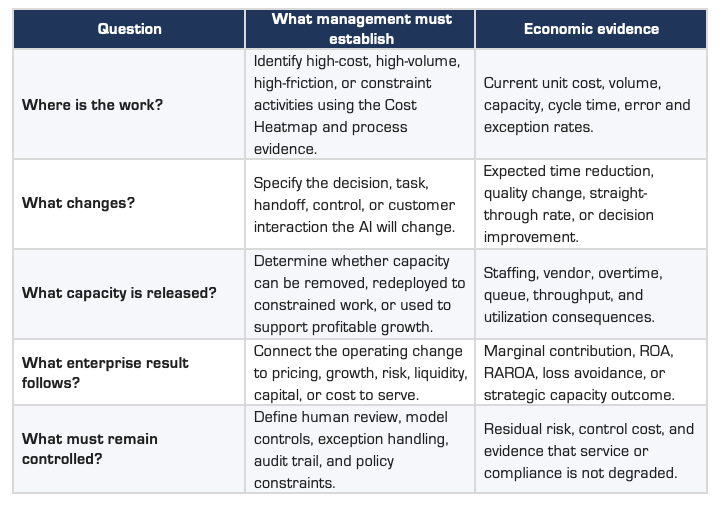
This is not a retrospective accounting exercise. It is the management architecture needed to understand where an operating change will matter. It allows executives to ask a better question than “Where can AI be used?”: “Where will a better decision, lower effort, or faster process create the greatest marginal economic contribution without weakening risk, service, or control?”
Cost Heatmap Makes the Opportunity Visible
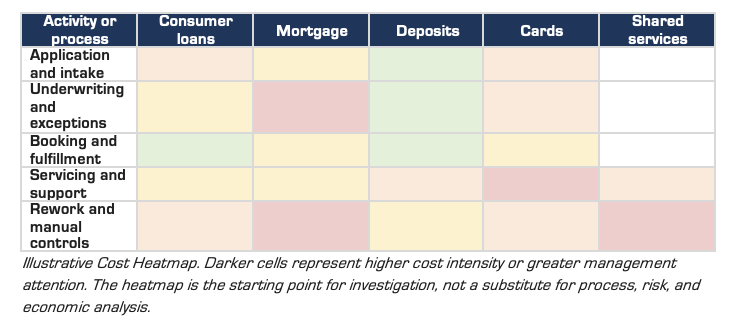
Kohl’s Cost Heatmap is a practical starting point for this work. It displays the activity cost intensity of products, services, channels, and operating processes so management can see where resources are actually being consumed. The purpose is not to label a department as expensive. It is to expose the economic pattern: high-cost work, complexity, avoidable rework, low-value exceptions, and services that may be strategically necessary but require a different operating design.
The heatmap gives AI teams a disciplined way to prioritize. It directs them toward work where an intervention can meaningfully change unit cost, capacity, throughput, quality, or risk, and away from low-cost activities where automation may be technically interesting but economically immaterial.
From Cost Heatmap to AI Investment Decision
An AI investment should be evaluated through a small number of linked questions. The answers should be quantified before the institution commits to scale.
The Enterprise Causal Model Is the Missing Link
The Enterprise Causal Model provides the structure that connects strategy to operations and financial consequences. It explicitly represents the relationships among customer behavior, demand, applications, processing, staffing, technology, risk, pricing, revenue, cost, capital, and performance measures. It does not replace managerial judgment. It makes the assumptions behind a decision visible, testable, and governable.
For AI, the model prevents a local use case from being assessed in isolation. An automated intake capability may reduce touch time but also increase applications, shift exception work, alter approval quality, require new controls, and change conversion. The model enables management to test those relationships together. That is how the institution identifies whether the investment improves the whole system rather than merely a component.
What Good AI Governance Looks Like
Effective AI governance is economic governance. The board and executive team should require each material AI initiative to have a named business owner, a defined activity or decision to be changed, a measurable baseline, a causal hypothesis, an approved control design, and an expected economic result. The business case should include the full cost of the solution, including recurring token or model costs, data, integration, oversight, security, and change management.
Post-implementation review matters just as much. Management should compare actual activity, capacity, customer, risk, and financial results with the original causal hypothesis. When results differ, the institution learns which assumption was wrong and improves the model. This turns AI from a collection of disconnected experiments into a controlled management capability.
A Practical Sequence for Financial Institutions
- Establish profitability truth. Use profitability, funds transfer pricing, and activity-cost information to identify where economics are strong, weak, or unknown.
- Build the Cost Heatmap. Locate high-cost activities, recurring exceptions, manual work, rework, and capacity constraints across products and services.
- Prioritize the constraint. Select AI opportunities that improve the economic constraint or release capacity that can be used productively.
- Codify the causal hypothesis. Specify how the intervention changes work and how that change flows through to cost, growth, risk, capital, and ROA.
- Run controlled pilots. Validate operating and economic assumptions with transparent controls and a defined comparison baseline.
- Scale only proven value. Expand investments that demonstrate marginal economic contribution and stop those that do not.
What AI Cannot Compensate For
AI can be a powerful amplifier of a well-managed institution. It cannot compensate for the absence of economic visibility, process understanding, or strategic discipline. Productivity becomes value only when the institution knows where the work sits in the system, what capacity and decisions it changes, and how those changes affect enterprise economics.
Profitability Analytics is therefore not a downstream reporting function for AI. It is the management foundation for deciding where AI belongs, proving whether it worked, and ensuring that local technology gains become durable improvements in ROA and enterprise value.
Steve Wofford is CEO of Kohl Analytics Group helps banks and credit unions understand profitability at a deeper level by identifying the economic contribution of products, members, customers, branches, officers, channels, and relationships. Unlike traditional approaches that rely primarily on broad cost allocations or market-based pricing assumptions, Kohl focuses on the actual costs, risks, funding requirements, capital usage, and operational activities that drive financial performance.
For more information, visit kohlag.com.



