LOST PINES, Texas– “How do you take everything in the news and bring it home so you can make good decisions?” There is no easy answer. But here’s what expert on geopolitics said credit union leaders need to be thinking about.
Dr. Mary Kelly, who graduated from the U.S. Naval Academy and who retired as a commander after holding numerous posts globally, and who also has master’s degrees in history and economics and a Ph. D. in economics, provided a high-level on macro-trends that could ultimately affect the economy and credit unions, in remarks to Catalyst Corporate’s Strategic Summit here.
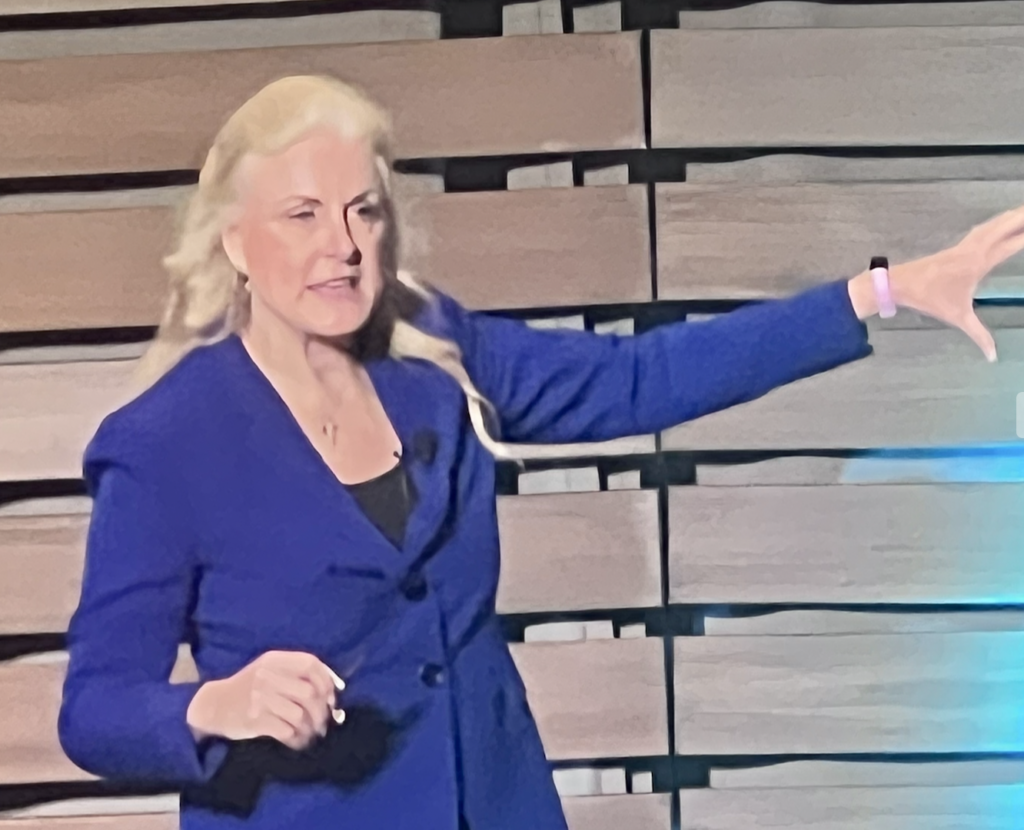
“One of the challenges in looking at geopolitics is how do you take everything in the news and bring it home so you can make good decisions,” asked Kelly.
Here’s an overview of just some of what Kelly covered during her remarks, including and in no particular order:
The Price of Oil & Gas
As anyone who has been to a gas pump knows, the price of energy is up about 25.5% over a year ago, Kelly said.
“But it’s not due to the Iranian war—except that it is. Here’s why,” said Kelly, who stressed that her views are apolitical. “We have plenty of oil. We are a net exporter. What’s driving up the price is the world price for oil due to a shortage. The oil companies are seeing record profits.”
Inflation, Labor, & Sentiment
Kelly acknowledged inflation remains “stubbornly high” in the 3%-4% range but said core inflation is not that high and is in fact at its lowest since 2021. But gas prices have driven up the inflation figure.
The labor market, said Kelly, remains strong, with unemployment steady at 4.1% and August seeing a gain of 162,000 jobs. “Millennials and Gen Z’ers are not participating in the labor force. It’s where the gap is,” she said.
Consumer sentiment remains weak, with the University of Michigan Sentiment Index falling to 47.8, near historic lows. “People don’t feel good about the economy. Our economy is based on consumer spending, and when we don’t feel good, we start spending money. “
The World Economies
Kelly reviewed a chart of the world’s top 14 economies and shared:
- The U.S. is largest economy in the world at $32.3 trillion, with GDP growth of 2.32%. “As the world’s largest economy, we actually want a trade deficit. We want to import stuff that other people can make cheaply. We would rather sell one $50,000 car than 50,000 $1 items.”
- China is second at $20.8 trillion.
- Russia is now the number-nine economy at $2.6 trillion and the war is “decimating the economy. There is a brain drain with people leaving.”
- California has a GDP of $4.2 trillion.
Countries vs. Companies
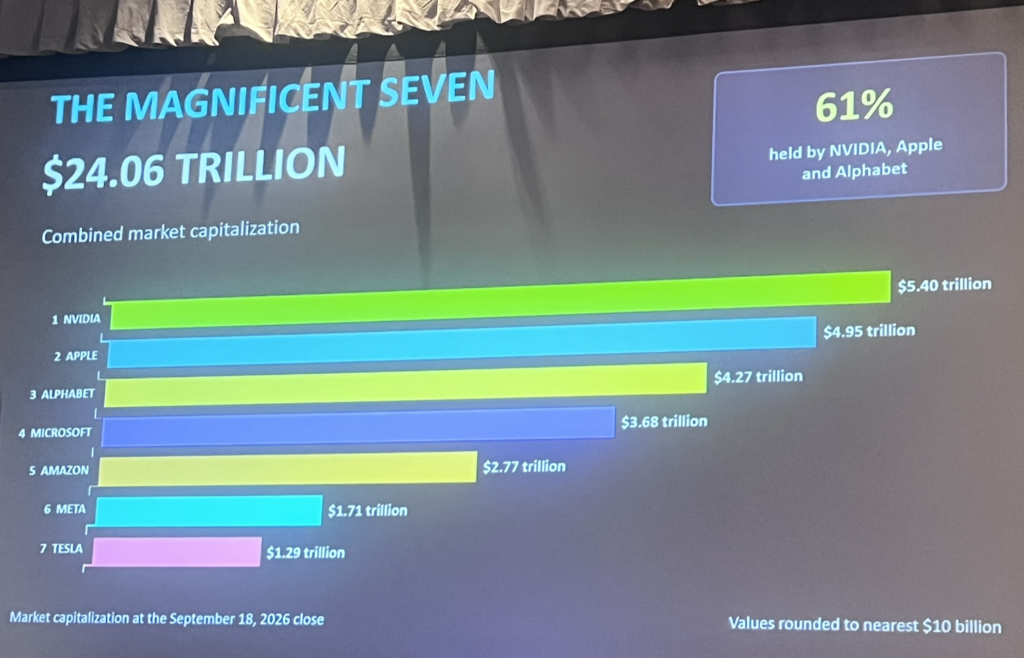
She then shared a chart showing the “Magnificent 7” companies (above).
“As we look at big picture issues, the money and expenditures matter,” Kelly said. “When we look at market capitalization and investment, where people invest, matters.”
Kelly then compared the market caps of the “Magnificent 7” companies, which exceed the GDP of most countries.
Those seven companies make up 35% of the S&P 500, which is a “lot of the eggs in the basket, which makes me a little nervous,” Kelly said. “All but one of the Magnificent 7 are up for the year (led by Apple at 24.7%). The only “loser of the year” is Tesla, which is down 16.6%.
Geopolitical & Economic Issues to Monitor
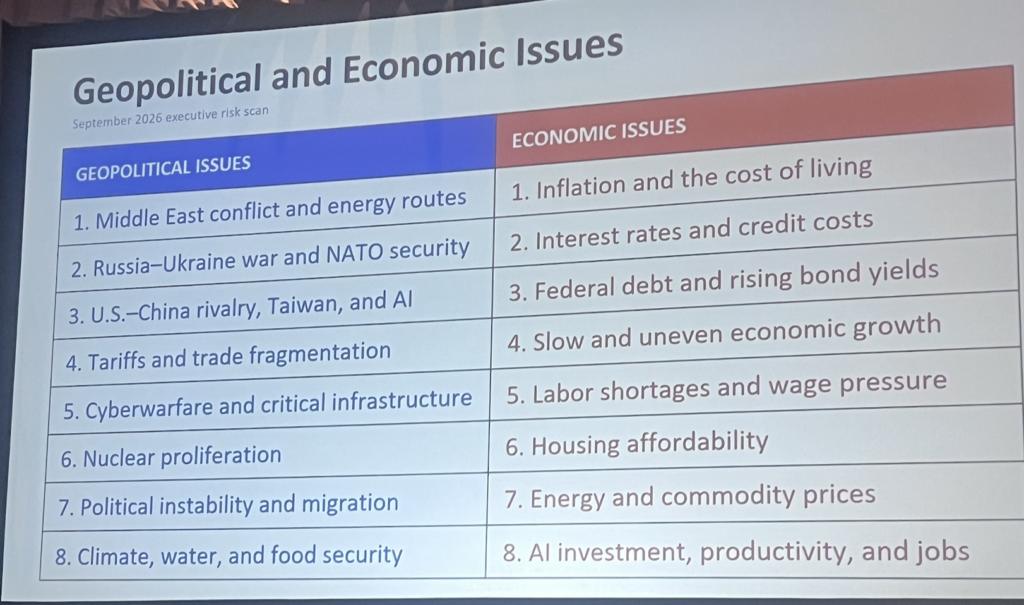
Kelly touched on numerous global hotspot issues, including:
Russia-Ukraine February 2024 and NATO
- Why it matters: The war continues to damage transportation, energy and economic infrastructure across Ukraine
- Escalation Risk: A strike near NATO territory, sabotage, or an airspace violation could broaden the war
- Watch Next: Track European defense spending, Ukraine’s air defenses and attacks on subsea infrastructure
“The benefit, if there is any benefit, is Ukraine has perfected drone technology,” Kelly said. “The problem is Russia isn’t very good. Three of their drones have landed in Germany. People ask me how this is going to end and frankly, I don’t have a good ending for it. The only way it ends is Putin dies.”
The Middle East/Israel-Hamas/Palestinian Oct. 7, 2023
“A fragile ceasefire has not resolve security, governance or reconstruction,” Kelly observed.
- Why it matters: Violence continues while Gaza faces damaged infrastructure and stalled reconstruction.
- Kelly also covered the Houthis, Hamas, Hezbollah, and others she said are backed by Iran, which has a “history of funding naughtiness.”
U.S.—Israel—Iran (February 2026) Conflict
“The most immediate threat to energy flows and regional stability,” Kelly said.
- Why it Matters: Direct conflict raises the risk of attacks on Gulf energy, facilities, commercial vessels and U.S. interests
- Economic Channel: Disrupted traffic through Hormuz can increase oil prices, freight rates, insurance premiums and inflation
- Watch Next: Monitor shipping volumes, Gulf infrastructure, Saudi involvement, and signs of wider regional escalation
Kelly said Iran has indicated it has nuclear weapons and plans to use them against the United States.
“I would have thought that perhaps the U.S. bombing and the taking out of the old regime would have given their people the power to rise up and take back their country,” Kelly said, repeating a position held by many at the time the U.S. attacked Iran. “How is this going to end?”
Kelly spoke on the same day President Trump spoke to the United Nations and mentioned “annihilating” Iran.
China, Taiwan and the South China Sea
“The highest-consequence long-term flashpoint for trade and technology,” said Kelly.
- Why it Matters: Military pressure around Taiwan overlaps with confrontations between China and the Philippines
- Economic Channel: A blockade would disrupt semiconductors, electronics, shipping, defense production and markets
- Watch Next: Monitor miliary exercises, maritime incidents, U.S. commitments and new semiconductor export controls.
“Long term I worry more about China than I do Russia or Iran. Why? Because they have the dollars.”
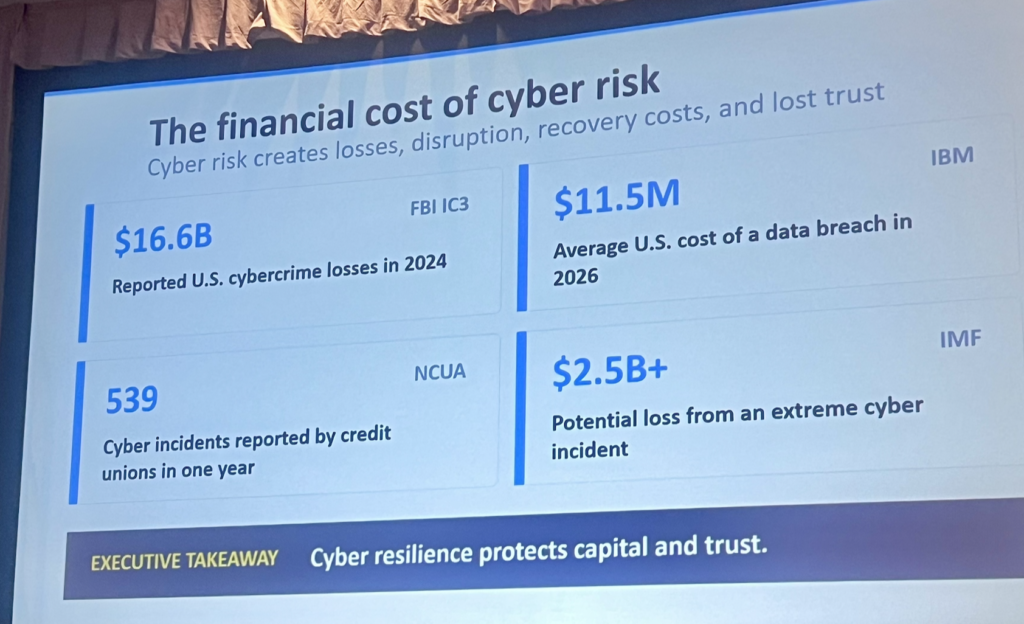
Cyberwarfare and AI Competition
“Digital infrastructure has become a geopolitical battlefield,” said Kelly.
Fragmentation of the Global Economy
“Trade policy increasingly serves national security,” according to Kelly.
- What is Changing: Tariffs, sanctions, export controls, subsidies, and investment restrictions now shape commercial decisions.
- Supply Chain Effect: Companies are diversifying suppliers, regionalizing production and holding more inventory.
- Watch Next: Watch new rules on chips, minerals, medicine, energy, agriculture and industrial goods.
Water, Food, Minerals and the Arctic
“Resource security now influences diplomacy, industrial policy, and defense.
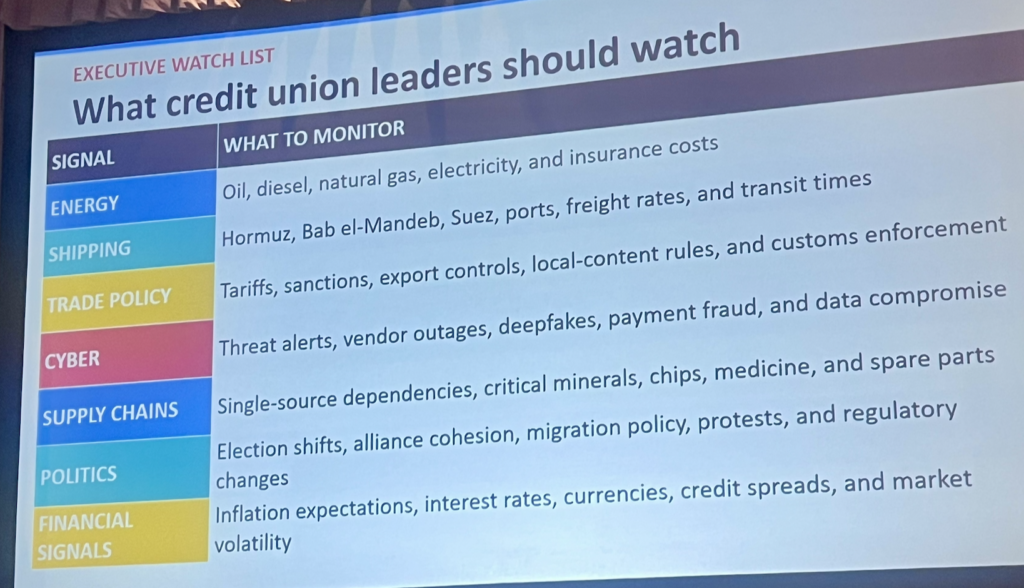
Issues to Watch For
Kelly said credit union leaders should be paying attention to these issues, below.