LOST PINES, Texas–Credit union CFOs and ALCOs were given some questions to be asking themselves as they look to 2027 and the management of their balance sheets.
The strategic advice and economic overview were shared by Steven Houle, VP of asset management with Catalyst Corporate, in opening remarks to the company’s Strategic Summit here.
Here is an overview of some of the many issues and forecasts offered by Houle.
Inflation
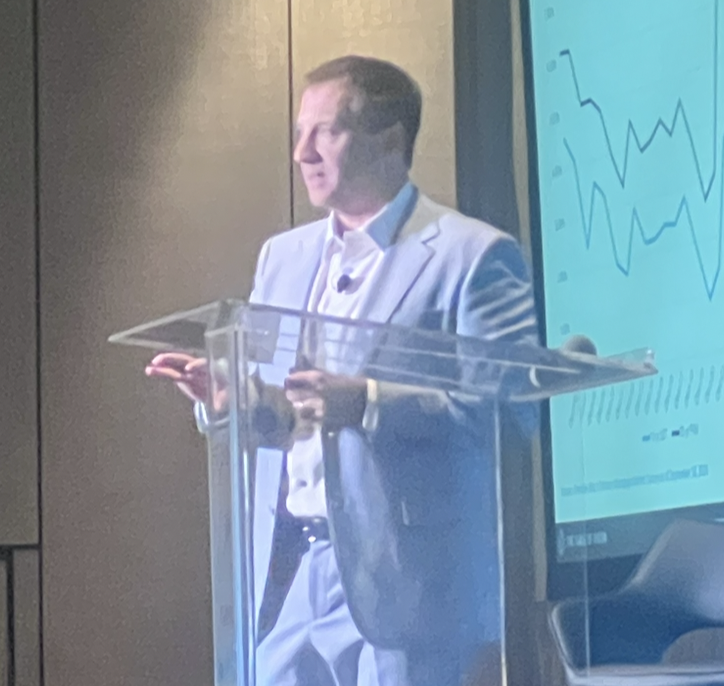
Houle began with the question he said he gets most often. His answer: “Inflation is not coming down.”
“The challenge with inflation for the past two years is how it has moved through to the consumer,” Houle said. “It initially affected the poorest consumers, and now it is moving to the middle income and highest income quintiles. If we see that, we could see the pullback in consumer spending.”
Employment
Houle said employment isn’t running hot or cold, it’s “right down the middle,” with the unemployment rate right around 4%.
GDP
GDP in Q2 was 1.5%, but Houle noted Q3 is forecast to be much stronger. “It looks like we’re going to get a pretty good bounce with GDP through the end of the year,” he said.
Houle reminded GDP is being driven in large part by the massive investments being made in AI and AI-related infrastructure.
U.S. Consumer Sentiment
Houle said gas prices and tariff concerns both have driven recent changes in consumers’ inflation expectations. Despite variation in views, inflation expectations remain elevated across the wealth distribution, he said.
“The consumer feels inflation will be over 4% for the next year. We are currently at 3%, and the Fed wants it at 2%,” he said.
Houle pointed out there have been countless references to the “wealth effect,” that is, how does the consumer feel about their financial position. And the answer to that really depends on where they are participating in the economy, Houle explained, pointing to the big differences between those with stock portfolios and those without.
Consumer Debt
Houle shared that:
House noted:
- Consumer debt has remained relatively flat at around $18 trillion, with $13 trillion of that in mortgage loans.
- Home equities have seen the most growth but remain just 2% of consumers’ outstandings.
- Both credit card and student debt have declined.
In looking at household debt by product and age, the home mortgage remains the number one debt as a percentage among all age groups.
Personal Savings Rate
At the same time, the personal savings rate as a percentage of disposable income (DPI), frequently referred to as the “personal savings rate,” was 3% in August. The average for 2026 is 3.3%, down from 4.7% in 2025. Houle expects the savings rate will improve in 2027 over 2026.
The Federal Reserve
As the CU Daily reported and as Houle noted, the statement issued by the Fed after its Sept. 16 meeting at which it voted 12-0 to raise fates noted economic activity remains “solid” and that productivity growth is strong. Houle highlighted the statement by the Fed that it will “deliver price stability,” indicating another rate increase this year and at least one in 2027 are likely.
The Yield Curve
Houle noted there has been a “drastic” increase in yields in 2026, as every CU CFO and ALCO knows, and pointed out that the two-year Treasury has become the “pivot point.” The five-year Treasury rate of more than 5% is the highest mark seen in 20 years, he said, even though it hasn’t always remained above 5%.
“It implies that by March of next year we’re going to see the short end of the yield curve going higher, and the other end of the yield curve get lower and flatten. The yield curve is more of a risk scenario for you if you need to navigate a flatter yield curve six months from now,” Houle said.
Rates
In discussing rates, among the points made by Houle were:
- New car loans are negative to the U.S. Treasury. “Buy a two-year Treasury and you will make more,” said Houle.
- “Where I think there is value is in the mortgage product, but even there we have seen spreads compress.”
- “One thing you need to protect yourself against next year is that optionality if loans start repricing on you.”
“It seems like there is a real shift to higher for longer, which is a real plus for credit unions,” said Houle, acknowledging that same scenario makes it harder for consumers.
Credit Union Trends
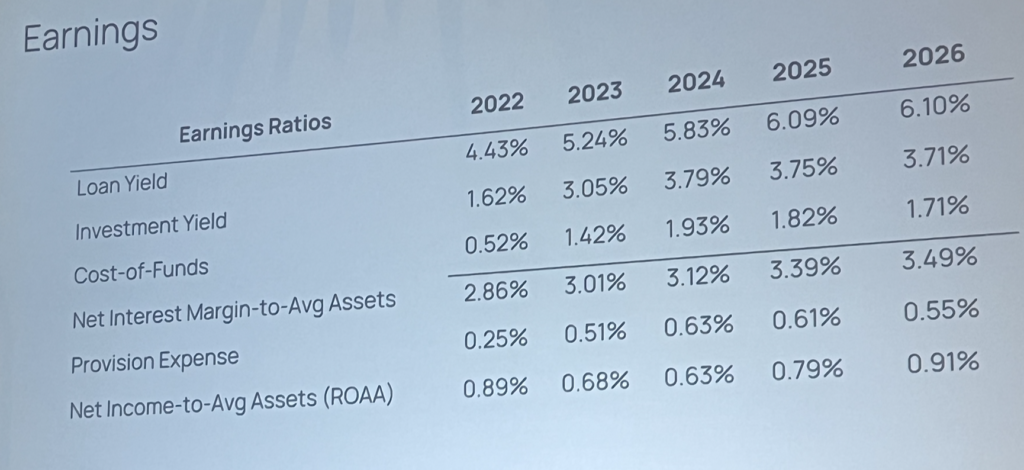
Houle told the Catalyst meeting 2026 annualized growth rates are tracking close to the 10-year averages, and that net worth remains strong at 11.5% with risk-based capital at 15.8% as a CU industry average.
Lending
Houle said credit unions are capturing 65% of the auto loan refinance market. He praised credit unions for showing the greatest difference in monthly payments on auto loans when compared to banks and finance companies.
He did say loan performance remains a concern for him, especially around credit cards and new vehicle loans.
Nevertheless, net interest margin is currently at its strongest point in approximately 20years, and Houle expects 2027 to be very strong for credit unions, depending on how fast they can roll assets up the yield curve.
Questions to Ask
Moving forward, Houle said credit unions should be asking themselves:
- Where do you want to be on the yield curve?
- What is the volatility of the assets you are adding?
- Are you prepared to move rates? Many CDs are over 4% already.
- Are you aware that if CU makes a shift into certificates that you will shorten the duration profile without knowing it?