


BATON ROUGE, La.–This weekend marks not just the 20th anniversary of the widespread devastation wreaked by Hurricane Katrina, but also the anniversary of one of the most unique efforts by one credit union to help another in the movement’s history.
Katrina’s destruction of New Orleans and Louisiana is well-documented, and the state’s credit unions, members and employees were not spared. Flooding, power outages, staffing shortages, and destroyed offices were widespread—as was the shortage of another critical credit union function—cash. Credit unions from around the country rallied to provide assistance and staffing to the Bayou State’s CUs, most especially those in New Orleans.

This is the story of how one credit union got the cash it needed—and how another delivered it.
The Problem With the E in E-Payments
While huge advancements in electronic payments have been made since Katrina’s havoc affected so many, but e-payments are useless when there is no electricity, batteries have run down and cell phone service is non-existent. That was especially true in 2005, which only put a premium on cash for use at those businesses that had somehow managed to open.
Below is an account as shared afterward by two credit union CEOs who had resolved to help members in the affected areas, even if it meant an unconventional means for doing so.
In Baton Rouge, just 82 miles northwest of New Orleans, Jeff Hendrickson was CEO of what was then Dow Louisiana FCU (today it’s Essential Federal Credit Union). He recalled that as ATM, credit card, and debit card networks were overwhelmed, partly as the result of a population that had doubled overnight as people along the coast and in New Orleans tried to flee Katrina’s path. It was, as he called it, a “huge burden” on all financial institutions.
No Money
On the Friday before the Monday arrival of Katrina, Dow Louisiana learned the Fed shipment of money it expected would not be coming, even though the credit union had already moved to extend its hours for Saturday, with plans to stay open on the following Labor Day to help as many people it could, if possible.
Other cash management providers offered no help.
Hendrickson recalled that he instructed the senior management team to reach out to Texas Dow Employees CU in Lake Jackson, Texas, for help, and it “leaped into action.” Or tried to, as it soon encountered a challenge after learning that driving funds the 321 miles northeast to Baton Rouge would not be possible.
Janice Arizmendi, TDECU’s chief of staff, contacted the Texas Department of Public Safety and learned that individual relief efforts were being turned away at the state border
It needed a Plan B.
One Last Look
Enter Ed Speed, who was CEO of TDECU at the time. Speed recalled he was supposed to have already left the office by the time Dow Louisiana contacted his credit union, but he was still in the office and just happened to look at his phone and check one last voicemail before leaving. That voice mail message had been left by Dow Louisiana.
The fittingly named Speed had that Plan B: he was a pilot who owned a plane.
“Jeff said that without more cash, people coming to his credit union would not be able to get food, shelter, clothing, and medicine,” Speed recalled. “Jeff said he would do whatever it took – even drive to Lake Jackson if we could find cash for him. He said that $500,000 to $600,000 would hold them until cash shipments arrived on Tuesday.”
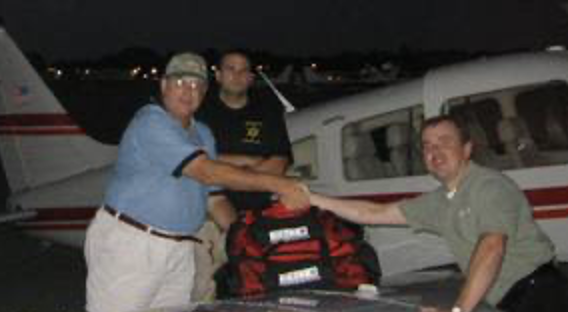
Speed said he met with TDECU’s senior staff, and within 15 minutes had a full count of cash on hand from its branches. A TDECU employee called a contact at 1st National Bank and also got a commitment of $200,000 if it were needed.
Less than 25 minutes later, Speed called Hendrickson and said it had $600,000 in cash ready to go. By 3:30 p.m., it had been counted and bagged, Now, all TDECU needed to do was deliver it.
Taking to the Air
Speed made the decision he would fly his plane to Baton Rouge, taking Lance Wortham with him. By 4:00 p.m., less than two hours after the initial call, the plane was loaded, and after waiting for some weather to clear, was in the air by 5. The flight to Baton Rouge took about two hours.
Speed recalled that when the FAA Houston Control Center handed him off to Baton Rouge Approach Control, he immediately heard how frenzied air traffic control communications had become as the Baton Rouge airport was now the staging area for all aviation rescue and relief efforts.
As Speed and Wortham approached the Baton Rouge airport, they were given extended vectors for sequencing, and after 45 minutes of 360-degree holding turns, the aircraft landed.
Words to Remember
Speed recalled that he will never forget the words of the Baton Rouge tower controller: “November-Eight-Four-Three-Five Foxtrot (N8435F), you are cleared to land Runway Four-Right (4R), straight in approach. Three Five Foxtrot, I need you to go as fast as you can!”
The plane touched down around 8, six hours after TDECU had been contacted.
Dow Louisiana’s Hendrickson was at the airport with his COO and armed security from the local sheriff’s department to greet his CU counterparts. The $600,000 in cash was driven to Dow Louisiana’s main branch and the credit union was able to keep its doors open and meet all the cash needs of members.
Speed and Wortham returned to Texas and landed around 1:45 a.m.
The Final Word
Speed recalled Hendrickson’s words at the time: “I knew if I called upon another credit union, if I relied on our movement, I knew someone would come through for us. I just knew it. This is who we are. This is what we do.”





One Response
Thank you, Frank, for posting this. I was just the Uber driver!