By Frank J. Diekmann

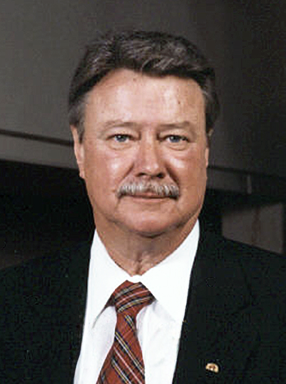
If you missed our reporting, Buck Levins recently passed away. Who?, you may ask. You’ve probably heard the phrase “forgotten by history,” so allow me to share with you that while you may not know the name, you should, as he played a pretty critical role in your job and the way your credit union’s business model operates.
Levins was the former CEO of Robins Financial Credit Union in Georgia and he was at the center of the yeoman-like effort that finally pushed through passage in Congress of a history-making piece of credit union legislation. Mr. Levins, for whom an award was named that is presented each year, was 84.
Levins, who served a term as chairman of what was then CUNA and is now America’s Credit Unions, was on the steering committee of the Credit Union Campaign for Consumer Choice, the joint CUNA/NAFCU campaign of 1997-98 that helped push the Credit Union Membership Access Act (HR 1151) toward overwhelming passage in Congress after credit unions lost a Supreme Court decision on field of membership.
In that ruling, SCOTUS said the Federal Credit Union Act did not allow CUs to serve multiple fields of membership, with the justices concluding it’s called “Field” of membership for a reason.
The Rivalry
If you’re new to credit unions and/or weren’t surprised the two trade associations merged more than a year ago to form America’s Credit Unions, there was a point in time when you would have bet against it on FanDuel, if it had been around. The two groups were most definitely not BFFs in the late 1990s, often taking opposite sides on issues before Congress, for example, and taking jabs at the other organization in off-the-record conversations with reporters. (I miss those days.) Indeed, at the time each would tell you it was they who truly represented America’s credit unions, and not that other outfit.
In fact, the rivalry was such that initially CUNA and NAFCU opted to go their own ways with campaigns to sway Congress to pass the CU Membership Access Act, which, for all the language it contains (congressional staffers are apparently paid by the word), what it basically did was add an “s” to create “fields” of membership. Though neither wanted to admit it initially, individually the two groups lacked the firepower in Washington, especially against a much better-funded, experienced and organized banking industry lobby in DC that believed the Supreme Court had nailed it and it was time for these too-big-for-their-cooperative-britches CUs who had misinterpreted the FCU Act to mosey on back to Podunkville and start expelling members, if need be.
Not Much of a Hill Operation
Again, if you just moved into the movement in the last decade or two, here’s another file for you to download: Before credit unions became the grassroots and state and federal capital advocacy machines they are now, they were a pretty dinky troupe of travelling white hat salesmen. As the 20th century was coming to an end, CUNA was a Madison, Wis.-based operation with an office in Washington, but it was really about the state leagues; and NAFCU was across the Potomac in Northern Virginia with a focus on federal issues (mostly NCUA and compliance) and not much in its wallet when it came to lobbying Congress.
How inexperienced were the CU rubes? I once accompanied a credit union delegation on a Hill Hike to a congressman’s office, and when everyone had sat down and the member of Congress with whom they were meeting asked what they wanted from him, the CU reps said “Nothing. But a picture would be nice.” I don’t think I’ve ever seen a happier representative.
That all changed pretty quickly and the ramifications are still felt a quarter-century later.
Backs Against the Wall
First, with their backs against the capitol’s marble walls, the two CU trade groups came together to form the Campaign for Consumer Choice, led by Larry Blanchard of a neutral third party (then CUNA Mutual, now TruStage), which also just happened to have some deeper pockets, although not deep enough on its own.
As all this was going on, CUNA had hired a former congressman as its president—Dan Mica—who knew exactly how Washington worked, and if you think the motivation is what’s good for We the People, well, if it’s really cold where you are right now, I’d suggest you walk outside for a bit. Mica tapped Buck Levins to lead the fundraising efforts, among others, a job I’m pretty sure no one willingly signed up for.
Fundraising is never easy, but here’s some more news for the newbies. In 2026 you’ve gotten pretty accustomed to being hit up for political donations, supporting the PAC, putting the green in the grassroots advocacy, etc. In 1997-98, people looking to collect money were avoided like the woman in the office asking everyone to chip in on the birthday cake for Larry in the Compliance Dept., whom nobody likes. Many in CUs thought their white hats were sufficient, thank you very much, and doing God’s or Ed Filene’s or whoever’s good works would always carry the day in Congress. Pinching the pennies even tighter was the fact many in credit unions weren’t paid nearly as well as they are today, and rusty-hinged vault doors swung open more easily than the wallets of many.
Passing the Hat
I once watched Mr. Levins pass the hat among credit union marketers, many of them young and among the lowest paid at credit unions, and he was successful in filling it. For more than a year he took that hat on the road to meetings big and small and did the same.
You often hear lawmaking described as a sausage-making process that you don’t want to witness, and what came out of the other end of the sausage machine after two years was a completely different credit union presence in Washington. Credit unions had gone from ‘wurst’ to ‘wiener’ in a very short time (see what I did there?! You get your money’s worth when you read this column!). And Mr. Levins was among the people who should be remembered for the sausage links they helped make that stretch all the way to today.
Foggy Memory
One of the last times I saw and spoke to Buck Levins isn’t clear. Not because I don’t remember, but because he was standing inside one of the smoking rooms that in those days used to be common in the Atlanta airport and elsewhere. Through the glass wall that only partially succeeded in restraining the thick blue haze behind it, I happened to spot him like a chance occurrence in a London fog. He saw me and came to the door, cigarette in hand.
‘Those things are going to kill you, you know,” I told him.
He laughed the laugh of someone who had heard that before and said something like, “Yeah, something will eventually.”
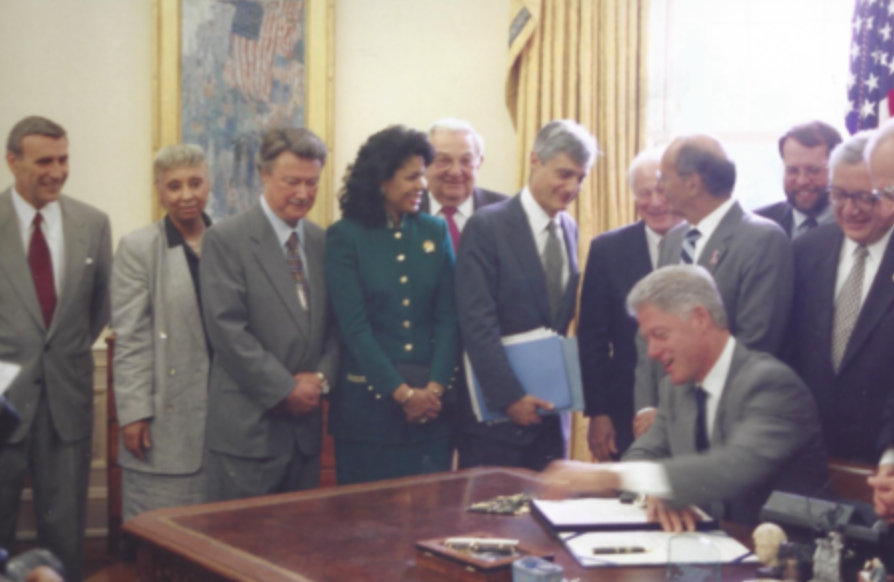
I would see him again in August of 1998 when he joined others from credit unions and Congress in the Oval Office as President Clinton signed the Credit Union Membership Access Act into law. That bill not only saved many credit unions from having to restrict their charters and perhaps even expel some members, but it also became a landmark pivot point for credit unions in the U.S. by vastly expanding membership eligibility.
The Debate Continues
Whether or not that expansion has ultimately been a good or bad thing continues to be debated within credit unions. Levins would leave Robins Financial CU in 2004 and today, the Buck Levins award is handed out every year at the America’s Credit Unions GAC. The award recognizes a credit union league, credit union or credit union individual whose efforts in the political arena have contributed to elevating the political presence of credit unions at the state or national level.
And now you know why.
Frank J. Diekmann is Cooperator in Chief at the CU Daily. He can be reached at [email protected].