
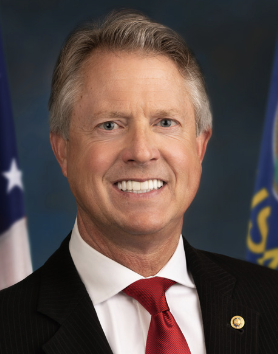
WASHINGTON–Of the many issues that have credit unions concerned following President Trump’s announcement that he wants a 10% cap on credit card APRs, is that the person looking to lead the charge on the issue in Congress is Sen. Roger Marshall (R-KS).
As the CU Daily reported here earlier, Marshall (R-KS) issued a statement on X saying he had spoken with the president and will be leading legislation to “lower costs for American families and to reign in greedy credit card companies who have been ripping off hardworking Americans for too long.”
Marshall has been the co-sponsor, along with Sen. Dick Durbin (D-IL) in prior sessions of Congress, of the Credit Card Competition Act, which is strongly opposed by credit unions and financial institutions, and which would limit interchange fees. As much as credit unions oppose the bill and its provisions, the nation’s retailers support it.
‘Signs’ Already Being Seen
Tony Hernandez, president and CEO of the Defense Credit Union Council, said the concern is that Marshall will either seek to resurrect the Credit Card Competition Act, or push other, similar legislation forward in Congress in 2026.
“I do believe Congress is going to have some legislation, which we’re already seeing some signs of,” said Hernandez. “We see a lot of detrimental effects on the military if the Credit Card Competition Act is implemented.”
For that reason, DCUC joined with the Association of Military Banks of America (AMBA) in sending a joint letter to Congress opposing the president’s plan. Hernandez said DCUC is also meeting with various veteran services organizations and military services organizations related to the 10% cap in order to get its talking points out.
A primary talking point is that the 10% cap will reduce program revenue and lead to a reduction in the extension of credit to certain borrowers.
“We do see the 10% cap as being very detrimental to junior enlisted members and officers who come in…with a lot of student debt,” Hernandez said. “There are a lot of impacts.”
The Popular Appeal of the 10% Cap

Asked by the CU Daily during a call with the media about the popular appeal of the 10% cap and the obstacles that creates in rallying opposition, Hernandez pointed to a December 2025 study by the Federal Reserve Bank of New York that concluded a federal cap or any type of interest rate cap leads to the loss of access to credit by many people. The study examined the effects of rate caps in states where such caps had been put in place vs. states that have no caps.
“I’m not sure (a 10% cap) is going to be the solution people are looking for,” Hernandez said. “There are some serious unintended consequences. (A rate cap) sounds good but I don’t think people have weighed the consequences.”
Affecting Nearly 50-Million Americans
During a call with the media on Monday, Greg Mesack, SVP-advocacy with America’s Credit Unions, noted approximately 47-million Americans are either subprime or near-prime borrowers, and said a 10% APR cap could mean that they no longer can access credit.
“The average credit union member has much lower income, much lower net worth than your average bank customer, so when we’re looking at the notion that credit unions have to support those in need, support those in the fringe, support those who are underserved,” credit unions would be less able to do so, he said. “And those are the ones who be most impacted by 10% usury cap. We’re working hard to educate the administration and educate Congress that this could be devastating…Your mom and pop businesses could be really harmed if all of a sudden the spending power of the average American is dramatically scaled back.”
Mesack also cited the statistic that 37% of Americans do not have $400 to cover an emergency expense, noting those individuals frequently turn to credit cards.
‘Pushing’ People to Payday Lenders
“You’re going to push those folks into payday lenders and unregulated loan sharks,” he said. “That’s not what we want. That’s not good for the country.”
James Akin, head of regulatory advocacy with America’s Credit Unions, said there are “much better alternatives” to provide consumers with affordable credit products than turning to a 10% cap on card APRs.
“Credit unions are already providing credit cards that are much more affordable than other financial institutions,” he said.
Akin also cited financial education, expanding access to nonprofit debt counseling, and encouraging refinancing for high interest debt as among those alternatives.
What Joint Letter States
In their joint letter to House and Senate leadership, DCUC and AMBA expressed “strong, unified opposition” any plans to resurrect Credit Card Competition Act (CCCA), warning that the legislation would harm service members, veterans, and the financial institutions that serve military communities.
The CCCA, which has strong backing from the nation’s retailers, had appeared during the last session of Congress and there were fears the bill or some of its provisions would be added to the National Defense Authorization Act. The language was ultimately not included, but concerns have been raised anew in the wake of President Trump’s call for a 10% interest rate cap on credit card APRs.

As the CU Daily reported here, Sen. Roger Marshall (R-KS), co-sponsor of the CCCA, has said he will lead the charge in Congress to have the card interest rate cap implemented.
‘Who Bears the Cost?’
“At its core, this is a policy choice about who bears the cost,” states Anthony Hernandez, DCUC President/CEO, Ret. U.S. Air Force Colonel, said in a statement, “The Credit Card Competition Act delivers guaranteed gains to large retailers all while undermining the financial protections our men and women in uniform depend on every day.”
Added Omuso George, AMBA president/CEO, Ret. U.S. Army Brigadier General, in a statement, “Financial readiness is not abstract; it directly affects a service member’s ability to focus, deploy, and perform. The Credit Card Competition Act puts retailer profits ahead of the secure, reliable financial systems military families rely on, and policymakers must recognize the real consequences of that choice.”
In the letter addressed to Speaker Mike Johnson, House Minority Leader Hakeem Jeffries, Senate Majority Leader John Thune, and Senate Minority Leader Chuck Schumer, DCUC and AMBA urged lawmakers to reject the bill and prevent its inclusion in any must-pass legislative package. While banks and credit unions often differ on policy matters, both organizations emphasized that the CCCA presents a rare case of full alignment across the military financial services sector.
‘Personalized Services’
The two organizations said both military banks and defense credit unions are known for offering a multitude of personalized services such as low-interest, no-annual-fee credit cards, deployment-relief loans, debt consolidation plans, financial counseling, and emergency assistance.
“By slashing that revenue and imposing rigid routing mandates, the CCCA would directly threaten these vital programs and benefits that military households depend on,” the letter states.
Cautions Shared
In the letter, DCUC and AMBA cautioned that the bill would disproportionately harm smaller, on-base credit unions and military-serving banks operating on thin margins, potentially forcing them to reduce credit availability, tighten lending standards, or eliminate popular card benefits.
The organizations noted junior enlisted service members and military spouses, who often face irregular pay, frequent relocations, and deployment-related expenses, would be among the most impacted.

The organizations also raised what they said are serious concerns about increased fraud and cybersecurity risks, noting that the CCCA would strip issuers of the ability to route transactions over the most secure payment networks. This could expose military cardholders, including those deployed overseas, to “greater vulnerability at a time when financial readiness is critical to mission readiness.”
Retailers Benefit
DCUC and AMBA told Congress the legislation would primarily benefit large retailers, not consumers. Citing past debit interchange caps under the Durbin Amendment, the groups noted that promised savings were rarely passed on to shoppers, while consumers instead experienced reduced access to free checking, diminished rewards programs, and fewer low-cost banking options.
“The CCCA is being driven by big-box retailers and e-commerce giants seeking higher profit margins, not by military families or consumers,” the organizations wrote. “There is no guarantee that any savings would be passed on at the register, while the harm to military financial services would be immediate and real.”
The letter added, “Service members and their families deserve better than to become collateral damage in a corporate lobbying fight. We urge Congress to reject the Credit Card Competition Act and work instead on solutions that promote competition, protect consumers, and preserve the financial readiness of our military communities.”
Letter to Secretary of War
Separately, the Defense Credit Union Council (DCUC) sent a letter to Secretary of War Pete Hegseth emphasizing the critical role credit unions play in supporting military families and outlining key priorities to enhance financial readiness.
In the letter, DCUC President/CEO Anthony Hernandez wrote, “For over 60 years, DCUC has worked hand-in-hand with the Department of Defense to ensure servicemembers and veterans have access to the dependable, affordable financial services they deserve. We greatly appreciate your recent focus on elevating troop quality-of-life issues and financial readiness, and we are eager to continue our partnership in support of the defense community.”
DCUC’s noted the letter highlights credit unions’ vital response during crises, including government shutdowns and natural disasters, offering emergency loans, fee waivers, and financial relief to military families in need.
“During each shutdown, credit unions have stepped up with emergency loans and payroll advances, exemplifying our ‘people helping people’ mission. However, these charitable stopgaps are not a permanent solution; Congress must ultimately act to shield servicemembers from financial harm during political impasses,” Hernandez said.
Advocacy Priorities
In the letter, DCUC outlined several advocacy priorities, including:
- Ensuring access to financial services on all military installations, especially at remote and overseas bases
- Strengthening financial readiness programs through enhanced partnership and financial education.
- Addressing regulatory hurdles created by inconsistent interpretations of military lending laws.
- Establishing a Department of War Advisory Committee to improve coordination on military financial services.
- Supporting veteran entrepreneurs by expanding access to small business loans.
- Protecting the tax-exempt status of credit unions as essential to their mission serving military and veteran communities.
A ‘Common Goal’
“We share a common goal: to improve the financial well-being of the men and women who wear our nation’s uniform, as well as their families and veterans,” wrote Hernandez. “Defense credit unions are an indispensable partner in achieving that goal.”
DCUC said it has formally requested a meeting with Secretary to discuss these priorities and explore ways to collaborate in 2026