ALEXANDRIA, Va.–Federal credit unions in 2026 will be paying operating fees to NCUA that are 24.65% lower than 2025, according to the agency, which said that will mean approximately $5,000 in savings for a $100-million CU, $50,000 in savings for a $1 billion FCU, and $200,000 in savings for a $10-billion credit union.
The decreased fees reflect NCUA’s smaller budget following the elimination of more than 300 jobs this year in the wake of a White House executive order.
The agency, which had earlier announced the reduced fees were on their way in 2026, provided the exact figures—along with dollar amounts—as part an update on its 2026-2027 budget during its December board meeting.
As the CU Daily reported earlier, NCUA had hosted a public meeting on Nov. 5 at which representatives of four organizations offered their input. NCUA said it has taken that input, input from comment letters and made other changes to the proposed draft budget for its final budget forecast.
The Net Impact
According to acting CFO Melissa Lowden, the net impact of the adjustments includes:
- A reduction of $3.6 million to the 2026 operating budget
- A reduction of $9.0 million to the 2027 operating budget
- An increase of $6 million the 2026 capital budget
- A reduction of $10.3 million to the 2027 capital budget
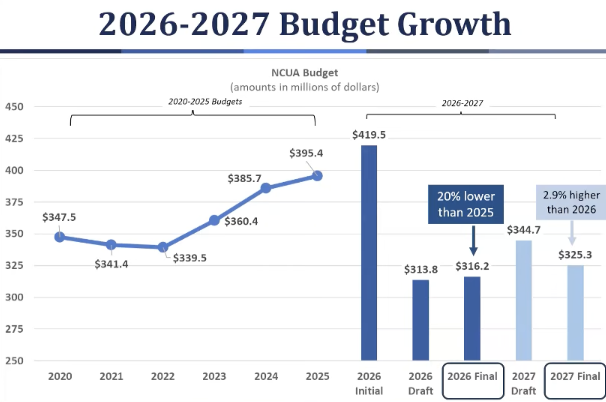
The recommended 2026 combined final budget is $316.2 million, with 967 full-time positions. That is $2.4 million higher than the 2026 draft budget, but still a reduction of 20% compared to the 2025, Lowden said.
The 2027 combined final budget recommendation is $325.3 million and 967 positions, which is $19.3 million lower than the draft budget, resulting in a projected year over year increase of 2.9% between 2026 and 2020.
Lowden noted all of the data is available on the budget page on the NCUA website.
Lowden said budget increases of approximately $1.9 million in 2026 and $2.7 million in 2027 reflect updated amounts reflecting the implementation of a new multi-year compensation agreement and an increase in government wide health insurance premiums, even though it will have fewer employees.
The agency will pay approximately $400,000 less in 2026 and 2027 for Federal Financial Institutions Examination Council training and other programs, she said, while it has also revised its forecast for the budget surplus from 2025 and the operating fees it projects receiving.

NCUA has budgeted $16 million in its 2026 capital budget for process improvement and technology investment expenses related to its reorganization.
Comments Received
According to Jim Holm, supervisory budget analyst, NCUA received 10 comment letters and statements from the public on its budget, which he said focused on the agency’s operations and program execution rather than specific budget matters.
Of those, he said:
- All 10 commenters expressed support for the 2026 budget reductions
- Several commenters expressed views about the value or purpose of specific ensued offices and as the “NCUA implements its reorganization and hiring plans it will consider the public’s comments about those specific offices,” he said.
- Commenters encouraged NCUA to balance staffing reductions with the need for an examination workforce that has the specialized knowledge and experience to oversee financial complexities and regional differences within credit unions.
- There was support for small credit unions, with NCUA encouraged to continue to provide technical guidance to these institutions
- Eight commenters provided positive views about the agency’s proposed capital investments with most commenters supporting the draft budgets proposed reorganization and technology investment budget
- Four commenters expressed support for responsible information technology investments that improve operational efficiency, including one specifically voicing support for automating business and data collection processes related to credit unions fields of membership
- Several commenters wanted more detail around the $16 million budgeted for process improvements and technology
- Five commenters noted that analytic tools and artificial intelligence offer opportunities for NCUA to make its examination process more efficient
- Five commenters encouraged NCAA to identify ways to lower the travel budget the agency’s budget for travel. Holm noted the recommended final budget is 13.4% below the comparable 2025 level and includes significant reductions in travel expenditures.
Financing the Budget & Methodology
NCUA finances its budget from annual operating fees paid by federal credit unions and with monthly transfers (the overhead transfer) from the NCUSIF for costs related to supervising state-charters.
Holm said the final 2026 OTR is 61.8%, which is the same level as that was presented in the staff draft budget, and 0.1 percentage point higher than the 2025 OTR.
The remaining 38.2% of the 2026 budget will be collected through the operating fee. In 2026, credit unions below $2.16 million in assets will be exempted from the operating fee.
The operating fee charged to federal credit unions in 2026 will decrease by approximately 24.65% compared to 2025, which is a 1.1 percentage point improvement from the estimate provided in the draft budget.
NCUA uses a three-tiered scale to compute the operating fee charge, which is also known as the assessment scale, with the dividing points on the assessment scale adjusted upwards on an annual basis based on FCU asset growth.
Operating Fees by Tiers
Holm said:
- The final operating fee rate applied to CUs with assets under $2.54 billion would decrease from $188.71 per $1 million of assets in 2025 to $142.20 per $1 million of assets, a reduction of approximately 24.65%.
- Credit unions with assets between $2.54 billion and $7.68 billion would be assessed at a rate of $41.44 per $1 million of their assets
- Credit unions with assets of more than $7.68 billion would be assessed at a rate of $13.84 per one $1 million.
Asked by NCUA Chairman Kyle Hauptman what the reductions might mean for individual credit unions, Holm said:
- A $100 million credit union in 2026 it would pay an operating fee of $14,219, down from approximately the $19,000 it would have paid.
- A billion-dollar CU would see total savings of approximately $50,000 in 2026
- A $10-billion credit union will see savings of approximately $200,000
Hauptman: ‘Better to be Santa Than the Grinch’
NCUA Chairman Kyle Hauptman said during the meeting NCUA will continue its shift toward a more streamlined agency focused on leveraging technology to reduce costs and improve efficiency.
“We’re going to continue prioritizing transparency and incorporating feedback in the budget and our operational planning,” Hauptman said. “This ensures we are responsive to the needs of credit unions while optimizing their resources. It helps us do what we’re supposed to do, which is to help credit unions to stay financially solvent. One way to help them be financially solvent…is to let them keep more of their money. In this holiday season I’m proud to give a bit of a gift to credit unions. It’s always enjoyable when you get to be Santa and not the Grinch.”
America’s Credit Unions Response
In response to NCUA’s budget announcement, America’s Credit Unions’ President and CEO Scott Simpson said, “We appreciate the NCUA Board’s vote to pass a budget that reflects a meaningful effort to reduce costs on credit unions and respond to long-standing concerns about regulatory expenses. A more disciplined budget that prioritizes the agency’s core mission of safety and soundness is in the best interest of credit unions and the members they serve. Continued transparency and smart modernization will be important to ensure the NCUA can carry out its responsibilities efficiently and effectively to protect credit unions.”