HAYSVILLE, Kan.–You really don’t know what you don’t know—but the CU Daily is here to help you, with critical information on where America’s most expensive backyards can be found, who’s willing to go into debt for a date, which NFL teams have the politest and most foul-mouthed fans and more!
The CU Daily leads the industry in reporting more than 100 news items every week—but there’s even more we don’t report, including dozens of press releases and announcements that have, at best, a tangential connection to credit unions.
Many are related to surveys and analyses sponsored by companies looking to get their names and brands into the media at little cost.

Here are just some of the announcements the CU Daily has received that did not make the cut—until now. And what better time than a holiday to learn this invaluable information.
Where the Smartest People Live in the U.S.
PALO ALTO, Calif.– SmartNews, which says it is a “global leader in news discovery, released a nationwide ranking of the smartest and most news-obsessed cities in America, saying it found it’s “not the country’s biggest cities leading the charge in intellectual curiosity, but rather small and midsized communities.
“Based on per capita daily news consumption, the data challenges long-held assumptions about where the most informed Americans live and redefines what it means to be one of the ‘Smartest Cities in America’,” according to the organization.
SmartNews said it ranked 999 cities in America and found that Haysville, Kan., with a population of 11,260, is the smartest city in the country. By comparison, New York City came in at 974 on the list of the smartest cities, with Los Angeles at 923, and Chicago at 912. The full list of the 999 Smartest Cities in America can be found on the SmartNews website.
Smartest Cities in America
- Haysville, Kansas
- Valley Center, California
- Green Valley, Arizona
- Cottage Grove, Minnesota
- Sequim, Washington
- Port Orchard, Washington
- Hutchinson, Kansas
- Grants Pass, Oregon
- Sun City, Arizona
- Ames, Iowa
Does Bad Credit Equal Bad Date?
LAS VEGAS–In a survey sponsored by Credit One Bank, people were asked, “Would you date someone with bad credit?”
According to the bank, it’s a question that “younger generations are asking more often as money matters reshape modern relationships. Once considered private, credit scores now influence everything from first dates to lifelong commitments.”
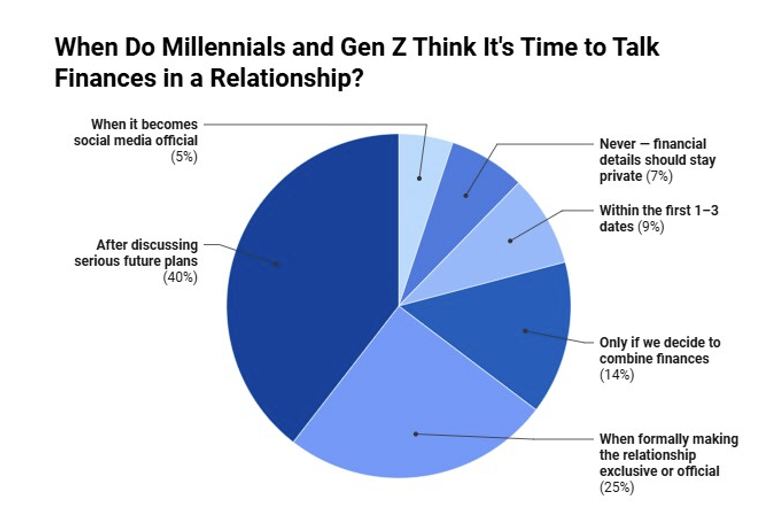
Credit One said its survey of 1,000 Gen Z and Millennial adults found:
- Nearly 70% of consumers would lose confidence in a boss with bad credit or major debt
- More than half say a high credit score makes someone more attractive
- 1 in 2 people admit to faking their wealth or success
- Over 25% of Gen Zers and Millennials acknowledge they don’t fully understand credit scores
- Over 70% of women almost never discuss money with their friend groups
- Nearly 50% of men would be willing to go into debt on a date
- Women are twice as likely to say “I don’t” due to poor financial habits
- 73% of Gen Zers and Millennials say they fully understand what a credit score is and how it impacts their life.
- Though almost half of men are willing to overdraft their account or go into debt to impress a date, only a mere 28% of women would do the same.

Where People Have the Most Spare Income
SINGAPORE–Switzerland ranks first globally for spare income, with residents keeping $5,479 monthly after covering basic living expenses, according to a study by the lending firm Singapore.
The analysis found European countries take seven of the top 10 spots in the global ranking for nations where people can save the most money.
Singapore is the only Asian country in the top rankings, securing third place with $3,030 monthly savings potential.
The study analyzed financial data across multiple countries to determine where residents have the greatest capacity to save from their salaries. The research examined five key metrics: average monthly net salaries after tax, cost of living indices, safety ratings, and quality of life scores. Countries were ranked based on estimated monthly spare money.
The complete research can be found here.
10 Full Days Lost to Scrolling at Bedtime
SCOTTSDALE, Ariz.–New research from Amerisleep.com reveals that the average American spends 38 minutes on their phone before sleep each night, totaling 231 hours, or nearly 10 full days of lost rest every year.
According to Amerisleep’s nationwide survey:
- 86% of Americans use their phone in bed before sleep
- 28% stay up past 2:00 a.m. on work nights due to scrolling
- One in six admits to falling asleep on the job due to bedtime phone use.
- One in four have missed a meeting, deadline, or shift due to late-night scrolling.
- 24% of Americans deleted TikTok specifically to improve sleep.
Breaking the Cycle
The company said there are five simple ways to break the cycle:
- Set a “phone curfew”: Power down 1–2 hours before bedtime.
- Keep your phone out of reach: Charge it across the room or outside the bedroom entirely.
- Replace scrolling with calm routines: Reading, journaling, or light stretching.
- Use built-in phone tools: Do Not Disturb, Sleep Focus, or night shift mode.
- Invest in a real alarm clock: Break free from the “I need my phone in bed” excuse.
Surprise: Employees Like Receiving Gifts
AMSTERDAM, N.Y.–In an announcement certain to stun credit union leaders, a new survey finds 78% of employees say thoughtful holiday gifts boost morale and loyalty—”making them a make-or-break factor in today’s workplace.”
According to new research from a corporate gifting platform, ReadySetGift, an overwhelming 93.9% of employees feel more appreciated when they receive company gifts, and nearly half (49.5%) say these gestures directly impact their job satisfaction.
Key Findings
- 93.9% of employees feel more appreciated when they receive holiday gifts from their company.78.2% say thoughtful gifts boost morale and loyalty, with 38.7% reporting a significant boost.
- 54.6% feel more valued when given a choice in their holiday gift.
- 57.0% want some level of personalization.
- 33.1%) see holiday gifts as essential for showing employee appreciation.
- 62.9% expect gifts worth at least $50 to feel meaningful and not “cheap.”
- While most employees crave personalization and choice, the report found that nearly 20% have never been given options beyond bulk HR-ordered items. This disconnect highlights why generic, one-size-fits-all gifts may do more harm than good.
Where Heartbreak Has the Highest Costs
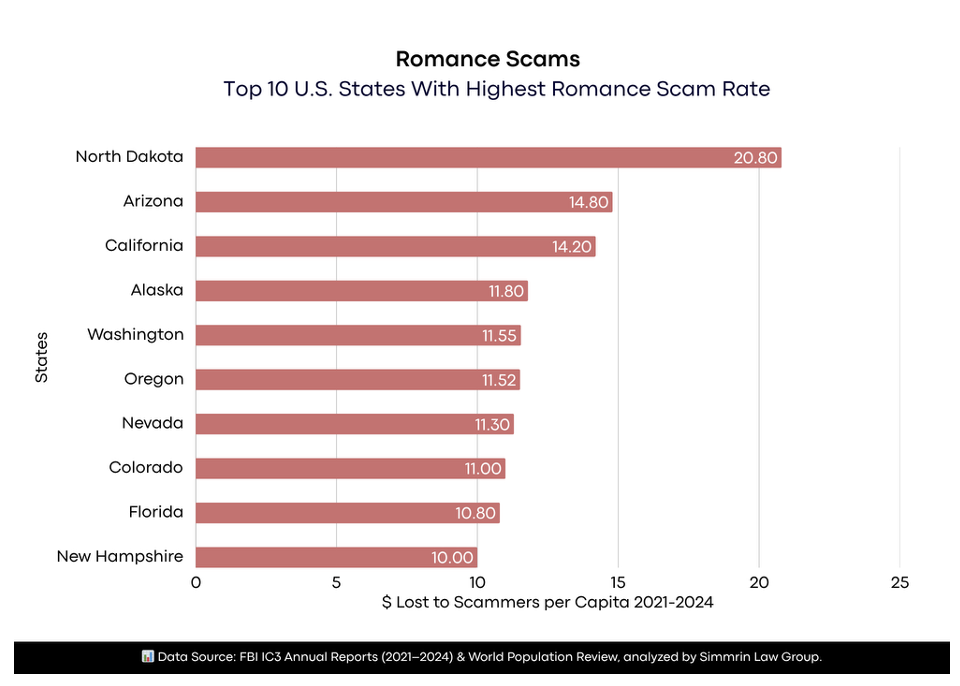
LOS ANGELES–A new data analysis has identified the states where romance scams cause the greatest heartbreak.
The study conducted by Simmrin Law Group analyzed federal cybercrime data across U.S. states via the FBI’s Internet Crime Complaint Center (IC3) annual reports from 2021-2024. Scam-related losses were compared to population data to identify top 10 states where residents have suffered the most emotional and financial harm from confidence and romance scams, the firm said.
North Dakota leads the nation with the highest per capita losses to confidence fraud and romance scams, with residents losing $21 between 2021-2024. Home to approximately 784,000 people, North Dakota reported over $16.3 million in total losses. The state experienced its peak losses in 2021 at $12.1 million and its minimum loss in 2024 ($868,352).
Arizona ranks second with a loss of $15 per capita due to confidence fraud and romance scams. With a population of approximately 7.4 million, Arizona reported total losses exceeding $109.9 million over the four-year period. The state saw its highest losses in 2022 at $31.5 million and the lowest in 2024 at $20.1 million.
California holds the third spot, Alaska ranks fourth followed by Washington, Oregon, Nevada, Colorado, Florida and New Hampshire.
AI Leads to ‘Major Shift’ in Interaction
DALLAS–Seventy-five percent of U.S. adults have used an AI system in the past six months, signaling a “major shift” in how consumers interact with technology, according to a new study by Joe Youngblood, a Dallas-based SEO strategist and marketing theorist and founder of JoeYoungblood.com.
The survey of 1,151 Americans shows a clear divide in usage patterns, Youngblood reported:
- 33% are heavy users, engaging with AI daily.
- 42% are casual users, turning to AI weekly or monthly.
- 25% rarely or never use AI, a group the study dubs “AI holdouts.”
The top reported uses for AI include:
- Searching the web (29.28%)
- Learning something new (24.76%)
- Fixing grammar and spelling (19.8%)
- Generating new ideas (19.64%)
- Cooking help (13.81%)
- Personal entertainment (16.59%)
The survey can be found here: Study: How American Consumers Are Using AI
Identifying America’s Most-Expensive Backyards
AKRON, Ohio–A new study has found America’s priciest backyards can be found in California, at over $80 per square foot, followed by Hawaii and New York.
The average American yard represents 88% of the total property area, with yards in the most expensive states typically being smaller than the national average, according to the study that revealed the states where homeowners are paying the most for their backyards.
The research, sponsored by fence installation company R&T Fence, analyzed yard values across all 50 states by comparing property sizes, values, and the proportion of land that consists of outdoor space rather than built structures.
Paying a Premium
“California’s high garden costs ($80.32 per square foot) come despite the state having relatively small average yard sizes of just 7,811 square feet, less than half the national average,” the company said. “This means California homeowners are paying premium prices for significantly less outdoor space than residents in most other states. “
The average California home costs $823,422, and approximately $627,365 of that value, over 76%, is attributed to the yard area alone.
California’s green space is nearly 40 times more expensive than the least costly state, Alaska, where space averages just $2.15 per square foot, according to the report.
5 Pieces of Parental Financial Advice That No Longer are True
NEW YORK–There are five pieces of “financial advice from our parents’ generation” that don’t always hold true anymore, according to a new report. “With rising inflation, skyrocketing housing costs, and the shift toward a cashless, digital-first economy, many of the money lessons passed down from parents and grandparents simply don’t work anymore,” according to Research from Intellectia.ai.
Intellectia.ai said there are five long-held financial advice stalwarts that no longer hold true, including:
- Just buy a house, it will always pay off.
“Homes are now far more expensive compared to income, and ownership is out of reach for many without heavy debt.” - Stay loyal to one company for life and retire with a pension.
“Most pensions are gone, and job-hopping often brings better pay and benefits than loyalty.” - Put your money in a savings account and watch it grow.
“With most bank accounts paying under 0.5% interest, savings often lose value against 3–5% inflation.”
- A college degree guarantees financial security.
“Tuition costs and student debt have surged, while wages for many entry-level jobs haven’t kept pace.” - Work hard, save hard, and you’ll be set.
“Rising living costs, housing prices, and healthcare mean hard work and savings alone often aren’t enough without investing or diversifying income.”
‘Shocking & Hilarious’: How People Behave in Theaters
WHEAT RIDGE, Colo.–A new national survey from Octane Seating, a provider of home theater seating, has found a “shocking and often hilarious look at modern moviegoing, from rowdy crowds to unexpected romances,” according to the company.
Key findings in the company’s survey include:
- 62% of Americans admit to getting intimate in theaters, including one in 25 who’ve had sex during a film.
- 41% have yelled at someone during a movie (phones, chatter, or PDA are the top triggers).
- 21% have filmed other moviegoers to mock them, with 9% posting it online.
- 39% of Gen Z say they’ve gone to the movies drunk or high (compared to 17% of boomers).
- 34% say horror movies attract the most obnoxious crowds.
- One in 10 have had food or drinks thrown at them mid-movie.
- 54% of Americans say they fear a mass shooting at a theater, rising to 64% among Gen Z.
- Half of Gen Z and 47% of millennials say they’ve shown up to theaters under the influence, compared to just 17% of Baby Boomers. Younger audiences are also more likely to record and post clips of other patrons online, fueling a new wave of “digital theater shaming.”
- Baby boomers (46%) are far more likely than Gen Z (27%) to say horror has the worst influence on audience behavior.
- 62% of Americans say they’ve gotten physically intimate at the movies, and 4% even said they “went all the way.”
Top Complaints
While 58% of Americans claim they’ve never disrupted a movie, the top complaints include:
- Talking during the film (40%)
- Phones glowing in the dark (19%)
- Seat kicking (10%)
The Most Polite Fans& Foul-Mouthed Fans in the NFL
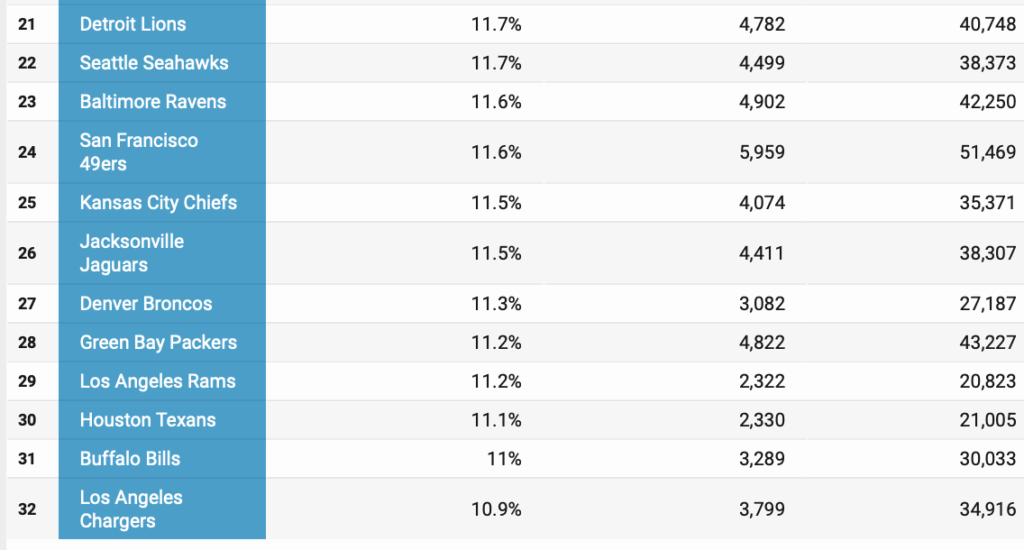
LAS VEGAS–With the 2025 NFL season in full swing, VegasInsider.com said it has analyzed 1.2 million comments from the subreddits of all 32 NFL fandoms to find out which fans are the most polite and on the contrary, which fandoms are the most foul-mouthed.
It said the comments was analyzed to reveal which fandoms are the most negative and which ones are the most positive.
The Findings
The findings included:
- Indianapolis Colts were found to be the most foul-mouthed fandom since 16.4% of the comments on their subreddit included swear words
- Cincinnati Bengals turned out to be the second most foul-mouthed NFL fandom (15.9% of their comments included swear words) followed by Dallas Cowboys in third place with 15.3% of their comments including swear words
- On the other hand, Los Angeles Chargers were found to be the most polite NFL fandom since only 10.9% of their comments included swear words
- Cincinnati Bengals turned out to be the most “negative” fandom, since 28.48% of their comments had a negative sentiment. In second and third place as the most negative are Dallas Cowboys and Indianapolis Colts, respectively. 28.27% of Dallas Cowboys’ comments were categorized as negative while Indianapolis Colts had 27.74% of negative comments.
- The top 3 most positive NFL fandoms turned out to be: Tampa Bay Buccaneers (52.44% of positive comments), Arizona Cardinals (52.33% of positive comments), Denver Broncos (51.57% of positive comments)

More Than One-Third of Workers Use PTO for Sleep
SLUMBERLAND, U.S.A.–According to Amerisleep.com’s new analysis, 37% of U.S. workers used PTO in the past year specifically to sleep.
The study, which surveyed over 1,200 Americans and analyzed data across 95 U.S. cities, shows how burnout and poor sleep health are reshaping the way people use their vacation days.
Key Findings
- PTO for sleep is common. 37% of Americans used vacation days in the past year just to rest.
- Millennials lead the trend. 43% of millennials used PTO for sleep, compared to 34% of Gen X, 33% of Gen Z, and just 20% of baby boomers.
- Higher earners are more likely. Six-figure earners are 26% more likely to use PTO for sleep compared to those earning under $100,000.
- Short-term recovery. On average, most Americans who took PTO for sleep used 2–3 days to catch up.
- Vacations shift in purpose. 31% of Americans have taken a vacation primarily to rest, with millennials most likely at 35%.
The complete findings, including generational insights and city rankings, are available here.