SAN DIEGO – The story of how a divided credit union board that at one point used to sit on opposite sides of the table and “shout” at one another as the CU was losing money, before it went through a “modernization” overhaul that was successful enough to recently attract more than 50 applicants to fill an open position, drew a strong turnout when that story with all its “pain points” and successes were shared with an audience here.
Monthly meetings that used to run three-plus hours and which were described as “toxic” now run no more than an hour and are more productive, thanks to a new culture built around clarity and caring that has led to “teamwork,” among board members, most of whom are now new, according to several board members and the CEO of Red Rocks Credit Union in Colorado.
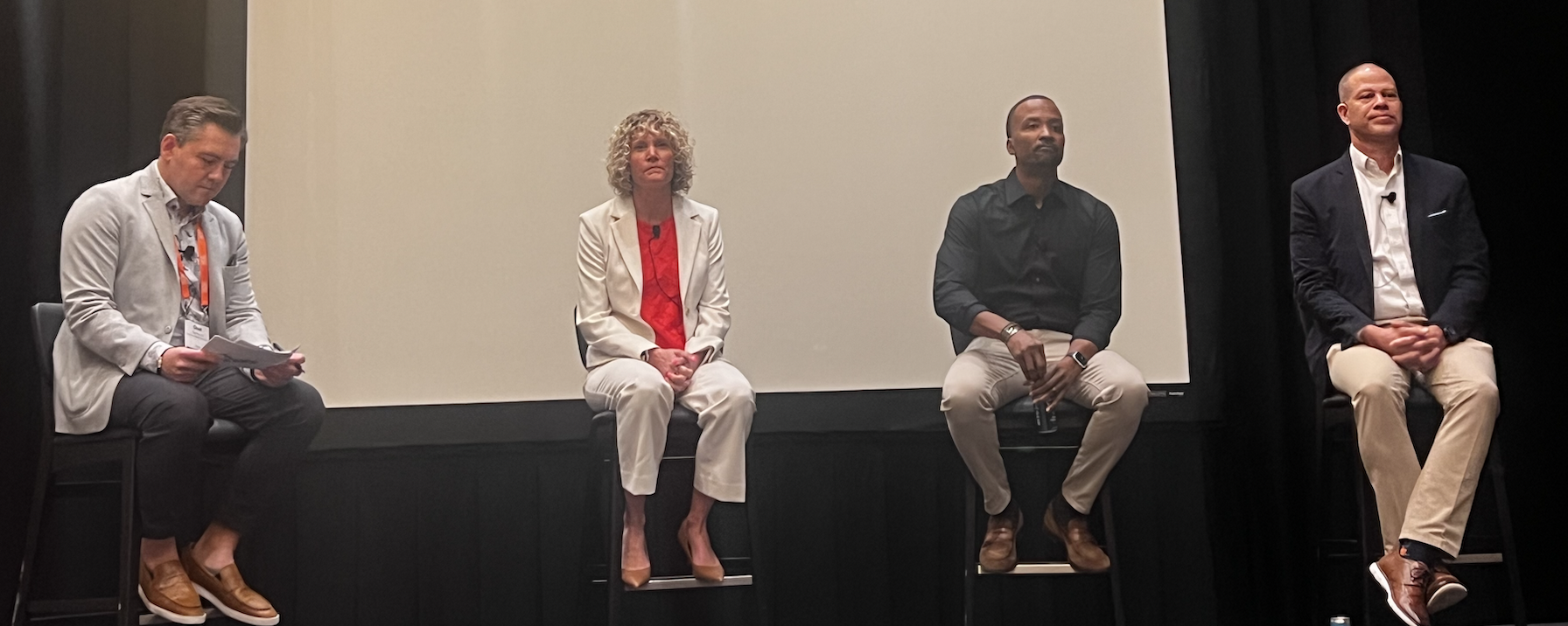
The trio from the $331 million, 18,000-member Red Rocks shared their perspectives during the CUES Directors Conference here. Offering their insights were board members Tiffany Watt and Joeri Carty, along with CEO Darius Wise. The session was moderated by Chad Helminak, who leads Purpose to Impact Consulting and who was previously with CUES and the National Credit Union Foundation.
Here is a look at how the Red Rocks CU participants described what has taken place at the credit union over the last five years:
Helminak: What was your journey like to the CEO role?
Wise: I was a full-time pastor for 17 years. A member of the church where I pastored was the previous president and CEO at Red Rocks. I was having a midlife crisis, if you will… and I sat down for lunch with him. I said to him I’m thinking about making a career change and he said, “It’s funny that you say that, I’ve been thinking about inviting you into my organization as my number two. I’ve got about five to seven years before retiring. I think you’re a leader of leaders. I can teach you this industry. What do you think about coming to the organization?” I told him no. Three months later he came back and said, “I really think you’re the guy.” I said yes.
What I thought was going to be a five- to seven-year period changed when, two years later, the CEO and the organization parted ways and I became the interim president and CEO. During the time I led the organization we went through a core conversion and a merger opportunity. We returned the organization to profitability after two years of operating at a net loss and the board called me and said they were actually going to talk to 11 people, but they thought I was the guy to lead the credit union forward. That was about two and a half years ago.
Helminak: How did you end up on the Red Rocks board?
Watts: They found me through a friend on the board who said, “I don’t know how much you know about credit unions, but this is great. It’s a great organization. It’s a great movement.”
For me, it’s a way I can use my business skills to do something that impacts me and our members. I have a background in accounting and business development… My friend knew my background and thought it would be a good fit with my skill set.
Carty: I knew a person on the board, too, and they found me. I didn’t really know much about Red Rocks Credit Union. I’ve been in the utility industry for 30 years. I became an associate board member and then a board member and six months later chairman of the board. That was four and a half years ago. I’ve learned a lot and am able to give back to the community.
Helminak: What were some of the driving forces behind needing to modernize governance and what do you mean by modernization?
Wise: When I walked into my first board meeting there was a shouting match. It was very clear to me that success is not finance, it’s not strategy, it’s teamwork. That provides the ultimate competitive advantage.
What was clear to me in that first board meeting was that there were these two disparate groups sitting on opposite sides of the table. My predecessor in the organization decided to part ways. We had a chair who had been on the board for 24 years and in the chair seat for 12 years. The vice chair was on the board for 20 years and in the vice chair seat for seven years. The board was stagnant and a rubber stamp.
I realized day one this wasn’t a team. This was a toxic situation. A credit union thrives based on the connectivity of the CEO and the board chair and board relationships. Modernization really came from the level of dysfunction in the organization.
Carty: It was really challenging to agree on a budget, challenging to agree on the strategic plan. We wanted to set up this board for the future, because this organization is going to be there long after I have retired from the board. We have a duty to our members and to making sure that we have a healthy organization. Growing and returning to profitability are all things that are important, but we can’t do that if we are a stagnant board and have no exposure to the management team.
We said we really need to think about this from a strategic perspective as a board. How are we holding ourselves accountable to set up the organization for success? We had to work through the messy middle and keep our members in mind. Coming out the other side, I think we now have great alignment on the board.
Helminak: What were the pain points?
Watts: It came down to the lack of trust, with the board and with our CEO, honestly. We didn’t have much exposure to the management team. There was a lack of trust with the COO and CFO. We made some decisions we probably wouldn’t have made if we knew the management team better. What prompted this board effort was all this turmoil. We were stagnant as a credit union. There was a need to grow to gain economies and move the organization forward. The modernization effort really came from this period. It seemed like the right time.
Helminak: What’s the overlap in the culture of RRCU and the board?
Wise: That’s what we attacked first. Smart people can figure out strategy. They understand financials. We started with not what are we doing, but how are we doing it. How do we work together? We had to establish an identity. Culture is the foundation you build on. We want to be open, honest and respectful. We’re going to be hard on the issue but soft on the person. We’re going to talk about hard issues with intentionality. We’re here to serve at the behest of our membership in a dignified way as we interact with each other.
We established core values. That’s not something we throw on the wall, but the rudder that dictates how we operate.
Helminak: When setting this vision as a board, what did that look like? What were the first steps?
Watts: I think our first step was really benchmarking. I asked our CFO to provide us with some names of other board members and CEOs in the credit union world. I made some calls. What do you think you do that’s effective? Not effective? What would you change if you could? I listened and they had some great ideas, some of which we took. That was the starting point for how we developed our committees and did board recruiting.
Carty: I remember our first board meeting. There were all these posters with all these beautiful words, and PowerPoints with beautiful words. No one could recite them. They were too long. You don’t need an entire page of values. You need it to be simple.
Wise: We hired secret shoppers to go into our branches. They asked our frontline team, “Why do you show up to work every day?” Ten of them gave 10 different answers. The things you are asking your team to embody need to be bite-size and chewable. Our purpose statement is two words: Enriching Lives. It’s our why. It’s who we are as a company. Our board aligned around that first and then that transferred into management.
Helminak: What was the accountability like and what were the key objectives on the front end?
Watts: We actually do an annual board assessment that we built internally with some help from consultants. We rank ourselves in a variety of different areas, from an expertise standpoint to intangible strengths. We triangulated that and looked at our gaps. One recent gap identified was someone who specializes in sales, someone with an IT background, and someone with a legal background. When we had an opportunity to recruit a new board member we were pretty specific about who we recruited.
Wise: We shifted from decisions being made by everyone in the room to a committee structure. We shifted from no term limits to having term limits. We shifted to a board compensation model. It was a rigorously debated topic. Our board had been volunteers for years. Our board was against it at first and then decided it was something they wanted to do.
How we communicated to the board from a reporting standpoint changed. My predecessor talked for three hours at the board meeting. That was painful to sit through. So, we shifted to a different reporting model and created efficiencies throughout. During the pandemic everyone went remote, and after the pandemic we decided to maximize the remote nature of meetings, and we now meet in person four times per year.
We switched technology to a new board portal that allowed the board to interact. Our meetings got more efficient. Our monthly meetings now are 30 minutes to an hour. Our quarterly board meetings are three to four hours.
Carty: We are accountable to review the board packet ahead of time and to ask questions ahead of time so the management team has time to review that and can exchange information. So, at the board meeting we have already read it and are only talking about the high points. Now we are using the time wisely. We are getting a lot more done in the 30-minute to hour-long meetings than we did in the three-hour meetings.
Watts: We actually eliminated the supervisory committee structure and went to a board audit/risk committee. One of the reasons was when we went to a board compensation model we wanted it to be fair to everyone, and we wanted to control the costs. And there were a few of us who had the expertise to run the audit/risk committee.

To the point of accountability, if you want someone to do something you pay them to do it. I’m seeing that change in accountability in the board.
The quarterly meetings are the fun ones. We talk a lot about strategy. We talk about growth and what we want to do in the future.
Helminak: I’m hearing a lack of ego and a level of stewardship. What are your term limits now?
Wise: Three threes. And the officers also have term limits. Every table officer serves a three-year term and then they rotate. Our vice chair is obviously a succession candidate for that chair role, but that’s not a hard fact. All of our board members are different and we want those different perspectives of leadership.
Helminak: What about the diversity of the board and the pipeline of new board members? What are you looking for that may not be on the board today?
Watts: This year we took a pretty multifaceted approach to a new board member. I reached out to my friends who were attorneys, for instance, and invited them to apply. We posted on LinkedIn and on our website. I think we received 50 candidates and 17 we thought were truly qualified. We also did not mention compensation. These were people who were just engaged with us.
We have a committee that led the effort to interview the 17 candidates. They narrowed that to four who met with the other board members. We all stacked hands pretty well on the one individual, who had a cybersecurity background.
Wise: Prior to that we hired a consultant who led us through a skills gap assessment, and that was pretty important. We looked at the demographics of the board. And we looked at what does the future of the board look like? What skill sets do we want? That was one of the more telling tools we walked through.
Carty: The candidates we got were diverse and reflected the communities we want to serve.
Helminak: What’s been the impact? What has the modernization of the board resulted in?
Watts: I think one of our board members summed it up best at our last retreat when they said, “This is the best retreat we’ve ever had.” There are a couple of reasons. We had the whole leadership team there with us. Two, we could talk about the fun things around how can we grow and serve members. That’s, frankly, why I wanted to be on the board.
Wise: The financials and our balance sheet are much healthier. What’s happening throughout the organization is a microcosm of what’s happening at the top of the organization. As a management team we have clarity, and when you have clarity, you can accomplish anything.
I think the work around modernizing the board is the most important work you will do. Prioritize it. Attack it with courage and honesty and vulnerability and do it together. Teamwork is the ultimate competitive advantage. Your credit union in 10 or 20 or 40 years will thank you for it.