CHICAGO – Fraud is draining business resources at an “alarming and unprecedented rate,” according toTransUnion’s newly released H2 2025 update to the Top Fraud Trends Report.
The report found companies worldwide lost 7.7% of their annual revenue on average due to fraud over the past year, representing an estimated $534 billion across the 1,200 business leaders surveyed.
According to TransUnion, in the U.S., business leaders reported their companies lost (on average) the equivalent of 9.8% of revenue due to fraud in the past year — a “staggering 46% increase when TransUnion surveyed business leaders in 2024,” the company said.
It added that rate is 27% higher than the global average of 7.7%, highlighting the disproportionate impact on U.S. companies. Among the 200 business leaders surveyed in the U.S., these losses amount to an estimated $114 billion among just those leaders surveyed, underscoring the urgent need for stronger fraud prevention strategies, TransUnion stated.
Exploiting Every Touchpoint
“Fraudsters are exploiting every digital touchpoint, from account creation to login and transaction,” Steve Yin, global head of fraud at TransUnion, said in a statement. “The financial impact is staggering, and organizations must rethink how they verify identity and secure customer interactions. To stay ahead of increasingly sophisticated threats, businesses must embrace innovative thinking and deploy adaptive strategies that disrupt fraud at every stage of the consumer lifecycle.”
TransUnion said the report, which draws on proprietary data from its global intelligence network and surveys of business leaders in six countries and consumers across 18 countries, reveals that as monetary losses grow in scale, fraud is growing in sophistication and diversity.
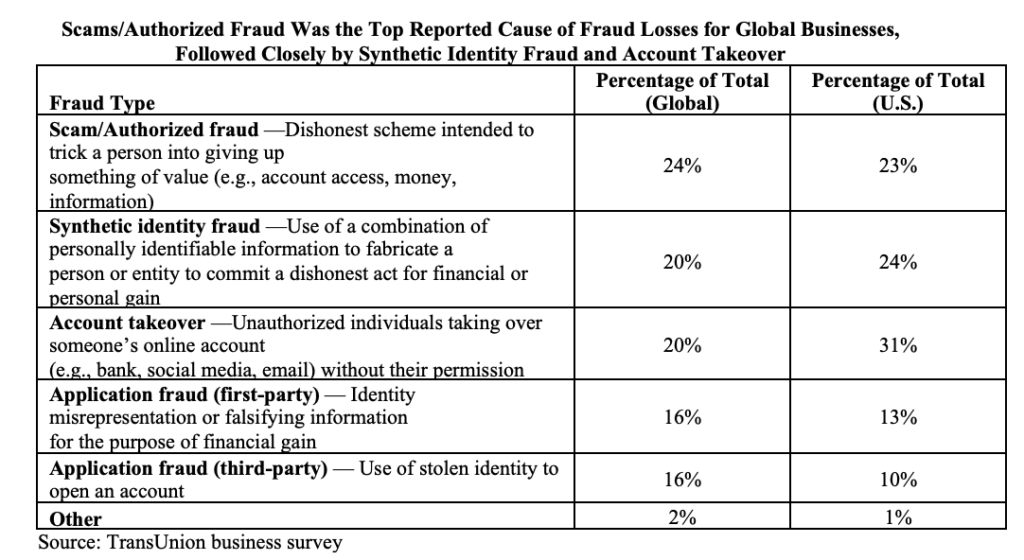
“When the global business leaders were asked which fraud was the predominant cause of business loss in the past year, scam/authorized fraud (24%) was number one, followed by synthetic identity fraud (20%) and account takeover (20%),” TransUnion said.
Account Takeover Fraud Surges
In the U.S., TransUnion said its analysis found account takeover fraud has emerged as the most damaging fraud type for businesses, responsible for nearly one-third (31%) of all reported fraud losses in the past year. This was followed closely by synthetic identity fraud at 24% and scam/authorized fraud at 23%, both of which continue to pose serious threats.
“While account takeover trails scam/authorized fraud globally, its growth trajectory is concerning,” TransUnion said.
According to data from TransUnion’s customers in its global intelligence network, digital account takeover volume worldwide grew 21% from H1 2024 to H1 2025, signaling a rapid escalation.

“Looking further back, the volume of account takeover fraud surged 141% from H1 2021 to H1 2025, underscoring its persistent rise over time,” the company said. “This trend reflects the increasing sophistication of fraudsters who exploit stolen credentials and bypass authentication systems.
Added Yin in a statement, ‘As account takeover fraud surges, businesses can no longer afford solely reactive defenses. The growing sophistication of fraudsters demands a proactive investment in layered security and identity intelligence. In today’s threat landscape, protecting customer accounts is not just a priority — it’s a business imperative.’”
Consumer Exposure to Fraud
Meanwhile, the survey found that globally, consumers continue to face a wide range of scams, with tactics often tailored to regional behaviors and vulnerabilities.
“TransUnion’s survey across 18 countries found that 48% of global consumers reported being targeted by email, online, phone call, or text messaging fraud from February to May 2025, while 52% were unaware, indicating potentially concerning under-recognition,” the company said. “Among those who said they were targeted, the most frequently reported scams were smishing (36%), phishing (34%), and vishing (33%), all designed to deceive individuals into giving up their valuable personal or financial information. These scams are often powered by compromised identity data from breaches and dark web marketplaces.”
Sophisticated Fraud
According to TransUnion, U.S. consumers are being increasingly targeted by sophisticated fraud schemes that exploit digital vulnerabilities. Over half (51%) reported being targeted by scams via email, online platforms, phone calls, or text messages between February and May 2025. The most common fraud types were phishing and smishing, each cited by 46% of those targeted, followed by vishing, the survey found.
“Alarmingly, 49% of U.S. consumers were unaware of whether they had been targeted, highlighting a concerning potential gap in fraud awareness,” TransUnion said.
The report also found that according to TransUnion’s global intelligence network, 77% of U.S. data breaches in H1 2025 exposed full Social Security numbers — the highest percentage in this research, which spanned a six-year period, the company reported.
‘More Important Than Ever’
“As scammers continue to evolve their tactics to enrich themselves, it’s more important than ever for consumers to regularly review their credit reports to ensure all listed information is accurate,” Margaret Poe, head of consumer credit education at TransUnion, said in a statement. “Those who suspect they’ve been targeted or victimized by fraud should not only check their credit reports but also consider placing a freeze on their credit files with each of the major credit bureaus.”
TransUnion said it came to its conclusions about digital fraud and data breaches based on intelligence from its array of TransUnion fraud prevention solutions.
For a copy of the report, go here.