By Travis Coley

Ed Speed hit the nail on the head when he described credit unions as existing in a “time of monsters.” But while the industry grapples with preserving its cooperative soul–a noble and necessary mission–it’s sleepwalking toward an existential crisis that threatens to render that soul irrelevant.
Here’s the uncomfortable truth: Credit unions are on the verge of losing not one, but two entire generations. Millennials and Gen Z aren’t just shopping around for better rates or flashier apps. They’re fundamentally disconnected from what credit unions represent, because credit unions have failed to meet them where they actually live, work, and bank.
The Digital Delusion
Let’s start with the elephant in the boardroom. Too many credit union leaders confuse digital marketing with digital transformation. Posting on Instagram and launching a mobile app isn’t transformation—it’s window dressing on a fundamentally analog business model.
Real digital transformation means reimagining how members discover, join, and engage with your institution. It means embedded banking, API-first thinking, and seamless omnichannel experiences. It means recognizing that for younger generations, the branch isn’t a destination, it’s an emergency backup plan.
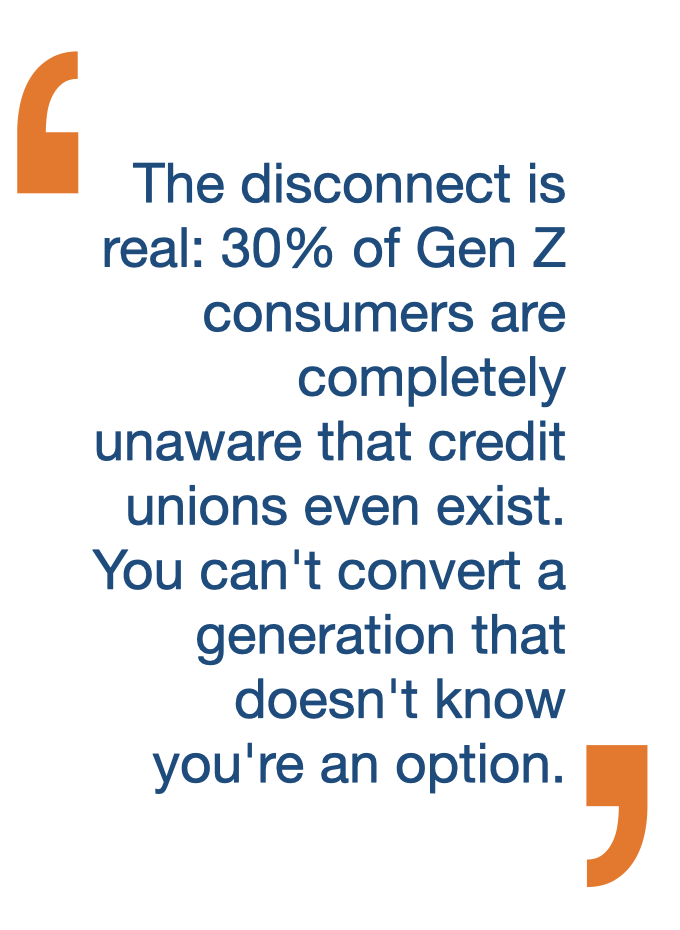
Yet walk into most credit union strategy sessions, and you’ll hear executives debating whether to add another teller window or extend Saturday hours. Meanwhile, their target demographic is splitting dinner bills with Venmo, investing spare change through Acorns, and getting financial advice from TikTok. The disconnect is real: 30% of Gen Z consumers are completely unaware that credit unions even exist. You can’t convert a generation that doesn’t know you’re an option.
Brand Evolution vs. Brand Extinction
The second crisis is even more insidious: brand stagnation masquerading as heritage preservation. Yes, your 75-year history matters. Yes, your community roots run deep. But if your brand strategy relies on convincing 25-year-olds to care about the same things that mattered to their grandparents, you’re not preserving heritage, you’re building a museum.
Successful brands honor their past while speaking fluently to their future. Apple didn’t abandon its innovation DNA when it evolved from computers to phones to services. Nike didn’t lose its athletic credibility when it became a lifestyle brand. Credit unions can absolutely maintain their cooperative principles while developing brand personalities that resonate with digital natives.
The Generational Exodus
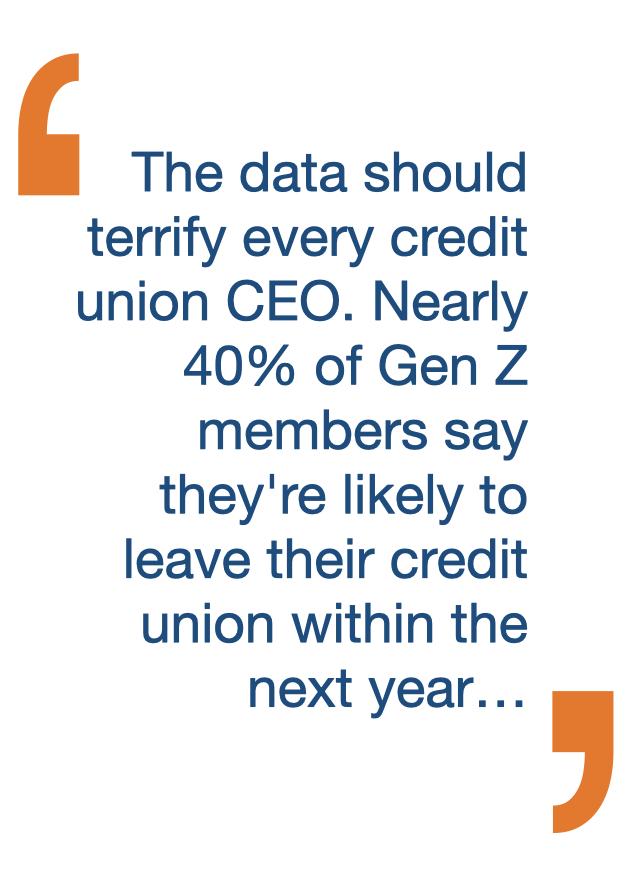
The data should terrify every credit union CEO. Nearly 40% of Gen Z members say they’re likely to leave their credit union within the next year, according to recent PYMNTS Intelligence research. Most are headed to traditional banks – institutions that younger consumers theoretically should trust less, not more.
But here’s what should keep you up at night: 90% of current credit union members say they would not recommend their credit union to their children. Read that again. Nine out of ten of your most loyal members – the ones who stuck with you – wouldn’t send their own kids your way. This isn’t just a retention problem; it’s a referendum on relevance.
The numbers get worse. Credit unions have achieved only 4-5% market penetration with the largest demographic cohorts in American history. Despite decades of operation and billions in assets, the industry has failed to capture even a twentieth of the generations that represent the future of financial services.
This isn’t about products or rates. It’s about relevance, convenience, and connection. When a generation that values authenticity, social impact, and seamless experiences chooses big banks over credit unions, that’s not a pricing problem, it’s a positioning catastrophe.
The False Choice Fallacy
The most dangerous myth in credit union leadership circles is that mission and modernization are mutually exclusive. This false choice has paralyzed decision-making for years. Leaders act as if embracing digital transformation somehow betrays their cooperative principles, or that authentic brand evolution dilutes their community focus.
This is strategic malpractice.
Your mission to serve members isn’t preserved by maintaining outdated processes, it’s fulfilled by making that service as accessible, relevant, and valuable as possible. Your community commitment isn’t demonstrated by clinging to 1995 marketing tactics, it’s proven by understanding how your community actually communicates, shops, and makes financial decisions in 2025.
The Innovation Imperative
Credit unions possess inherent advantages that should make them irresistible to younger generations: member ownership, profit-sharing, community focus, and generally better rates. These aren’t relics – they’re exactly what socially conscious consumers claim to want.
The problem isn’t your value proposition. It’s your value communication and delivery mechanism.
Consider this: A 28-year-old wants to refinance her student loans, but your application process requires three in-person visits and paper documentation. She can get approved with a fintech lender in 10 minutes from her phone. Your rate might be better, but your process is a deal-breaker. And when 31% of young members say they’re planning to leave their credit union due to fees, you’re not just losing on convenience – you’re losing on the one thing you thought you had locked down: value.
Or this: A Gen Z member cares deeply about environmental impact, but your brand looks and sounds identical to every other financial institution from 1987. A challenger bank with sustainability messaging and carbon tracking features captures his loyalty, even though your credit union has been financing solar installations for decades.
The Path Forward
This isn’t about abandoning your principles. It’s about amplifying them through modern channels and experiences. Here’s what genuine transformation looks like:
Digital-First Member Journey: From discovery through onboarding to ongoing engagement, assume mobile-first interaction. Every touchpoint should be designed for smartphones, not desktop computers.
API-Everything Architecture: Your systems should integrate seamlessly with the financial tools your members already use. If you can’t connect with their budgeting app, investment platform, or payment system, you’re not their primary financial relationship.
Brand Differentiation That Matters: Stop talking about “people helping people” and start demonstrating unique value. Showcase your community impact with real stories, real metrics, and real outcomes that resonate with values-driven consumers.

Embedded Financial Services: Meet members in their existing workflows. Partner with employers, retailers, and platforms where your target demographics already spend time and money.
Predictive Member Service: Use data analytics to anticipate member needs and proactively offer solutions. Reactive customer service is table stakes; predictive member advocacy is a competitive advantage.
The Urgency Factor
Time is not on your side. Every month you delay meaningful transformation, thousands of potential members choose alternatives, and they’re not coming back. Brand loyalty isn’t inherited; it’s earned through consistent, relevant experiences that align with customer expectations.
The credit union industry can continue debating whether digital transformation compromises cooperative values, or it can start building bridges to the generations that will determine its future. You can honor your history while embracing your potential, but only if you stop treating evolution as betrayal.
The choice is clear: Transform or become irrelevant. Your mission deserves better than extinction.
Your members – current and future – are waiting for you to show up where they are, not where they were 20 years ago. The only question left is whether you’ll meet them there before it’s too late.
Travis Coley is managing director with Whitepenny, a full-service brand and digital strategy firm. Mr. Coley has more than two decades of strategic planning and corporate finance experience, and helps advise clients through the lens of gaining strategic advantage, growth, capital investment and brand as an asset,.