
WASHINGTON–While many credit union leaders often look to regulators for advice and guidance, NCUA Chairman Kyle Hauptman says he believes that ultimately, they’re looking in the wrong places. Instead, they should be looking around them, he told CUs gathered here.
Hauptman, whose term at NCUA expired in August of 2025 and who has already been appointed to the Public Company Accounting Oversight Board (PCAOB). is awaiting the Senate confirmation of his successor before moving on. He spoke to Mitchell Stankovic’s Underground meeting along with his chief of staff, Sarah Bang, and the two of them touched on numerous topics in response to questions posed by Samantha Paxson, principal/chief growth officer with Acumen Financial and founder of Power & Light Collective.
Here is some of what was discussed:
Paxson: What advice do you have for credit union leaders on resiliency?
Hauptman: The more people are looking at Washington to insulate them, the more we failed. Your greatest risks are the same as they always were: are people going to pay loans back? Eighty-five percent of all assets are car loans and home loans. Your greatest risks are the same as they always have been.
‘We’ve been doing a spring cleaning. As a monopoly government agency, things just kind of pile up, none of which are terrible ideas, but we’ve gone through all of these regs and some of them are so obscure you can’t even believe it. What happens is something happens somewhere to credit unions and soon every credit union during their exams has to give us this document, they should have this policy. It’s not a crazy idea, but it adds up.
We realized not every patient needs an MRI. We have shifted the dynamic there. Some of these regs are just outdated or duplicative. (The reg reduction proposals) are not supposed to be game-changing stuff; it’s just supposed to be things that pass a cost-benefit test. For us to say that there’s a merger announcement or something and that in the print newspaper the point size should be 12.5– if any employee at NCUA is spending time doing that we have screwed up massively.
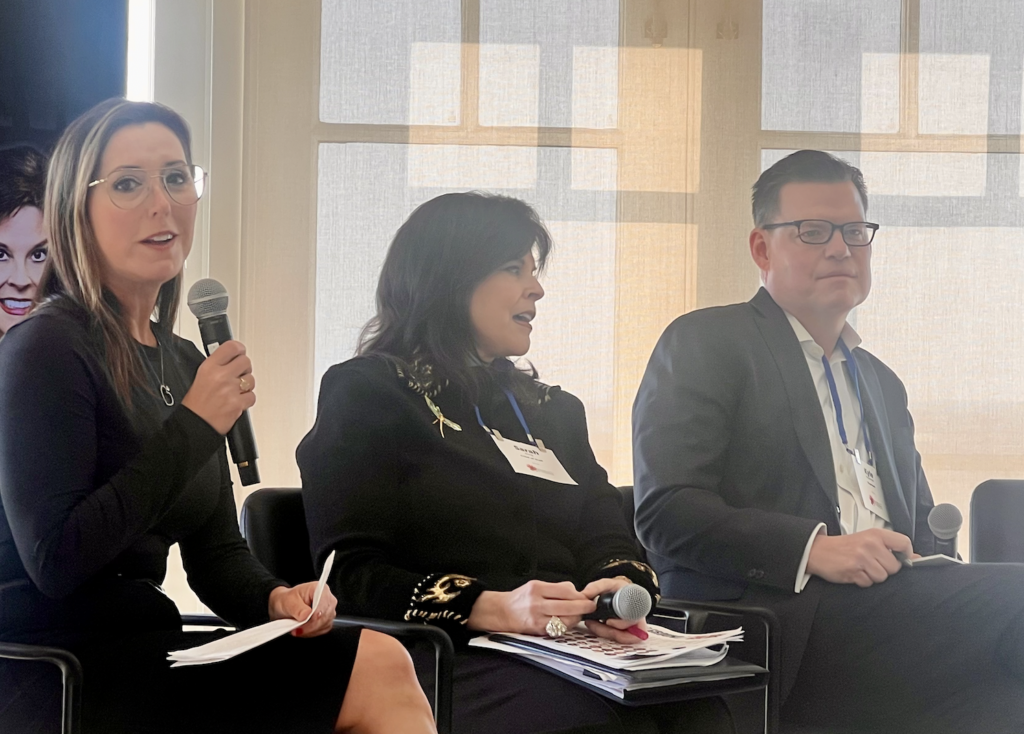
Paxson: You’ve been in many seats in credit unions. What is your experience and what have you observed since you’ve been at NCUA and what’s your advice?
Bang: It’s the same thing I have seen over 43 years. We have a wonderfully cooperative business. When I tell my banker friends that we share ATMs, that we get together and talk about what worked and what didn’t, I don’t know a group of bank CEOs that does that. That takes bravery and it takes cooperation.
The other thing I would mention is that the credit unions that are doing better are those that are putting mission first. But when I say mission, I take it back further to the business model. Credit unions are cooperatives that were formed to get services to the member-owners. In a merger the owners have to be satisfied.
Paxson: I’ve heard the word merger a lot. How do you think about mergers?
Hauptman: NCUA’s sole role is to make sure that people are not losing their field of membership. That’s my only rule. We have to look at those (mergers) from an insurance perspective; is the resulting thing insurable?
With any credit union, somebody put a lot of effort to create that one and whenever they did it there were still lots of financial services options out there, but they said, ‘No we want it, whether it’s hotel employees in D.C. or Broadway actors in New York. When it’s gone it is usually gone forever, because nobody’s ever going to start another Broadway actors credit union in New York.
There are still about 8,000 depository institutions in the United States, 4,000 banks and 4,000 credit unions. Do you know how incredibly different that is from other countries? I lived in Australia for a year and there are four banks in the whole country…Canada has 6. A lot of countries are like that. Imagine if all we had was JPMorgan, Wells Fargo, Citi and BofA. It would be fine for certain types of people, people who have a W2 job, direct deposit, you’re a U.S. citizen, you have a Social Security number–nothing about your life sets off any alarms at FinCEN. That sounds a lot like a federal employee.
We’re better off (with all those financial institutions) than if we just had a handful of banks.
Paxson: You were CEO of am shared branch network. Is merging the new form of cooperation and collaboration?
Bang: It depends. I think there’s a different between cooperation and collaboration. Cooperation is you give me a roll of toilet paper, I give you a roll of toilet paper. Collaboration is the bloody awful part of cooperation. You have to sit around a table with people you are collaborating with and one of them is going to get more than you. In the end, you have to take the long game on collaboration. Whether a CU merges or not, keep the member, the owner first and foremost. If you can be sure your owners are going to be served, that’s great. People have to understand that collaboration is really hard.
Hauptman: My term is over. At some point there will be other board members. when the new board members are announced, they are going to need somebody. If they are DC people, that’s helpful, but they are probably not first language fluent credit union people. My successor needs a Sarah Bang. I encourage you to do that. You don’t have to be on the outside.
Bang: It took a lot of courage for this man to hire me. I know he was getting political pressure.
Paxson: What advice have for CU leaders on weathering what’s next?
Hauptman: Credit unions don’t need anyone here to tell them how to innovate. (The market is) going to change again, but it’s always changed. The core is people have money, they send money, it’s lent. None of that has changed in thousands of years. How we do it has changed. So, stablecoins which are just like using cash except you can actually use it over the Internet, and you send cash immediately with same day settlement and tokenized securities.
Tokenized deposits are just another way of doing it…When we were out in Las Vegas for Money 2020, we were talking about stablecoins a lot. I said you already know what a stablecoin is. This entire town was built on a type of stablecoin. It’s a (poker) chip. It’s a settlement token.
Paxson: For your successor, the next chief of staff, what would you tell your replacement about credit unions?
Bang: It’s the same advice I would give anybody: the answers are in the credit unions. They’ve thought about all of this. Keep it transparent and keep talking to them. My advice to credit unions is please comment on our (Deregulation Project proposals).