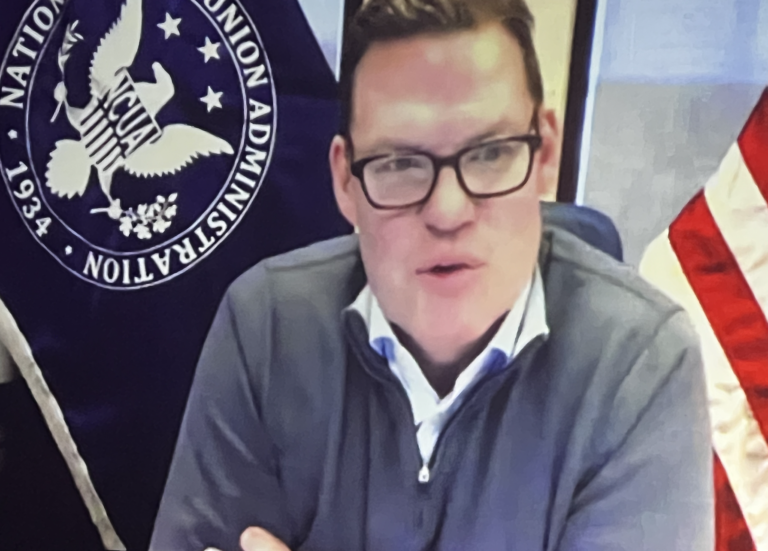
POIPU, Kauai — Credit union board members were given an overview from the chairman of the National Credit Union Administration on his key concerns, regulatory and supervisory developments, artificial intelligence and more.
Speaking to Rochdale’s Volunteer Leadership Institute via a prerecorded video interview conducted by Roberta Rodgers, vice president of compliance with Rochdale, NCUA Chairman Kyle Hauptman told the assembled volunteers and members of management that two areas he has been watching closely are mortgage and auto loans. He noted his view, however, is largely cautionary, as he does not see significant risks in either area of lending, at least in the current economic environment.
Unlike the financial crisis of more than a decade ago, Hauptman said he believes that if there is an economic downturn, credit unions will likely experience more of a “normal” environment. Most people, he said, should still be able to sell their homes and tap home equity if needed because they are not upside down on their mortgages.

He said he does not anticipate a widespread foreclosure trend stemming from any change in the U.S. economic direction.
Hauptman acknowledged some concerns about the state of auto lending nationwide.
“Auto loans are scary nationwide. Delinquencies are higher right now than at any point in the financial crisis,” he said. “If we start to see an unemployment spike, then we could have a situation like 2009-10, where people drop off the keys and say, ‘Have a nice day.’”
Credit Union Health
Overall, Hauptman told the CU volunteers that credit unions remain healthy, with industrywide net worth exceeding 11%.
“Capital is the universal blood donor; it doesn’t need to know what problem it is solving. It’s there to cushion all manner of things,” he said. “We’re seeing deposit growth. Credit unions are still doing what they are supposed to do.”
More broadly, when it comes to industry health, Hauptman pointed to ongoing consolidation but said it mirrors trends in the banking industry and is not driven primarily by economic distress.
What’s Coming in Examinations
Asked by Rodgers what changes credit unions should expect in examinations in 2026, Hauptman cited deregulation efforts the agency has been championing — three rounds have been announced to date — as well as staffing reductions. NCUA is now operating with 23% fewer employees than a year ago following White House-ordered reductions.
He said the agency has undergone a “spring cleaning,” conducting a cost-benefit analysis of everything it does, including existing regulations and enforcement practices. NCUA, he added, has reviewed every step it takes — and requires credit unions to take — down to the “mouse click.”
The result, he said, will be a more streamlined examination process.
“Credit unions are going to see fewer total documents asked for at the outset,” Hauptman said. “That list had gotten bloated over time.”
Many documents collected as part of a checklist were never reviewed, he said, prompting the agency to “strip down” its requests.
No More CAT Scans
“I compare this to going in for a physical. Everybody gets their blood pressure measured and gets weighed, and then some people need an MRI or a CAT scan,” Hauptman said. “We had gotten to a situation where we were asking everybody for an MRI or a CAT scan.”
He added that NCUA removed certain guidance that had been attached to regulations without changing the regulatory text itself.
“We didn’t change any words, just removed the guidance. Because it was attached to rulemaking, it was given extra weight,” he said.
Hauptman said examinations will also continue to occur less frequently, with a sharper focus on areas that pose the greatest risk to the National Credit Union Share Insurance Fund.

While some processes will be streamlined, he cautioned that there are limits to what NCUA can change.
“I want to remind board members that a lot of what we do is outside of our control, like HMDA regulations and CFPB rules. I would love to change those if we could,” he said.
NCUA & AI
Asked where boards should focus when it comes to artificial intelligence, Hauptman reiterated his view that credit unions must continue to innovate. He noted that both credit unions and the agency itself are exploring how to deploy AI effectively.
Regardless of the technology, he said, existing rules still apply.
“We don’t have an AI regulation coming out,” Hauptman said. “Everything still applies.”
All lending regulations, for example, must be followed whether decisions are made by humans or AI-driven algorithms.
“If something is wrong or illegal in what your chatbot said, you can’t say you’re using a new chatbot and still working through it,” he said. “It’s still on you. If it’s illegal or abusive, there is no AI exemption.”
Credit Unions & Stablecoins
As The CU Daily has reported, NCUA is required under the GENIUS Act to undertake rulemaking related to digital assets and stablecoins. The larger question, Hauptman said, is what comes next.
Because of their structure, credit unions face specific issues related to which entities can issue stablecoins, but Hauptman said he expects those questions to be resolved. He added that credit union rules will align with those for banks.
Ultimately, he said, stablecoins are “just another way to send money,” but they also pose risks to certain credit union revenue streams — particularly debit interchange.
In the past, Hauptman said, vendors have accepted $98 on a $100 sale as the cost of offering card payments. With stablecoins, however, merchants can receive the full $100 and may offer incentives such as discounts or loyalty points.
Hauptman said he expects most credit unions will eventually issue their own coins and that “eventually everything will be tokenized.”
“The most important thing with a stablecoin is ‘stable,’” he said. “The whole thing crumbles if it’s not.”