
WASHINGTON–Has credit union executive compensation gotten out of hand? What about payout CEOs are getting in mergers? What about the ‘We Love Working Here’ employee pay discount? What advice does NCUA’s chairman and chief of staff have for credit unions? What is the business case for stablecoins? All those questions and more were part of some frank and freewheeling discussion during the Underground conference here.

Hosted by Mitchell Stankovic each year on the morning America’s Credit Unions officially kicks off its Governmental Affairs Conference, this year’s Underground meeting was themed “Breakthrough CULTure,” and featured more than one-dozen different panel discussions and remarks.
Below, the CU Daily kicks off its coverage of what was discussed and debated. You can also find coverage of parting thoughts by NCUA’s chairman and chief of staff here, and coverage of the debate around the business case for Stablecoins here. Additional coverage will follow throughout the week.
What’s Happening With Exec Compensation? Too High? Too Low? And What About the Payouts Some CEOs are Taking in Mergers?
WASHINGTON—Has credit union CEO compensation gotten out of hand? Is it just right? Or is it still too low? The answer is all three, according to one panel here, where it was stressed that compensation brings with it some other questions around intangibles unique to CUs.
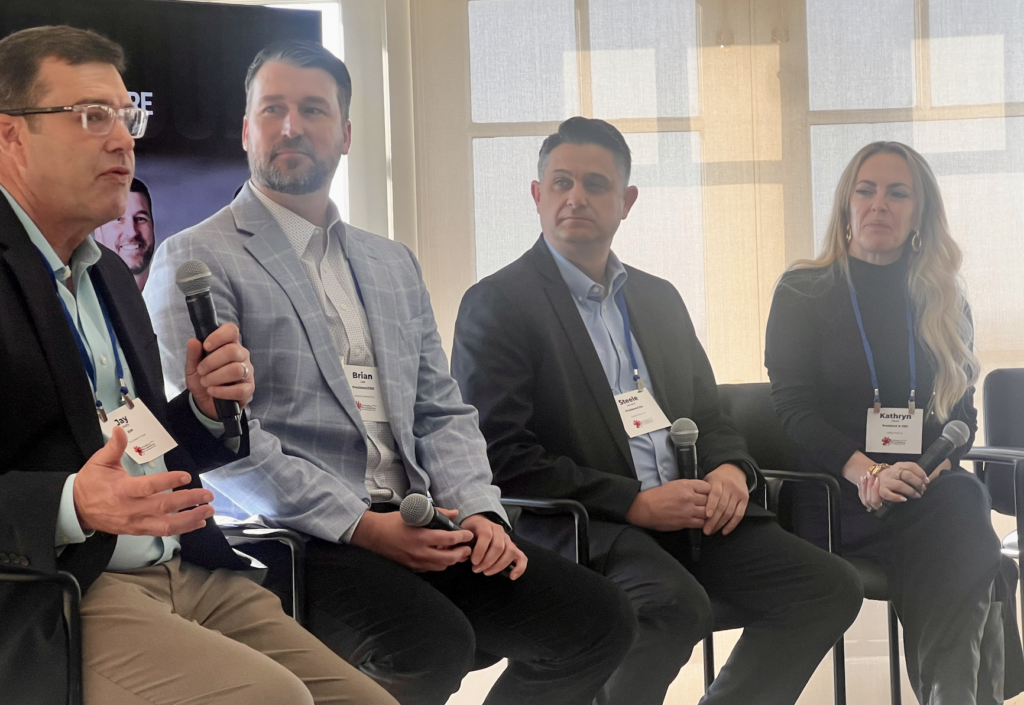
Addressing the question of executive compensation during Mitchell Stankovic’s Underground conference were Jay Petty, EVP with the Sheeter Group; Brian Lee, president and CEO of Arizona Central CU; Kathryn Davis, president/CEO of Valley First CU, and Steele Hendrix, president and CEO of Boulder Dam Credit Union.
Petty, who served as moderator, noted CU executive compensation has risen significantly, which he said is a “healthy sign” for credit unions, as it indicates growth.
“These have become very big jobs,” he said. “The important thing is that we’re prepared for it and every credit union has to have their own way of addressing this.”
Davis: I don’t think we should be ashamed. These are sophisticated businesses and that requires us to pay. But I think the challenge is, are you living your mission and are you serving? I have 81,000 people relying on me and my team to do the right thing and you need to pay people in order to bring that skill set to the table. I don’t think we should shy away from it. I don’t think we should feel shame. But I do think we better be showing what we’re doing for every single member and really show that member value. Are the founding fathers of your credit union proud of you? Would they still believe that you’re living those values? think that’s where some of the rub could be.
Hendrix: Sometimes, we have to convince our board of directors. We have to convince our members. We have to make sure our volunteers and the leaders in those seats have the knowledge and understanding of what this particular career requirements are. That’s difficult to do.
We’re a small, tight-knit community of about 15,000 people just outside of Las Vegas and we did have a member who pulled the 990 and posted (executive compensation) on a local social media group. I think our response to that is what becomes critical. We went through this without any scars, but I think we have to be prepared to answer those questions so can we justify these things. It’s easy to justify if we have the numbers to back it, if we have the communication about to back it, and the board of directors to support it
Lee: Sometimes we give the old ‘we-love-the-industry’ discount. You have to pay your employees. I have really pushed that we don’t pay at a discount. I think that works for executives, as well. We need to keep the best executives we can in this industry and if we have folks that could go somewhere else and get much more money, we need to make sure that we’re holding on to them.
I came from another credit union that was a little smaller than my current credit union. It’s funny. When I left a couple of my board members kind of asked the question of what we could have done to keep you here. I had been in that role for about five years, and they were just getting to my executive compensation that they promised when I got the role.
When I came to this new credit union, one, they paid me more than I asked for, which was awesome, and two, within six months I had my new executive compensation plan that they had promised. It showed a lot more not just the dollar amount, but the willingness to say ‘We want you here. We’re excited that you’re here and we want you to be a part of the team forever.’
Petty: What is your advice for boards?
Davis: Boards can put their own lens on this from their own careers, especially if they are long-time board members. I think the comparables can be eye opening for boards. It took my board 18 months to get around to creating a plan. I think the education piece is huge. You want your board members to be comfortable, and I would highly recommend hiring someone to help you.
Petty: What are other softer items, the nonfinancials, that you value?
Davis: It’s the work I get to do. It’s not rubber stamping the work. I feel like we’ve gone through this whole transformation at my credit union; this really deep dive on mission, and they just let me run with it. That’s really, really important to me.
Lee: It’s the flexibility to get the job done how you see fit. If we can have that understanding of the overall goals, and trust that ‘we trust you to do it,’ that makes my job enjoyable.
Narcissism & Groupthink in Credit Unions? Yes, Say Panelists. Here’s Their Advice
WASHINGTON–A diverse group of credit union leaders here offered some interesting perspectives around the issues of “narcissism” and “groupthink in credit unions,” touching on everything from how minorities are viewed within the movement, what it takes to tackle certain” mythologies within CUs, and even the thornier topic of the kinds of payouts going to some CEOs in mergers.
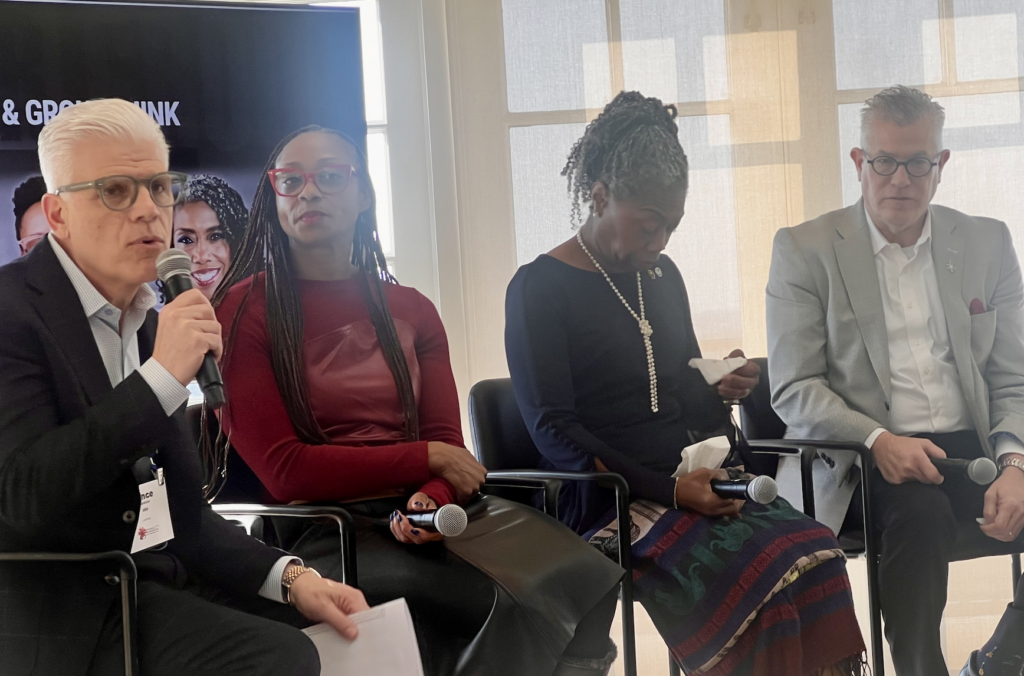
Taking on those issues during Mitchell Stankovic’s Underground meeting were Steven Stapp, CEO of Unitus Community CU; Emma Hayes, chief learning and development officer at SECU (North Carolina); Renee Sattiewhite, CEO of the African American Credit Union Coalition; and Vince Passione, CEO of Lenkey. Passione acted as moderator.
Here’s some of what was discussed:
Passione: One could make the argument the AACUC exists because the credit union movement wasn’t fully living its mission. How much has changed and where are we still talking to ourselves and not listening?
Sattiewhite: One person told me they thought this question was distasteful. Here we are. I don’t know that it’s about to change. It is what it is. This climate is scary and so we are where we are and that’s the answer: we are where we are.
Hayes: When you find yourself in rooms and in audiences and at tables where you’re often. instead of participating in it, you really need to establish something that signifies that you exist. I think that’s what the AACUC did. It was a way to amplify the voice of those who were in the industry and in prominent positions in the industry because representation doesn’t matter. It makes a difference when people can see themselves in something that you’re asking them to buy into.
The history of this great nation tells us that it wasn’t really built for everyone when it was built. So, as we have evolved and grown and matured as a nation, we’ve done that as an industry and part of that was finding organizations that created community like the African American Credit Union Coalition and, for this industry, making it such that you cannot be ignored.
Passione: You walked into SECU and found 85 years of ingrained culture. SECU built its entire identity on the branch and relationships with members. How do you address the mythology without breaking the mission?
Hayes: Having someone from the outside come into the C-Suite hadn’t happened before (at SECU), so that was a change for the organization. But the organization was poised and ready for that change. They have been on this journey of evolving for 85 years and 85 years is a long time to build a history and to build a culture that is rich in heritage.
If we think about a myth, a myth is simply a story that’s told over and over and over again that really helps us understand how we got here, what we value, who we are. So, when we think about the mythology and how do we break that collection of stories we don’t want to break? Our members, our employees, they’re endeared to that story. If you have a history that’s never told, how do you remember, how do you engage people to get them excited about who you are and where you’re going?
I think as we think about where we are right now as a nation and how our histories are potentially being rewritten, I think there’s never been a more important time to tell our story, to keep our story at the forefront to be a constant reminder for our members. They’re why we exist.
We do have 276 branches across North Carolina and 1,200 ATMs. With that we’ve built these relationships. We know our members come into the branch because of the relationship. But we also have a million members who are just digital members.
Passione: Chip Filson has talked about ‘cooperative cannibalism’ triggered by CEOs looking to get millions while members get nothing in mergers. Is this not CEO narcissism in its most brutal form?
Stapp: I’ve had about 14 different mergers throughout my career and really there’s been some credit unions that needed to merge, where the board had not set up any type of retirement plan for their CEO. There was a necessity for compensation to be to be made there.
Each individual merger has concepts and ideas and that really need to be fully disclosed to the members that are voting on that merger. It needs to be very, very crystal clear. I think executives all need to be paid, but there is a range of reasonableness, and we are starting to see some examples that are outside the range of reasonableness.
I’m going to go back to the credit union philosophy that we all share the same last name, we are all family members, and when our family members kind of go off the rails it impacts the whole entire family. I think we really need to be careful in our movement, especially now when individual compensation exceeds all the money that all of our foundations receive in a year.
A merger does right have to consider the benefits to the members and the benefits to the employees. If you can answer those two clearly, that can move the merger forward. If you are leading with what the exiting CEIO is getting, that’s s not the reason for the merger.