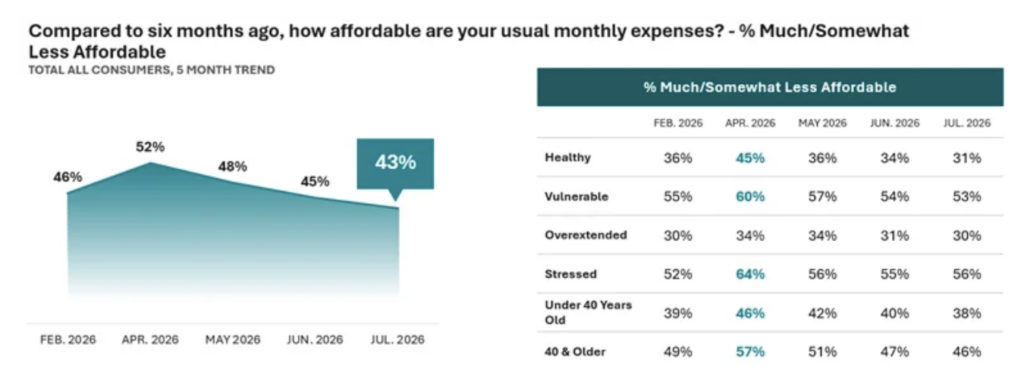
TROY, Mich. — In the 30 days prior to a new poll taken by J.D. Power, 29% of consumers reported taking at least one action the company characterized as indicative of financial distress, such as selling possessions to pay bills, missing rent, mortgage or utility payments, or skipping or rationing prescription medications because of cost.
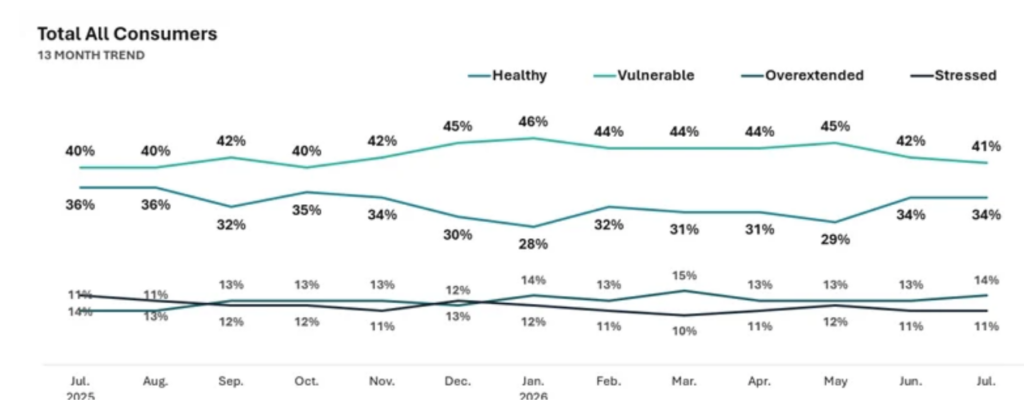
Moreover, housing costs are emerging as a growing source of financial stress for U.S. consumers even as concerns about gasoline prices decline and the share of Americans considered financially healthy remains at its highest level in eight months, J.D. Power stated in its new August Financial Health Report.
J.D. Power said 34% of consumers were classified as financially healthy in July, unchanged for the second consecutive month and the highest level since November 2025. The remaining 66% were classified as financially vulnerable, overextended or stressed.
The K-Shaped Economy
The findings illustrate what J.D. Power and others have described as a K-shaped economy in which financial resilience varies significantly among different groups of consumers.
Overall, 77% of consumers said they had changed their day-to-day spending because of rising costs, unchanged from June.
The most common response was cutting back on dining out, entertainment and other lifestyle expenses, cited by 41% of consumers. Another 32% said they switched to less expensive brands or stores, while 28% delayed nonessential or discretionary purchases.
More Severe Measures
More severe measures were also widespread. J.D. Power found 27% of consumers had cut grocery spending or skipped meals, while 18% borrowed money from family or friends to cover expenses. Fourteen percent sold personal belongings to pay bills, 9% missed rent, mortgage or utility payments and 9% skipped a prescription or rationed medication because of cost.
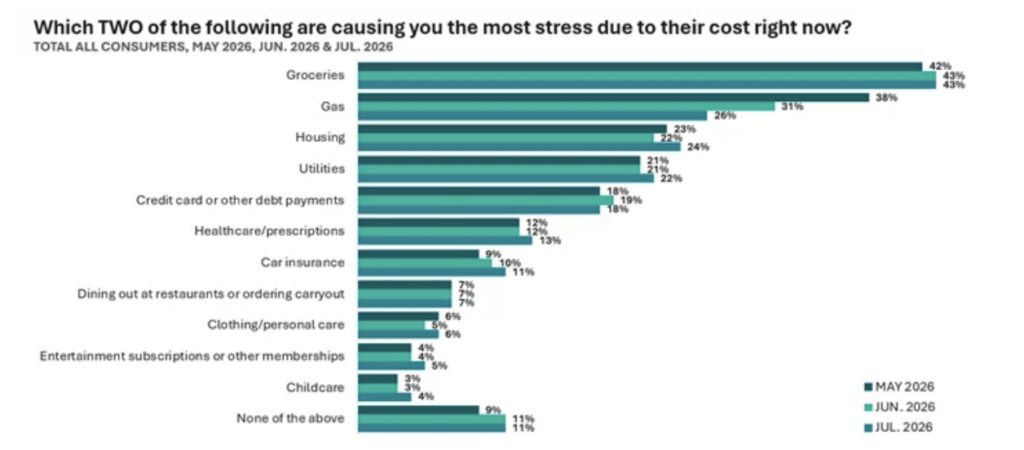
Groceries remained the largest source of financial stress, cited by 43% of consumers, unchanged from June.
However, concerns about gasoline prices declined sharply. Twenty-six percent cited gas prices as a major source of financial stress, down 5 percentage points from June. Housing costs were close behind at 24%, putting them near becoming the second-largest source of financial stress.
Some Improvements Found
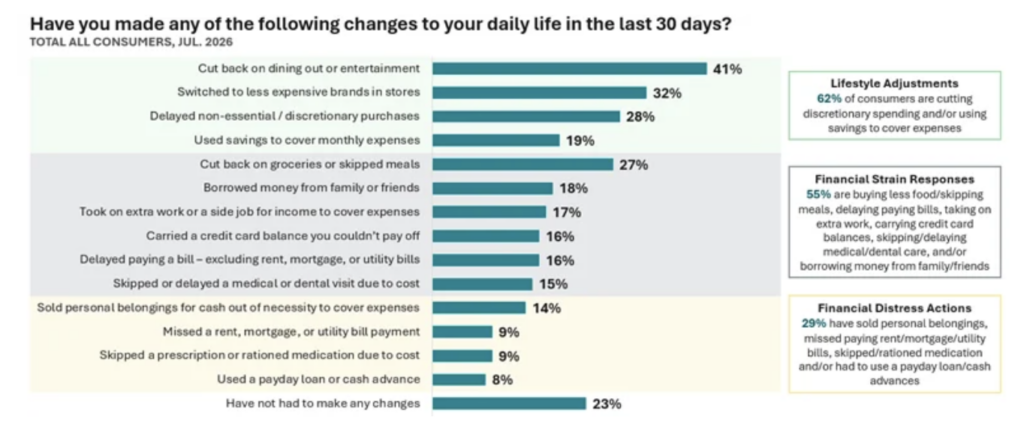
J.D. Power also found some improvement in consumers’ perceptions of affordability. Forty-three percent said their monthly expenses felt less affordable than six months earlier, down from 45% in June and continuing a decline from a peak in April.
Financially stressed and vulnerable consumers were considerably more likely to report worsening affordability, at 56% and 53%, respectively.
Opportunity for FIs
J.D. Power said the results present an opportunity for banks and other financial institutions to help consumers achieve smaller, tangible improvements in their finances when larger moves, such as paying off major debts, may be unrealistic.
The company said banks and card issuers receive their highest customer satisfaction and brand advocacy scores when they help consumers address credit and borrowing needs and improve their credit scores.
The J.D. Power Banking and Payments Intelligence Report is based on responses from 4,000 U.S. consumers surveyed in July. The report was authored by Jennifer White, managing director of financial services intelligence at J.D. Power.