SAN DIEGO—There are three areas where most credit unions are seeking to improve, and three questions to be asking when it comes to creating efficiencies, according to one person who has partnered with CUs on not just those issues, but on better leveraging their data.
Anne Legg, who has worked with more than 600 leaders in credit unions, leads THRIVE Strategic Services, which specializes in helping CUs to simplify their data transformation, identify new revenue sources, lessen member friction, and increase talent productivity, has shared her perspective in some of the lessons she has learned as part of the CU Daily’s Profitability Imperative series.
Below, she offers her insights on the challenges facing credit unions across the enterprise, including where credit unions can get started as they seek to improve profitability and growth.
The CU Daily: First, some background. Tell us more about the work you are doing with credit unions.
Legg: My work with credit unions centers on helping them unlock and activate the data they already have to improve member outcomes, operational efficiency, and long-term relevance.
That work typically spans three connected areas:
- Data readiness and literacy – helping leaders and teams understand what data they have, how it connects, and how to use it confidently in daily decisions.
- Member experience and friction reduction – identifying where members struggle, stall, or disengage, and using data to remove that friction.
- Measurement and impact – helping credit unions move beyond anecdotes to clearly measure how their work improves members’ financial lives and the communities they serve.
Whether through education, strategic accelerators, or impact measurement frameworks, the goal is always the same: to move data from overhead to advantage.

The CU Daily: Where do you find credit unions most want to improve?
Legg: Most credit unions want to improve in three very practical areas:
- Efficiency: Doing more with the same or fewer resources
- Growth: Deeper relationships, not just more accounts
- Clarity: Knowing which initiatives truly move the needle
There’s a strong desire to modernize, reduce friction, and prepare for AI — but also a sense of fatigue. Leaders want progress that feels achievable, not overwhelming.
The CU Daily: Where do you find they have the most opportunity to improve but are often unaware of it?
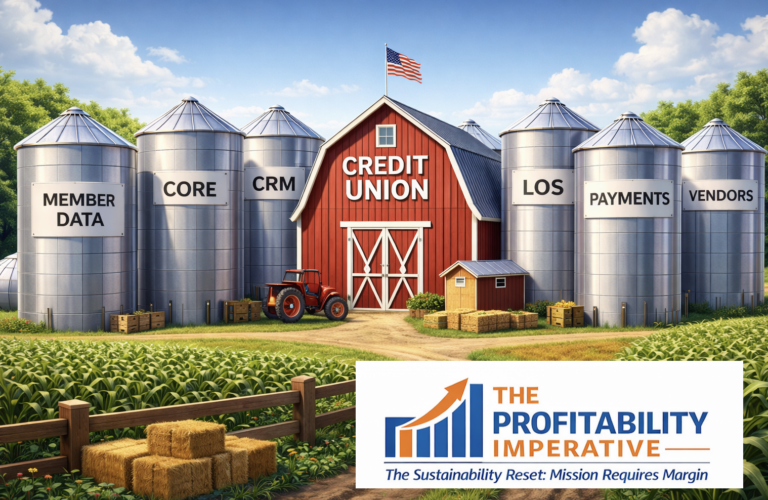
Legg: The biggest overlooked opportunity is existing behavioral data.
Credit unions are sitting on rich insights in payments, transactions, service interactions, and channel usage — but that data is often siloed, under-analyzed, or used only for reporting instead of decision-making.
Many don’t realize that small changes informed by this data — especially around member friction — can drive outsized results without major technology investments.
The CU Daily: Can you share examples of changes credit unions have made that translated directly to the bottom line?
Legg: Yes — and what’s interesting is how small many of these changes were that have very real impact:
- Reducing repeat service calls by fixing a single root cause uncovered in interaction data
- Improving loan conversion by adjusting timing and messaging based on member cash-flow patterns
- Lowering charge-offs by identifying early stress signals and intervening sooner
- Shifting payment behavior by making it easier for members to stay within the credit union ecosystem
None of this required massive transformation. They required attention, alignment, and measurement.
The CU Daily: Is there an expense that can often be eliminated but is overlooked?
Legg: Yes: the cost of friction. Friction shows up as:
- Repeated calls and follow-ups
- Manual rework
- Exception handling
- Member confusion
- Employee burnout
Because friction is spread across departments, it rarely shows up as a single line item — but collectively, it’s expensive. When credit unions measure and reduce friction, they almost always uncover cost savings hiding in plain sight.
The CU Daily: Is there an income opportunity that is often overlooked?
Legg: Absolutely — deepening existing relationships. Many credit unions focus heavily on acquisition while under-leveraging the members they already serve. When data is used to understand life events, financial stress, or changing behaviors, credit unions can:
- Offer more relevant products
- Improve wallet share
- Increase loyalty and retention
The revenue opportunity is not “selling more,” but serving better.
The CU Daily: How can a credit union understand whether it’s as efficient as it could be and best serving members?
Legg: Start with three questions:
- Where do members struggle most today?
- Where do employees spend the most time fixing problems?
- Which activities repeat without improving outcomes?
Then connect operational metrics to member experience metrics. Efficiency without member benefit is just cost-cutting. True efficiency improves both sides at once.
The CU Daily: Any other lessons learned or insights you’d share?
Legg: Two stand out:
- Progress beats perfection. Waiting for perfect data or perfect alignment delays impact.
- Measurement changes behavior. When teams can see outcomes, decision-making improves naturally.
Most credit unions already do extraordinary work. The opportunity is to make that work visible, measurable, and scalable.
The CU Daily: Finally, away from spreadsheets and Excel, where are the cultural deficiencies — and how can credit unions build a culture for sustainability and growth?
Legg: The most common cultural gap is permission — permission to experiment, to question long-held processes, and to use data without fear of being “wrong.”
Sustainable cultures are built by:
- Making learning continuous, not episodic
- Encouraging cross-functional collaboration
- Rewarding curiosity and progress, not just outcomes
When people feel safe to explore and improve, growth follows.