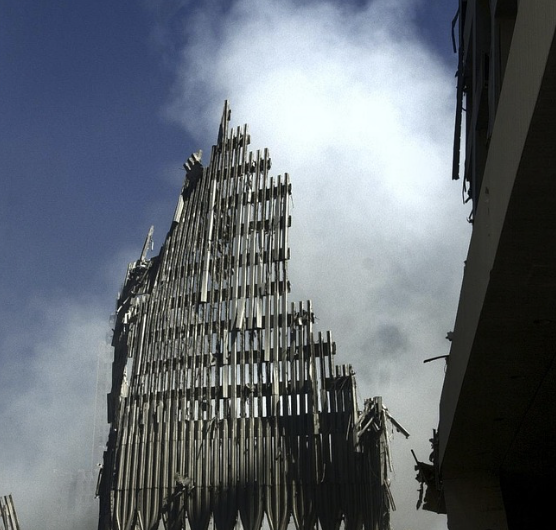
NEW YORK –In a memory that remains fresh for many, 24 years ago today the terrorist attacks of Sept. 11 destroyed or disrupted operations at four credit unions in lower Manhattan that had offices in or near the World Trade Center, disrupted another CU inside the Pentagon, and would lead to an investigation involving stolen funds from one CU’s ATMs that would take years.
While 2,977 victims were killed on that tragic day, there were none affiliated with any of the credit unions, which evacuated their respective offices in time to spare lives.
All credit unions that were affected either continued to operate from other locations or were back in operation within 48 hours.
Two CUs in World Trade Center

Two credit unions had offices in the World Trade Center’s buildings, including XCEL FCU, which was located on the 39th floor of the North Tower, while FAA Eastern Region FCU had a branch inside tower 6 of the World Trade Center. That branch was also completely destroyed.
In Northern Virginia, PenFed FCU operated a branch inside the Pentagon. It was not damaged.
XCEL, which had been chartered to serve the Port Authority of New York and New Jersey, eventually relocated its offices across the Hudson River to Bloomfield, N.J. , where the $190-million credit union continues to operate today. FAA Eastern Region Federal Credit Union changed its name to Aspire Federal Credit Union in 2009.
The Kindness of a Stranger
In a blog post from 2021, Bill Mellin, the president and CEO of the New York Credit Union Association, shared that on the morning of 9/11 several members of the association’s staff had traveled to New York City for a training event being held at Municipal Credit Union’s corporate office located at 22 Cortlandt Street, which is just a short walk to the World Trade Center site.
“Once the attack occurred, cell service was at best limited and sporadic. We were able to make contact a few times. We knew that the office was evacuated and that they were on foot moving as quickly as possible away from the site,” Mellin shared. “Initially all our staff was together, but in all the chaos one member got separated and could not be found. Later on we learned that she had fallen in the street. When she looked up all that she could see was the feet of hundreds of people running away. If it wasn’t for the kindness of one man, who couldn’t speak English, who reached down and guided her, and helped her resume her run, we don’t know what would have happened.”

ATMs Emptied Out
While Municipal Credit Union’s facilities in lower Manhattan escaped damage, and none of its employees were hurt, the same couldn’t be said for its bottom line.
In the weeks following the September 11 attacks, as many as 4,000 members of Municipal CU fraudulently withdrew $15 million by exploiting an ATM computer system failure
The attacks had damaged the credit union’s headquarters and its computer link to the ATM network, making it difficult to verify account balances, and Municipal CU opted to leave its ATM network running to avoid causing further hardship for its members. The policy allowed anyone to withdraw cash without the system properly checking if they had sufficient funds.
During a following investigation, then Manhattan District Attorney Robert M. Morgenthau described the scheme as a “free ride,” where people started with small withdrawals and escalated to taking the maximum amount they could.
Many of the people who exploited the glitch were city, state, or federal government employees who were members of the credit union, including one nurse who made 54 withdrawals, leaving her with a negative balance of over $18,000.
The computer issue was fixed in November 2001, and between 2002 and 2003 more than 100 people were charged with grand larceny for stealing at least $5,000 each. By June 2003, 118 people had been charged.
Arrests Made
Before charges were filed, the credit union gave members who had overdrawn their accounts a chance to take out loans to repay the money. Many who refused or ignored notices were subsequently arrested.
By June 2003, Municipal CU reported recovering more than $10 million of the $15 million stolen.
Time For Reflection
In remarks offered on the 15th anniversary of the attacks, then NCUA Board Chairman Rick Metsger said, “It’s a time for reflection on our values and our national identity, a day to commemorate those who sacrificed so much and be thankful for what we have and what we share. As we remember those we lost, we will redouble our efforts to strengthen the ties that bind us together. The idea of America, a democracy that embraces many races, cultures, and beliefs, has, if anything, taken on greater importance, and the credit union movement has always embodied that diversity that makes our nation stronger.”