WASHINGTON—America’s Credit Unions is urging the Treasury Department to establish a strong federal framework for stablecoin issuers, while it has joined with the Defense Credit Union Council and a larger coalition in opposing a Federal Communications Commission proposal that would impose new requirements on offshore call centers.
America’s Credit Unions submitted comments to the Treasury Department as the agency works to implement provisions of the GENIUS Act and seeks feedback on how to determine whether state-level regulatory frameworks for payment stablecoins are substantially similar to federal requirements.

In its letter, America’s Credit Unions said Treasury should establish a strong federal regulatory baseline for permitted payment stablecoin issuers (PPSIs) and prevent what it described as “unsafe or poorly calibrated” state regulatory regimes from being deemed equivalent to federal standards.
‘Appropriate Enforcement’
“Setting a federal regulatory baseline promotes enforcement, supervision, and governance around stablecoin issuance and other activities,” America’s Credit Unions wrote in its letter, adding that such an approach would help foster a healthy and competitive ecosystem for credit unions participating in the stablecoin market.
The organization also cautioned Treasury against relying too heavily on standards developed by the Office of the Comptroller of the Currency when determining the federal framework.
“Largely basing the Federal regulatory framework on the Office of the Comptroller of the Currency (OCC) requirements and interpretations could establish a regulatory floor that evolves to become less stringent than rules applicable to federally regulated credit unions which are not national banks or federal savings associations, resulting in a competitive disadvantage for those entities,” the letter stated.
The comments come as Treasury develops regulations under the GENIUS Act, legislation designed to establish a federal framework governing payment stablecoins and their issuers.
Letter to Senate Finance Committee Outlines Priorities
Separately, ahead of Treasury Secretary Scott Bessent’s appearance before the Senate Finance Committee on the Treasury Department’s fiscal 2027 budget request, America’s Credit Unions outlined in a letter several legislative and funding priorities for lawmakers.
Among its recommendations, the trade group urged Congress to continue protecting the federal tax status of credit unions and called for support of several programs that serve low-income and underserved communities.
The Specifics
Specifically, America’s Credit Unions:
- Urged Congress to ensure the Trump Account program preserves consumers’ ability to hold accounts at the financial institution of their choice, including credit unions
- Called for full fiscal 2027 funding of $324 million for the Treasury Department’s Community Development Financial Institutions Fund
- Supported $4 million in fiscal 2027 funding for the National Credit Union Administration’s Community Development Revolving Loan Fund.
The organization said the CDFI Fund enables certified credit unions to leverage federal dollars to expand financial services, lending and economic development efforts in underserved communities.
Additional Opposition Expressed
America’s Credit Unions also reiterated its opposition to proposed changes by the General Services Administration to financial assistance certifications within the System for Award Management, arguing the revisions could negatively affect communities served by CDFI credit unions and organizations benefiting from Community Development Revolving Loan Fund grants.
Opposition to FCC Offshore Call Center Proposal
In a separate filing, America’s Credit Unions and the Defense CU Council joined other financial services and business organizations in opposing an FCC proposal that would impose new requirements on offshore call centers.
According to the coalition letter, the proposal would require disclosures at the beginning of certain calls, establish limits on the percentage of customer service calls that may originate from or be answered at foreign call centers, and provide consumers with the right to have calls transferred to U.S.-based representatives.
The coalition argued the proposal would do little to combat fraud while creating new burdens for legitimate businesses.
“These requirements will not stop criminal operations’ use of illegal call spoofing to perpetrate fraud; instead, they would regulate ordinary customer service communications of legitimate businesses, including routine account-servicing and fraud-response interactions involving our members,” the letter stated.
Challenge to Legal Authority
The organizations also challenged the FCC’s legal authority to implement the proposal.
According to the filing, the Telephone Consumer Protection Act does not authorize the FCC to impose restrictions on businesses that utilize foreign call centers. The letter further argued that Section 251(e) of the Communications Act does not provide authority for the FCC to regulate calls placed from offshore call centers operated by non-telecommunications companies.
The coalition additionally cited the U.S. Supreme Court’s “major questions” doctrine, arguing it reinforces the conclusion that the FCC lacks authority to impose broad restrictions on offshore call center operations.
Simpson Visits With Hill Offices
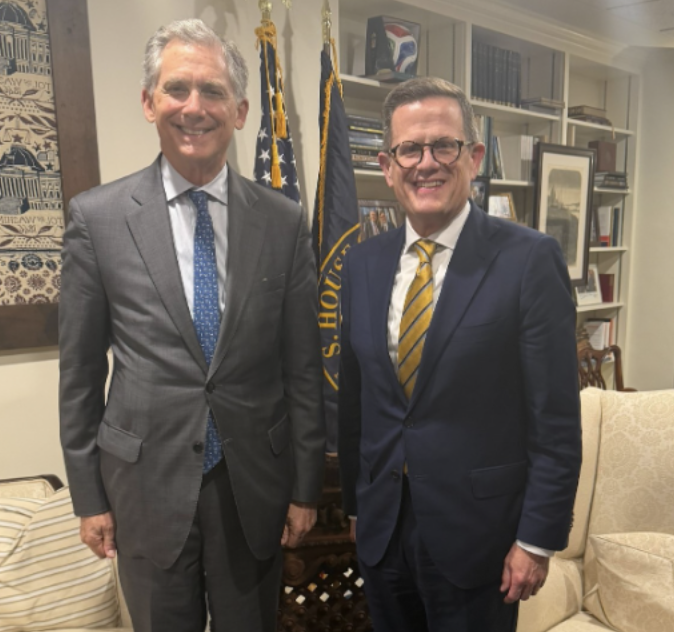
Separately, America’s Credit Unions President and CEO Scott Simpson visited with several members of Congress ahead of expected budget deliberations in both chambers.
According to the trade group, Simpson met with:
- Sen. Angela Alsobrooks (D-MD)
- House Financial Services Committee Chairman French Hill (R-AR)
- House Ways and Means Committee Chairman Jason Smith, R-Mo., with several meetings also scheduled for tomorrow. I am providing photos from Simpson’s meeting with Rep. French Hill and Rep. Jason Smith at the end of this email.
Potential New Bills
According to America’s Credit Unions, the meeting with Hill took place as discussions for potential additional budget reconciliation bills are ongoing. Simpson discussed how America’s Credit Unions can work with the Financial Services Committee to provide regulatory relief and modernization to help credit unions better serve their members, the trade group said.
“Chairman Hill specifically cited the challenges facing small credit unions and the need to provide them with regulatory relief,” ACU Said.
Meanwhile, America’s Credit Unions said Simpson’s meeting with Chairman Smith discussed the importance of the credit union tax status to credit unions serving communities in Missouri, and “how credit unions are excited for Trump Accounts as a way to help members build life changing wealth for their children. Chairman Smith also highlighted how he served on a credit union board in college.”
ACU said Chief Advocacy Officer Kathleen Coulombe also shared the group’s data privacy white paper with Congressional offices.