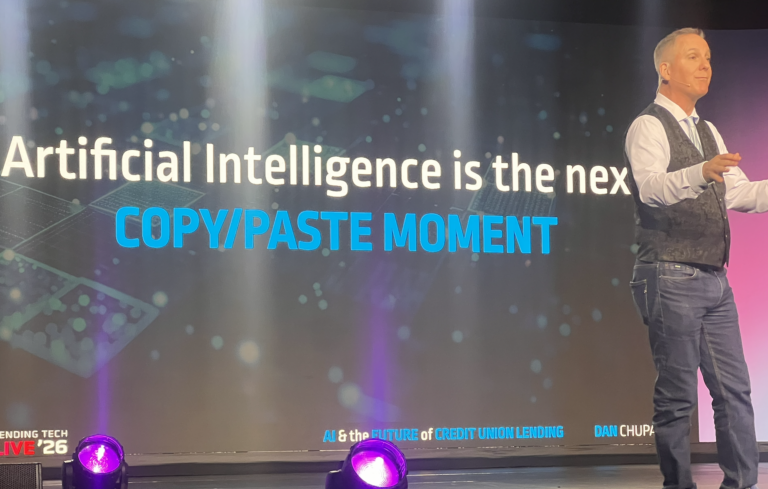
PALM DESERT, Calif. — Artificial intelligence is poised to fundamentally reshape how people work, communicate and make decisions—even if it no better than a “B-minus student”–but it will never replace human abilities to solve problems, make judgments and imagine new possibilities, according to AI education and research expert Dan Chuparkoff, who urged CU leaders to “challenge” the AI they are using.
Speaking to Origence’s Lending Tech Live conference, Chuparkoff told credit union lending leaders that AI is already becoming so integrated into daily work that many people will soon find it difficult to function without it—but it will not be replacing them.
“There’s an interesting threshold you cross as you start using AI every single day to help you do the things that you need to do to do your work,” Chuparkoff said. “You’re going to start to realize that you can’t do it without AI helping you anymore.”
Chuparkoff said AI can help organizations manage information, improve communication, speed up processes and identify problems more quickly than humans alone.
“AI is changing everything about everything,” he said.
A Challenge
He challenged attendees to make a list of everything they do over the next month and revisit it in 18 months.
“You’re going to find that every single thing on that sheet of paper is different,” he said. “And if it’s not different, you should take another look at that list.”
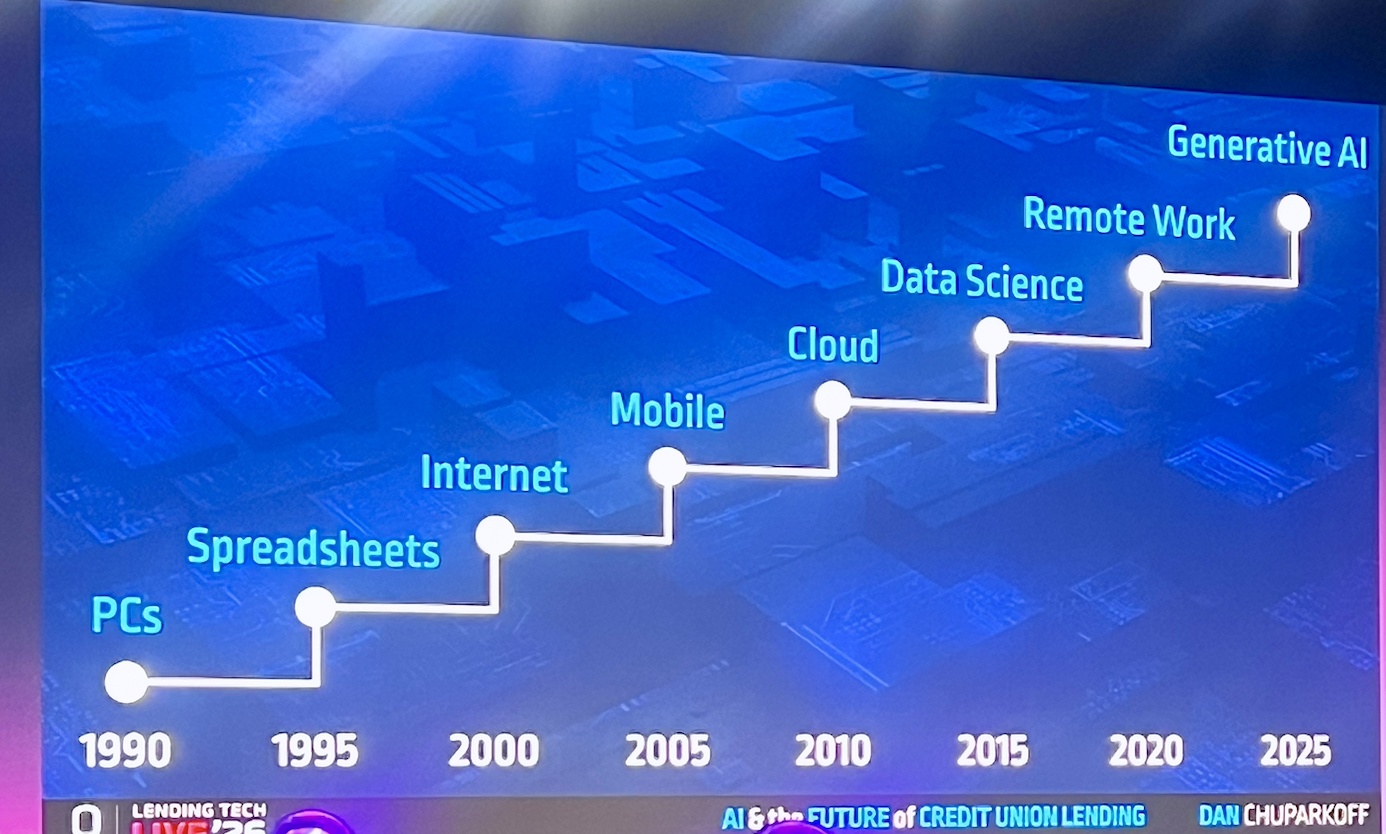
Chuparkoff said AI represents just the latest in a long line of technological transformations that have altered the workplace.
“I help people reinvent the way they do stuff with the power of technology,” he said. “Right now the technology that we care about and talk about a lot is AI, but before we know it that’s going to be robots. After that it’s going to be quantum computing.”
Chuparkoff said he has studied technological transformation for 35 years, tracing his own journey from growing up in a trailer park in Tampa, Florida, to leading teams at Google and overseeing products used by billions of customers.
“You can’t unsee technology improvement,” he said.
Understanding AI’s Limitations
Chuparkoff said one of the biggest challenges facing organizations today is that many people are discussing AI without fully understanding what it is, how it works and what it cannot do.
“The problem now is everybody’s talking about AI and the world but most people don’t really understand what it is and how it works, and they definitely don’t understand what it doesn’t do,” he said.
He compared current experimentation with AI to hitting a piñata without knowing what is inside.
“Nobody really knows what’s in there, so they’re just sort of banging at it with the stick,” Chuparkoff said. “It’s your job as leaders of your organization and the shepherds of your members’ money to crack open the piñata and figure out what’s in there without creating unnecessary risk.”
Three Topics to Understand
Chuparkoff outlined three topics he said leaders should understand:
- Why AI makes mistakes.
- How AI can be used in financial services and lending.
- Three things AI can never do.
He explained that generative AI systems are fundamentally prediction engines.
“GPT, or Generative Pre-trained Transformers, is just about predicting ‘here is the most likely next thing to happen,’” he said.
That predictive nature explains why AI sometimes generates inaccurate information, often referred to as hallucinations.
“AI is wrong sometimes because it gives you low-confidence answers,” Chuparkoff said.
A Challenge
He encouraged users to routinely challenge AI-generated responses by asking how confident the system is, where information originated and how many assumptions were made in reaching a conclusion.
“You want to understand the confidence of the AI you’re using by asking how sure it is every time,” he said.
Chuparkoff argued that concerns about hallucinations are often misunderstood.
“Some people are saying I can’t use AI yet because of the hallucinations, or I can’t use AI until I can depend on it,” he said. “But that’s not even a problem people are working on right now. That’s just a symptom of any probability-based machine.”
OK, When Will I Die?
He compared AI’s predictive capabilities to the actuarial models used by life insurance companies.
“AI is doing the same exact thing that life insurance actuaries are doing,” he said. “They’re looking at the tables in the past and trying to decide what the most likely outcome might be.”
He also warned that AI learns from internet content, which can include misinformation.
“AI just learns from the internet and unfortunately the internet is crazy,” Chuparkoff said. “It’s filled with experts, but also trolls and jokes and misinformation, and the experts are outnumbered.”
AI as a ‘B-Minus Student’
Rather than viewing AI as an all-knowing expert, Chuparkoff said users should think of it as a capable but imperfect assistant.
“You have all spent 20 years developing expertise in your fields,” he said. “An AI assistant is a B-minus student in everything else.”
That means professionals can use AI to augment skills outside their primary areas of expertise, he said.
“You’re a B-minus salesperson, a B-minus musician, a B-minus researcher and a B-minus communicator,” Chuparkoff said. “AI builds out the rest of your skillsets to help you build out the things you’re not great at.”
He cautioned attendees against viewing AI as an autonomous decision-maker.
Not a ‘Co-Pilot’
“AI is an assistant, not a co-pilot,” he said. “You are still responsible and in charge of this work.”
Chuparkoff criticized the popular “co-pilot” label used by some technology companies, arguing it incorrectly implies shared responsibility.
“You are imagining a co-pilot flying the plane when you are not,” he said. “It’s the wrong metaphor.”
Instead, he compared AI to an intern.
“You hire an intern, have them do the work, it usually needs improvement and by the end of the summer you are great at giving them instructions and you understand their capability skill,” Chuparkoff said. “You’re going to do this with AI.”
Credit Union Lending Applications
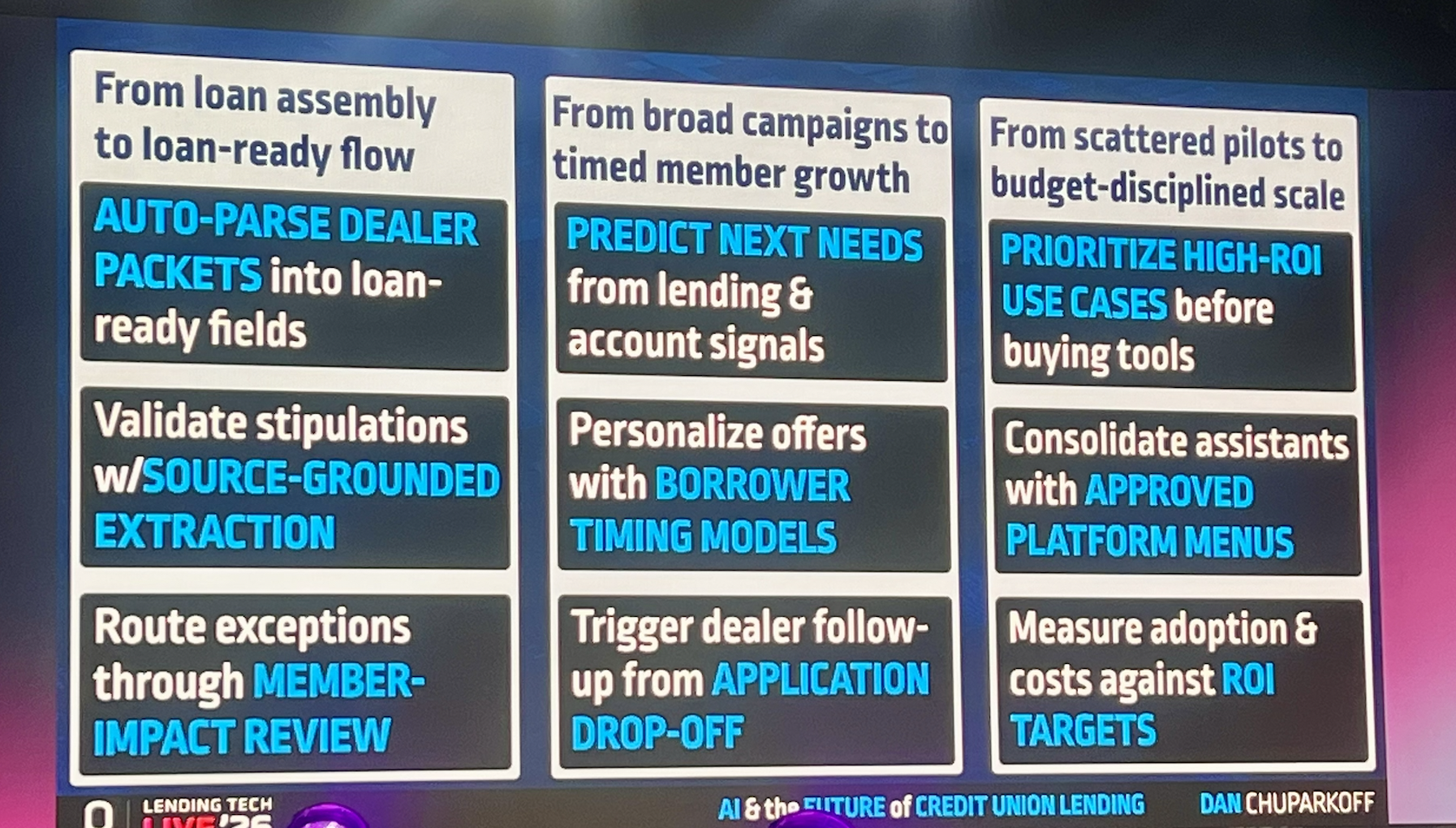
Turning specifically to credit union lending, Chuparkoff acknowledged that he does not work within the industry and therefore relied on AI to help identify potential use cases.
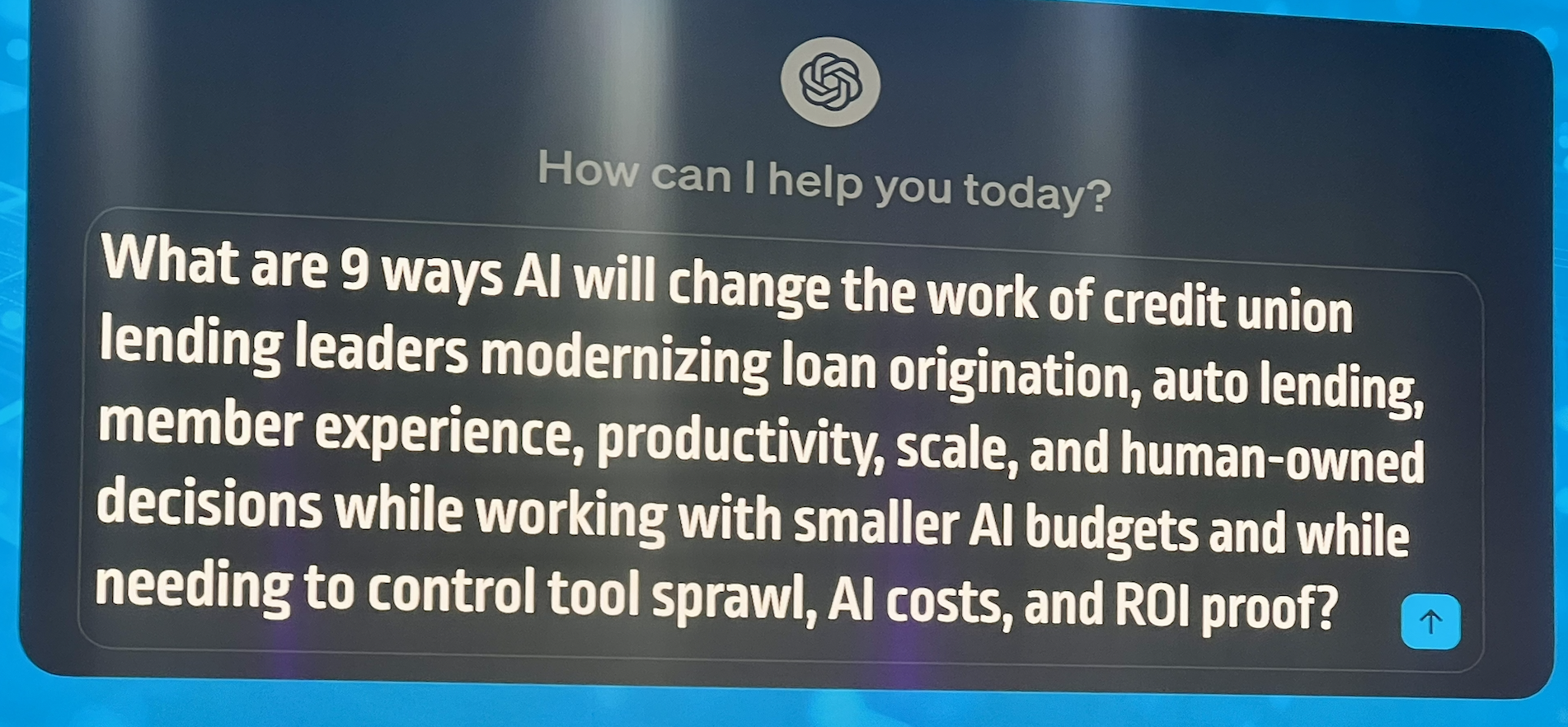
“The first thing I did when I got this engagement is I went to AI and asked this question: What are nine ways that I would change the work of credit union lending leaders who are modernizing loan origination, auto lending, member experience, productivity, scale and human decisions while also working with smaller budgets and needing to control tool sprawl, AI costs and ROI?”
Chuparkoff said the exercise generated nine responses, which he shared with attendees.
“The teams that succeed are the ones that figure out what the right ROI is for the AI use cases,” he said.
He encouraged attendees to begin engaging AI systems now so that future industry changes do not come as a surprise.
“You should go back to your credit union and start having a conversation with an AI system,” Chuparkoff said.
He compared access to modern AI systems to having a team of elite business consultants available at a fraction of traditional costs.
“It’s like having a team of business transformation experts from Deloitte or McKinsey sitting next to you every single day and it only costs $20 a month,” he said.
Performance Enhancement vs. Automation
Chuparkoff said many users are approaching AI incorrectly by asking it to produce finished work products.
Instead, he urged professionals to use AI as a performance-enhancement tool.
“Most people are doing this the wrong way,” he said.
Rather than asking AI to write a story or complete a task, he suggested asking the technology to evaluate and improve work already produced.
“I go through this loop over and over again so that every time I have a call with a customer or a speech I get feedback that helps make me better,” Chuparkoff said.
“Make AI a performance enhancer, not a surrogate for doing work. Tell AI to make you better.”
Where AI Brings Improvement
He predicted AI will improve areas including:
- Storytelling.
- Access to information and data.
- Image creation
- Email quality
- Project planning
- Language translation
“Before AI changes your industry, it’s going to change the way you work,” he said.
The Three Things AI Cannot Do
While AI will continue to become more capable, Chuparkoff argued there are three areas where humans will maintain a permanent advantage.
Those areas are:
- Problem solving
- Decision making
- Imagination.
He said much of modern work consists of communication, process management and investigation, all areas where AI can improve efficiency.
As those activities become more automated, humans will have more time to focus on solving problems.
“You never run out of work because you are able to solve more problems,” Chuparkoff said.
He argued AI will struggle to move beyond analysis and recommendations into genuine decision-making.
“Sometimes you just want to take a risk,” he said. “AI will always push you toward commodity decisions.”
The Value of Memories & Hope
He also said AI lacks the memories and hopes that guide human judgment.
“We have memories,” Chuparkoff said. “The things we remember about the past that we’re trying to recreate, what we didn’t like and we’re trying to avoid, the worst project that you ever worked on, the best customer experience that you ever had, the best boss you had, the worst boss you had. That’s what drives you.”
Likewise, humans are motivated by aspirations and visions for the future.
“Hope guides your actions,” he said. “You take chances, you take risks, you try things that really seem like they’re impossible.”
Lack of Imagination
Because AI can only analyze existing information, it cannot truly imagine future possibilities, Chuparkoff said.
“It can only look to the past,” he said. “It doesn’t know about the growth you are imagining for your company.”
“We will always need people to solve, decide and imagine in every single job and every single role.”
A Communication Revolution
Chuparkoff said AI’s greatest near-term impact may come through communication.
“We live in an infinite work world now,” he said.
According to a study by McKinsey, people spend approximately 68% of their time communicating through meetings, email and chat, he said.
“Communication is a lot of the work,” Chuparkoff said. “Our communication is pretty slow and inefficient.”
Because AI is built on language models, it is particularly effective at improving communication and information sharing, he said.
The Global World
“AI has already started to make our communication a little more efficient,” Chuparkoff said. “AI will reinvent the way we share information.”
He also highlighted rapid advances in language translation technology.
“We live in a global world now,” he said.
As an example, Chuparkoff cited his recent use of Apple’s AirPods translation capabilities while traveling in France. “I understood everything that was said,” he said. “It’s amazingly empowering.”
He predicted real-time translation will dramatically expand interactions among employees, members and customers who speak different languages. “This is going to change the world dramatically,” Chuparkoff said.
A Rethinking
As technological change accelerates, he said organizations must rethink how work is allocated.
“The only thing that isn’t growing exponentially is the hours in your week,” Chuparkoff said.
“The only way to survive that is to look at that work pyramid again and flip the pyramid of work. You should squish the things on the bottom and align it with your aspirations for a better world.”