

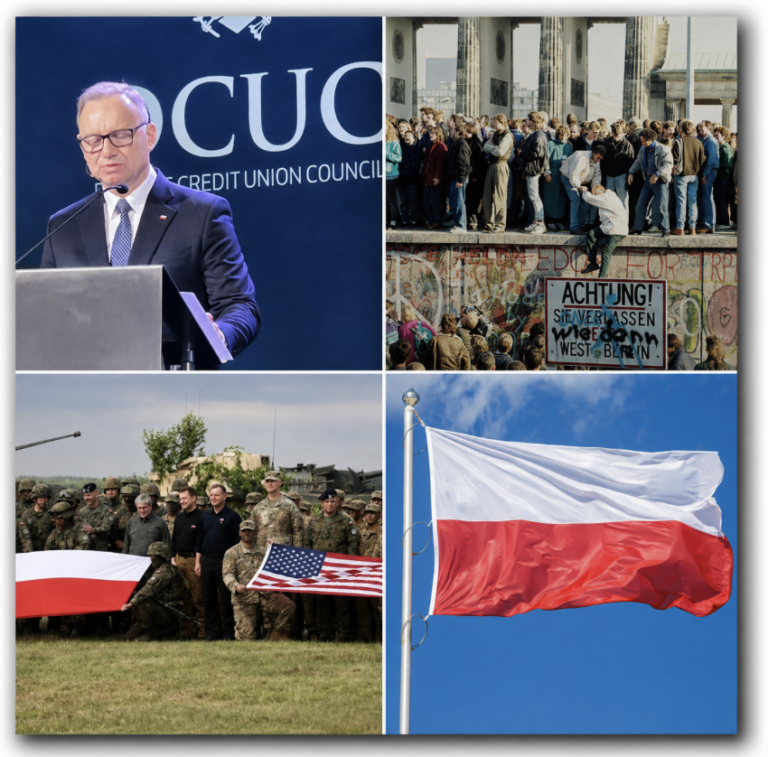
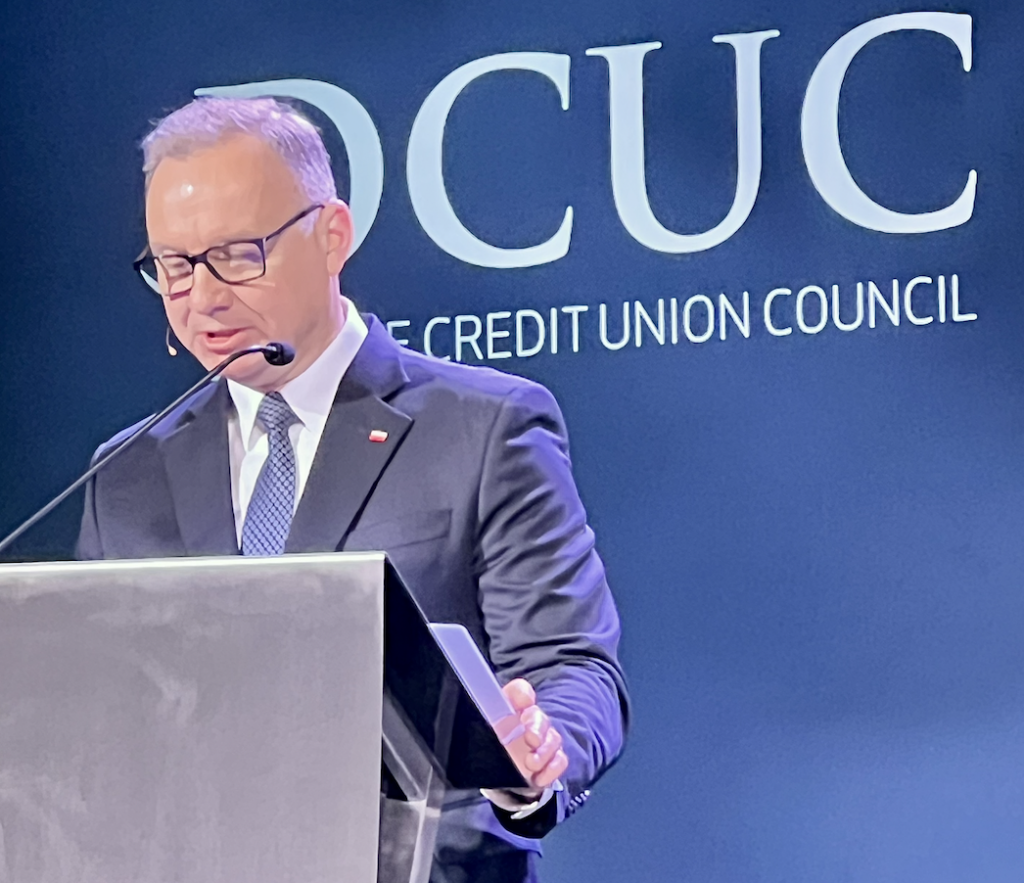
AVENTURA, Fla. — Former Polish President Andrzej Duda told credit unions gathered here the lessons he learned growing up under communist rule shaped his unwavering support for strong alliances with the United States, robust national defense and continued backing for Ukraine, while warning that Russian President Vladimir Putin should not be viewed like other political leaders.
Speaking to the Defense Credit Union Council’s annual conference, Duda reflected on Poland’s history under Soviet domination, his country’s transformation into a NATO ally and his decade in office, during which he worked closely with four presidential administrations.
Duda, who was elected president in 2015 and re-elected in 2020 before leaving office in 2025, said he was born in communist Poland in 1972, when the country was part of the Soviet sphere of influence.
“Our government was not chosen by us,” Duda said. More than 60,000 Soviet troops, equipped with nuclear weapons aimed at NATO and the United States, were stationed in Poland, he recalled.
A Nation’s Identity Endures
Despite decades of communist control, Duda said Poland’s national identity endured.
“We were occupied, but we were never occupied in spirit,” he said.
Duda pointed to the long history of cooperation between Poland and the United States, noting that Polish soldiers crossed the Atlantic to fight alongside Americans during the Revolutionary War. Credit unions also emerged quickly in Poland after the fall of communism–with strong assistance from the then Georgia Credit Union League—and today represent a strong movement.
He described growing up in what he called a “household of quiet resistance.” Raised in a Catholic family, Duda said his relatives never joined the Communist Party or served the regime.
He credited Poland’s peaceful democratic transformation in 1989 to several forces coming together, including the Solidarity labor movement, Pope John Paul II and former U.S. President Ronald Reagan.
A Chain Reaction is Set Off
Duda said Poland’s first democratic election triggered a chain of events that ultimately led to the fall of the Berlin Wall and, within two years, the collapse of the Soviet Union.
At age 18, Duda said he experienced Western Europe for the first time after restrictions on travel were lifted.
“We did not have passports in communist Poland,” he said, adding that the freedom to travel was something Americans often take for granted but was extraordinary for Poles of his generation.
He said he remains grateful to Reagan, the United States and others who supported Poland’s struggle for freedom.
Duda said those experiences shaped his views on national sovereignty and international partnerships.
Located between Russia and Germany, Poland has repeatedly lost its independence throughout history, he noted.
The Threat Russia Represents

“Today, Russian imperialism is the greatest threat to Central Europe and, by extension, to world peace,” Duda said, pointing to Russia’s invasion of Georgia and its two invasions of Ukraine.
Duda said he met Putin once but never had a conversation with him. He cautioned that world leaders should recognize Putin’s background as a former Soviet KGB officer.
“I always emphasize and say to my colleagues: Remember, Putin is not a normal, regular politician,” Duda said. “He is a professionally trained officer of the Russian Soviet KGB. He has special, extraordinary skills. He is not a regular politician you can talk with.”
Duda also recounted his own political career, which began unexpectedly in 2006 when he accepted an appointment as Poland’s deputy minister of justice. A lawyer with a doctorate in law, he later served in both the Polish Parliament and the European Parliament before winning the presidency.
Work With 4 American Administrations
During his two five-year terms, Duda said he worked with four presidential administrations and strongly advocated for expanded NATO and U.S. military deployments in Poland.
Among his proudest accomplishments, he said, were strengthening Poland’s military and expanding its economy.
Today, Poland spends 5% of its gross domestic product on defense, he said, and has become the world’s 20th-largest economy.
Duda also highlighted Poland’s extensive purchases of U.S.-made military equipment, describing them as part of a broader effort to modernize the country’s armed forces and deepen defense ties with the United States.
Reflecting on Russia’s full-scale invasion of Ukraine, Duda said he was in Kyiv with Ukrainian President Volodymyr Zelenskyy just hours before the attack to demonstrate Poland’s support.
He said he returned to Ukraine multiple times during the war and that Poland provided military assistance throughout the conflict.
Over his decade as president, Duda said he worked every day to strengthen the relationship between Poland and the United States and to build alliances that would endure beyond any single administration.
What Leadership is About
Closing his remarks, Duda said leadership is defined by resolve during difficult moments.
“Leadership under pressure is not about the absence of fear. It’s about knowing who you are, what you are standing for and who is standing beside you,” Duda told the meeting.



