
STAMFORD, Conn. — Banks are embracing artificial intelligence and cloud computing, but most have no intention of abandoning the decades-old mainframe computers that continue to run deposits, loans, payments and other critical operations, according to new research.
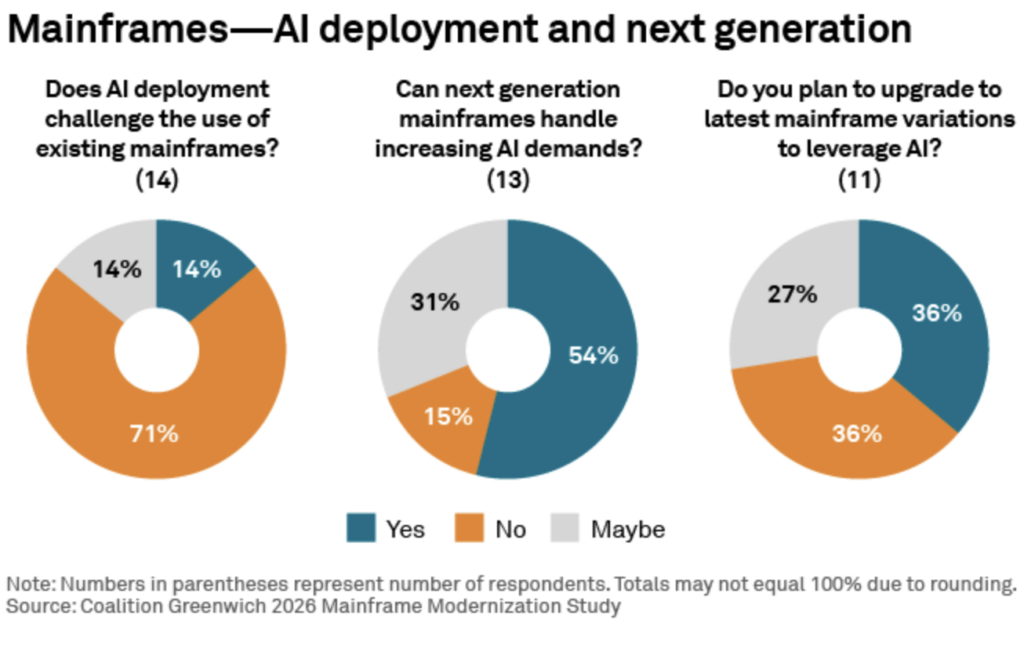
The financial-services research firm Crisil Coalition Greenwich, benchmarking and analytics firm found 71% of bank technology executives believe AI will not challenge their institutions’ continued use of mainframes. At the same time, 92% said more than half of their banks’ core banking applications still rely on mainframes.

Rather than moving those applications wholesale to the cloud, banks generally plan to modernize applications running on mainframes while using cloud infrastructure selectively, according to Crisil Coalition Greenwich’s report, “Even AI Can’t Take Down the Mainframe.”
The findings suggest that despite years of predictions that cloud computing would displace legacy technology, banks increasingly see their future as a hybrid environment in which mainframes and cloud systems coexist.
Exec Retirement Will Come First
“Most CIOs/CTOs will retire before any mainframe plans are fully abandoned, and the question of balancing mainframe use versus the cloud will be inherited by millennial and Gen Z professionals,” said David Easthope, senior analyst in market structure and technology at Crisil Coalition Greenwich and author of the report.
Crisil Coalition Greenwich provides banks, asset managers, investment banks and other financial-services companies with research and proprietary data used to benchmark performance, evaluate customers and competitors and identify industry trends.
Mainframes Remain at Center of Core Banking
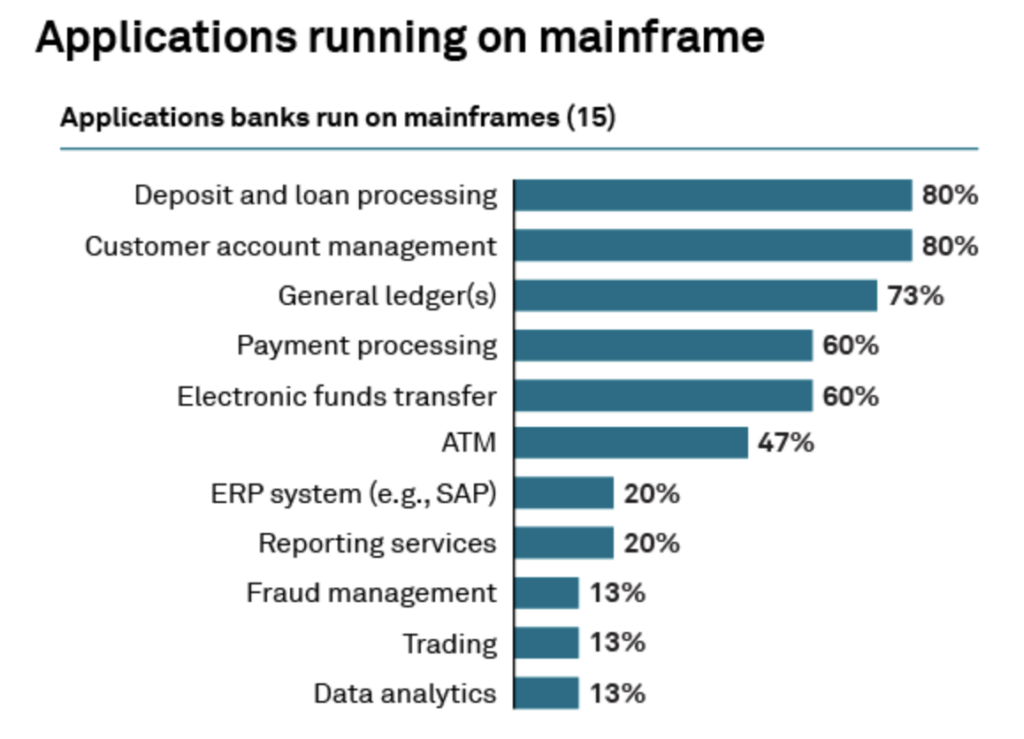
Crisil Coalition Greenwich said consumer banking applications, including deposits, loans and payments, remain heavily concentrated on mainframes, and banks expect many of those applications to stay there despite broader modernization efforts.
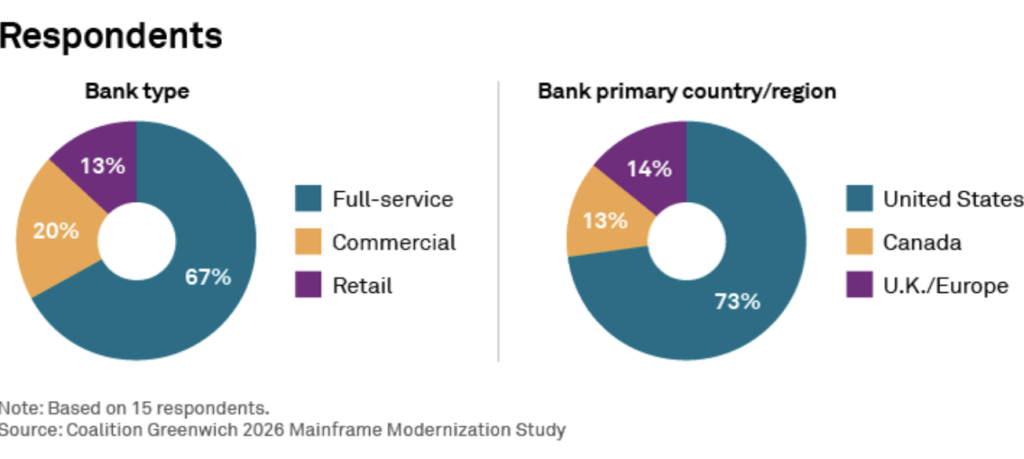
The firm interviewed 15 technology professionals at major banks in the United States, Canada, the United Kingdom and Europe. Participants included CIOs, CTOs and other technology executives at leading global banks, regional institutions and smaller retail and commercial banks.
More than 90% said at least half of their core banking applications run on mainframes, with some institutions reporting concentrations above 75%.
Executives consistently described mainframes as robust, reliable and scalable, according to Crisil Coalition Greenwich. Among their principal advantages are:
- High-volume transaction processing.
- Reliability and uptime.
- Security.
- Scalability.
- The ability to continue running existing applications when mainframe hardware is upgraded.
- Encryption and data compression advantages for data at rest.
Additional Functions
The firm’s research found mainframes also remain important outside traditional consumer banking.
Diversified global banks use them for treasury operations, securities processing and some legacy investment-banking applications inherited over time through acquisitions.
Crisil Coalition Greenwich said it is not suggesting investment banks and trading firms move applications to mainframes, but said leaving existing applications on the systems can make sense because of their reliability and resilience.
Decades of Acquisitions Complicate Cloud Migration
One reason mainframes have proven so difficult to displace is the long history of the banks using them, Crisil Coalition Greenwich said.
Large financial institutions built through decades of acquisitions have inherited layers of legacy infrastructure and core banking technology. When those systems continue to work reliably, executives can be reluctant to undertake expensive and potentially risky migrations.
The equation can be much different for a new or “greenfield” institution or fintech bank. Without legacy infrastructure, those institutions can establish cloud-based core banking systems from their inception.
But Crisil Coalition Greenwich said banks’ continued reliance on mainframes involves more than institutional inertia.
Faster Upgrades
Upgrades to newer mainframes can often be completed over a long weekend without requiring major changes to the banking applications running on them. Applications written for a mainframe generally do not need to be rewritten when an institution upgrades its mainframe infrastructure.
Moving legacy applications to the cloud can be considerably more complicated.
Cloud migrations can require extensive recoding so older applications can operate in a virtual environment, according to the research.
The financial structure is also different. Mainframe budgets are often established through three-year capital-spending cycles, allowing banks to plan for and allocate the necessary money. Cloud computing generally involves shifting to an operating-expense model under which banks pay for capacity on demand.
Interest in the Cloud
CIOs and CTOs remain interested in the potential advantages of cloud computing, Crisil Coalition Greenwich said, but some told researchers they have not always seen those promised benefits materialize.
Banks Favor Modernizing Rather Than Abandoning Mainframes
The research indicates most banks considering modernization do not view it as synonymous with leaving the mainframe.
Among technology executives surveyed:
- 27% plan to modernize legacy applications while keeping them on mainframes.
- 20% plan to maintain their existing mainframe applications without expanding them.
- 13% plan to migrate all software and applications off mainframes.
- 13% plan to phase out and decommission their mainframe platforms.
Modernization Strategies
Banks are considering core modernization strategies that include API enablement, microservices and integration with public cloud infrastructure, according to the analysis.
Only 25%, however, are pursuing a full core banking replacement and migration, according to Crisil Coalition Greenwich.
At some of the largest banks, senior executives are among the strongest proponents of maintaining mainframes, the firm said. Some favor migrating only about 5% of applications off mainframes each year.
At that rate, Crisil Coalition Greenwich said, many current CIOs and CTOs will have retired before their banks could fully abandon the technology.
AI Adds a New Dimension
The rise of AI is changing a long-running technology debate within banking.
Technology executives have spent years weighing cloud computing against on-premise architecture based on factors such as cost, scalability and security. The growth of AI is increasingly shifting the discussion toward another question: Where should AI workloads run?
AI applications in consumer and commercial banking are commonly deployed in the cloud, but Crisil Coalition Greenwich noted that AI capabilities are also available directly on mainframes.

IBM, which the firm identified as by far the largest provider of mainframes, has developed AI capabilities for its systems, including tools supporting fraud prevention.
That could be particularly relevant to banks because credit card transaction data used to identify fraud often resides on mainframes, the analysis stated.
Education May be Needed
Not all bank technology executives are familiar with those newer capabilities or know how to use them, Crisil Coalition Greenwich said, suggesting additional education will be necessary.
Over the next several years, however, expanded AI capabilities could make mainframes more useful for certain banking applications even as banks continue expanding their use of cloud computing.
Most Don’t Expect AI to Displace Mainframes
For banks, Crisil Coalition Greenwich said, the near-term AI question is less about whether the technology will replace mainframes than about determining the appropriate infrastructure for particular AI workloads.
Some executives interviewed by the firm are not yet considering AI for core banking applications. Others see potential advantages but do not expect AI to alter their underlying infrastructure decisions.
More than half of executives believe their mainframes can accommodate growing AI demands, although the newest AI capabilities available on the systems are not yet driving major technology decisions.
Overall, banks continue to value mainframes primarily for resilience and dependability rather than their ability to rapidly introduce new technology, according to Crisil Coalition Greenwich.
A Tank Not a Ferrari
The report characterized the distinction as viewing the mainframe more as a tank than a Ferrari.
Banks also must consider latency when deciding where AI workloads and data should reside. Crisil Coalition Greenwich said CIOs and CTOs want to avoid introducing unnecessary latency into critical functions while preserving mainframe advantages involving encryption, compression and data at rest.
Hybrid Model Seen as Banking’s Likely Future
Crisil Coalition Greenwich concluded the banking industry’s technology future is unlikely to involve a winner-take-all contest between mainframes and cloud computing.
Instead, banks are likely to maintain hybrid environments, assigning applications and workloads to whichever infrastructure is best suited to handle them.
“Despite the bullet-proof nature of mainframe computing, the future of the banking industry is undoubtably a hybrid environment in which mainframes and cloud computing coexist and support different workloads,” Easthope said. “Banks will continue to modernize core applications on mainframes, while using cloud infrastructure where it provides greater flexibility, speed or access to new capabilities like AI.”
Under that model, banks can continue relying on mainframes for high-volume, mission-critical core banking processes while turning to cloud infrastructure when it offers greater flexibility, faster development or access to emerging capabilities.
‘Could Persist for Years’
The research suggests that arrangement could persist for years — and potentially decades — as banks incrementally modernize technology accumulated through generations of mergers, acquisitions and infrastructure investments.
Crisil Coalition Greenwich conducted the telephone interviews from December 2025 through February 2026. The 15 participants were technology professionals at banks in North America, the United Kingdom and Europe, with the sample spanning leading global institutions, regional banks and smaller retail and commercial banks.
The study examined the share of banking workflows running on mainframes, executives’ perceptions of the technology, plans for mainframes and cloud computing and the potential future role of mainframes in supporting AI applications.