
COLUMBUS, Ohio — Nearly half of consumers surveyed by mortgage lender Lower said they would be comfortable with artificial intelligence approving or denying a mortgage application, though most still want a person involved in major decisions or problems that could jeopardize a closing.
Lower surveyed 1,000 U.S. consumers about AI’s role in the mortgage process, from answering questions and comparing rates to reviewing documents and making lending decisions. The results suggest consumers are open to AI doing more than helping them research a loan, but draw distinctions between using it for a task and giving it control of the entire process.
Comfort Extends Beyond Research
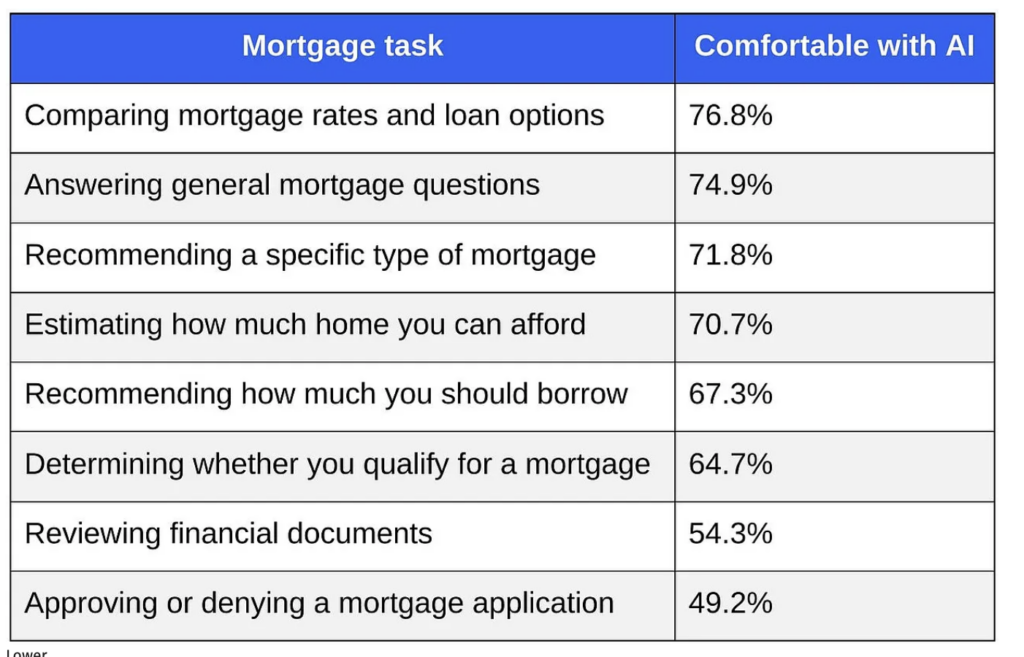
Lower said 49.2% of respondents were comfortable with AI approving or denying a mortgage application. That was the only task measured for which comfort fell below 50%. Other findings included:
- 67.3% were comfortable with AI recommending how much they should borrow.
- 64.7% were comfortable with AI determining whether they qualify for a mortgage.
- 54.3% were comfortable with AI reviewing their financial documents.
More than 7 in 10 were comfortable with AI recommending a mortgage type, Lower said. The company reported that comfort was highest for uses such as comparing rates and answering mortgage questions, though it did not provide figures for those tasks in the information released.
Prior Use Makes A Difference
Consumers who had already used AI for a mortgage or loan question were more willing to see it take on a larger role. Among that group, 72.1% were comfortable with AI approving or denying an application, compared with 41.1% of those who had not used it for that purpose.
Current mortgage holders also expressed greater comfort with AI making an approval or denial decision: 58.4% said they were comfortable with it, compared with 33% of consumers who had never had a mortgage and did not plan to get one.
“Once AI has answered the question and saved someone real time, they’ll trust it with more,” said Gino Fronti, Lower’s vice president of product for LOAI. “People have seen it work.”
Human Review Remains Important
Asked what role AI should play overall, 38% of respondents said it could make recommendations but a human should make the final decision. Another 18.8% said AI could make some decisions independently if a human reviewed major decisions.
Smaller shares favored broader AI control. Lower said 5.2% were comfortable with AI making most mortgage decisions independently, while 4.3% would allow it to handle the entire process without human involvement.
“People like to start the mortgage process online, from getting their questions answered to getting pre-approved. But at some point they want an advisor,” Fronti said. “This is the largest investment of most people’s lives. Many people don’t want to make that decision entirely inside a browser window.”
Where Preference for Humans Was Strongest
The preference for human help was strongest when respondents were asked about an unexpected issue that could delay or prevent closing. A human loan officer was the choice of 54.4%, while 28.4% wanted a loan officer and AI working together. Just 7% chose an AI-powered mortgage assistant alone. In all, 82.8% selected an option involving a loan officer.
Asked what would make them more comfortable using AI during the mortgage process, 49.1% selected access to a human whenever they wanted one — the most commonly chosen response. Another 38.1% selected human review of important AI recommendations or decisions.
Fronti said AI could handle routine paperwork and give loan officers more time to advise borrowers. “Technology is taking the paperwork off our plate, not the relationship,” he said.
About The Survey
Lower said Pollfish surveyed 1,000 U.S. consumers on Sept. 9, 2026. Questions covered specific mortgage tasks, AI’s role in decisions and when respondents would want human involvement. Percentages reflect Pollfish’s stratified, weighted results. For questions allowing more than one answer, the percentages represent the share selecting each response and may not add up to 100%