TUSTIN, Calif.–With credit union members everywhere facing growing financial pressures, SchoolsFirst FCU dove into its own data and found transportation costs were a particular pain point, so it responded with several special card offers, while additionally providing assistance with another challenge for members: affording housing. Here’s a look at what it has done.
As the CU Daily first reported here, SchoolsFirst Federal Credit Union launched a limited-time credit card rewards promotion offering increased rewards on gasoline and electric vehicle charging purchases after seeing a sharp increase in members’ fuel spending.

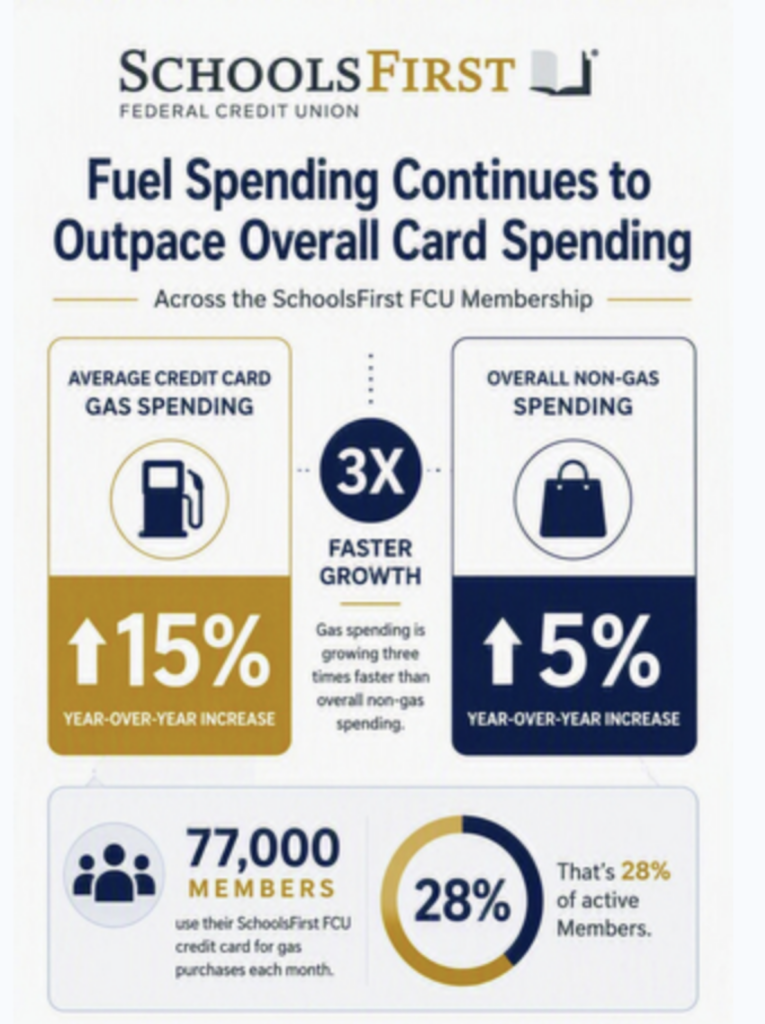
The $37-billion SchoolsFirst FCU said average credit card spending on gas has increased 15% year over year, three times the 5% growth recorded for overall non-gas spending.
Approximately 77,000 members use a SchoolsFirst FCU credit card for gas purchases each month, representing 28% of the credit union’s active members, according to SchoolsFirst.
How Program Works
Under the promotion, eligible existing cardholders and members who open a new eligible SchoolsFirst FCU credit card can earn either 5% cash back or five times the normal points, depending on the card product, on qualifying gas and EV charging purchases.
SchoolsFirst said the promotion is also part of its broader effort to offer credit cards with competitive rates and rewards for everyday spending.
Stating that housing is also another major affordability challenge for school employees, especially in California, it said it has learned is that the hurdle isn’t making the monthly payment, the actual hurdle is coming up with the upfront cash needed for the down payment. In response to this insight, SchoolsFirst launched a $7,500 grant for eligible first-time homebuyers that can be used toward a down payment and closing costs.
Below, Jose Lara, president of SchoolsFirst FCU, shares with CU Daily readers what the credit union has been doing and some of what it has learned.
The CU Daily: Has SchoolsFirst FCU been looking closely at the financial behavior of its Members? Has there been anything in the data or a trendline the credit union has seen?
Lara: We regularly analyze member spending trends to better understand where financial pressures are emerging. One trend that stood out was transportation costs. We saw gas spending increase about 15% year over year, compared with roughly 5% growth in non-gas spending. We also found that approximately 77,000 members use their SchoolsFirst FCU credit card for gas purchases each month, which signaled an opportunity to provide targeted value.
The CU Daily: What initially led to looking at this spending data? How does SchoolsFirst FCU sift through all the data it captures and find meaningful action points?
Lara: We start with a simple question: What challenges are our members facing today? Data helps us move beyond assumptions and identify real-world trends. Rather than looking at data for its own sake, we focus on patterns that connect directly to member needs.

When we see a trend that is both meaningful and actionable, we explore whether there’s a product, service or educational opportunity that can help.
The CU Daily: Given the incentive provided of 5% cash back or 5x points on gas purchases or EV charging, did you see a change in Member behavior?
Lara: The promotion was designed primarily to provide relief on an expense members were already incurring. While engagement metrics are important, our first measure of success is whether we’re helping Members get more value from their everyday spending. We continue to evaluate participation and spending behaviors to better understand long-term impact.
The CU Daily: Separately, how did the focus on housing come about? Was that data-based, more anecdotal, or a combination of both?
Lara: It was a combination of both. We heard from school employee members that homeownership felt increasingly out of reach, and our analysis confirmed that many were financially capable of managing a mortgage payment but struggled with the upfront cash required for a down payment and closing costs. That insight shifted our focus from qualification challenges to affordability barriers.
The CU Daily: What has been the response to the $7,500 grant offer to eligible first-time homebuyers?
Lara: The response has been very positive because it addresses a very specific challenge our Members face. School employees often have stable careers and strong financial habits, but saving enough for upfront homebuying costs can take years. The grant provides meaningful assistance at a critical point in the homeownership journey.
The CU Daily: Given the cost of housing in California combined with rates that remain high, as generous as it is, does $7,500 make a difference?
Lara: By itself, $7,500 won’t solve California’s housing affordability challenges. But for many buyers, the hurdle isn’t the monthly payment. It’s assembling enough cash to close. When combined with other features of our School Employee Mortgage program, including low down payment options, the grant can help bridge the gap between being almost ready and becoming a homeowner.
The CU Daily: Given the number of smaller credit unions that would benefit from SchoolsFirst FCU’s perspective, any advice or lessons learned?
Lara: Start with a member problem, not a data project. The most valuable insights often come from connecting what Members are telling you with what the data is showing you. Focus on identifying a small number of meaningful trends and then ask, “What can we do differently because we know this?” Data becomes powerful when it drives action.
The CU Daily: Is the SchoolsFirst FCU membership primarily composed of school employees? What makes it unique?
Lara: Yes. SchoolsFirst FCU was founded by school employees and serving school employees and their families remains our mission today. What makes the field of Mm
The CU Daily: In its work to better understand its data, how has SchoolsFirst FCU deployed AI, and what do you have planned ahead?
Lara: TBD