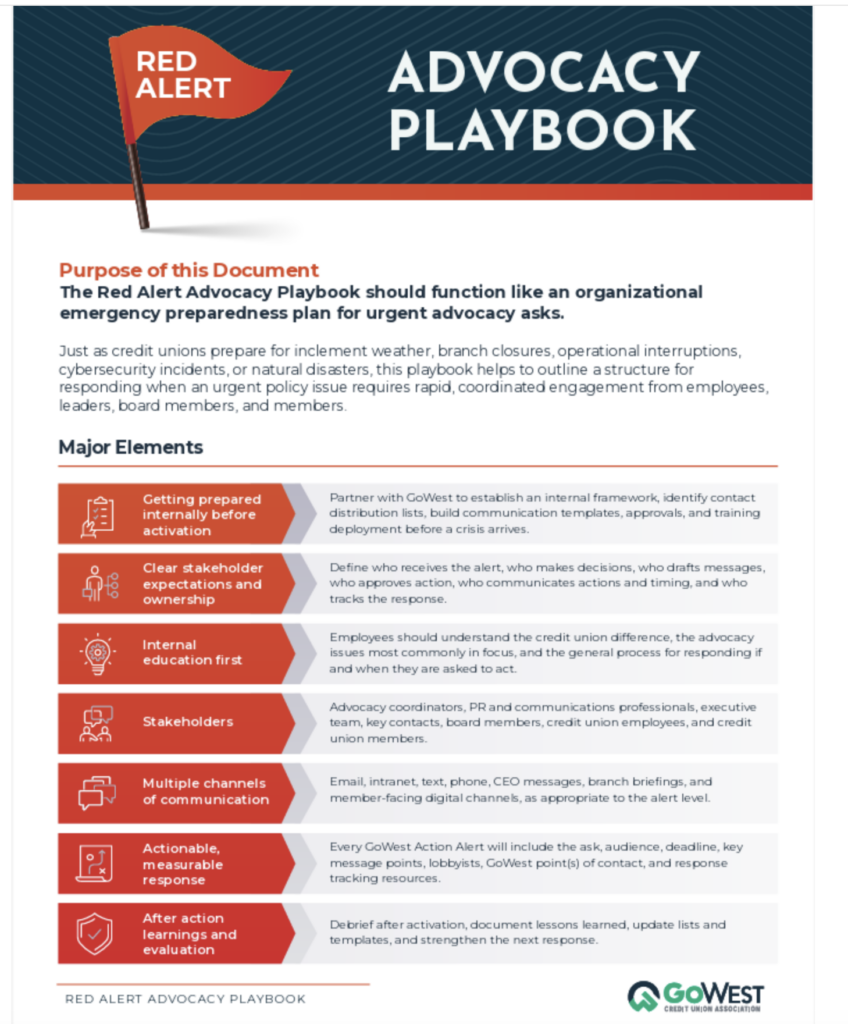
AURORA, Colo.—After a year of work, revisions and updates, an advocacy “Playbook” has been introduced by the GoWest Credit Union Association that aims to give credit unions everything they need in working with elected officials–including how to get started and questions they might not have considered–at whichever level they feel most “comfortable.”
During the association’s recent MAXX conference, Jennifer Wagner, EVP and chief advocacy officer, and Katy Wagnon, chief experience officer, shared details of the new Red Alert Advocacy Playbook with the CU Daily, including how it came to be, what’s involved, what’s been learned in the process of creating it, and how it also has applications for credit unions in responding to other crises they may face.

The Red Alert Advocacy Playbook is an online tool that offers a step-by-step guide to walk credit union leaders through the decision-making process around advocacy, including identifying roles and key players in the credit union, conversations to be had, the testing of operational procedures, sample messaging and templates and more.
Wagner described the Playbook as similar to a workbook.
The First Conversation
According to Wagner, when it comes to advocacy the first conversation needs to take place within the C-suite and then move forward to engagement with employees and the board (the Playbook includes steps for doing so).
In addition to offering sample policies that can be implemented, Wagner said it also asks questions and, depending on how the CU responds, provides the process for implementation.
“It’s a deep dive,” said Wagnon. “Like a crisis tabletop exercise, you’re going to want to walk through it for a couple of hours. And then it doesn’t just end there, because you’re going to need to have additional conversations and bring additional people to the table and work through messaging.”
The Playbook has its origins in 2025 during the budget reconciliation process, when Congress was looking for what are known as “pay-fors”–that is, ways to pay for tax cuts, and the credit union tax exemption received attention as one of the potential places to find income.
“We saw that need for credit unions to up their level of messaging,” said Wagner. “As we were talking to credit unions and preparing for what could be an inevitable go-time–as we’ve got a threat and we’ve got to respond–we realized that credit unions haven’t had a lot of direction or a tool to help them through the internal conversations about what would happen if they received a Red Alert call to action.”
Not Waiting for a Crisis
Wagner said GoWest’s advocacy teams further recognized not all credit unions were comfortable talking within their organizations and with members about their roles in advocacy.

“This playbook allows them to hold those conversations now before there’s a crisis,” Wagner said, adding the Red Alert Playbook has been in the works for approximately a year.
According to Wagnon, over that year there were numerous “stops along the way” as the Playbook’s pieces were assembled.
“This was something that we took very seriously, especially hearing from them and knowing that they maybe haven’t had all of those conversations,” explained Wagnon. “There are advocates who are really dialed in on advocacy and people from our PR working group who understand how critical advocacy and that credit union narrative is. But what about the operational side of it? To be able to advocate, you have to do be able to do that from an operational standpoint.”
In some cases, Wagnon said, there can be disagreements in the C-suite over what the message should be to employees and members, as well as over what those constituencies should be saying to elected officials and why they should be doing so.
The Need for Speed
Many also don’t understand the importance of being prepared to move quickly, as trying to manage a crisis after that crisis has begun only exacerbates the challenge, Wagnon said, which is another reason the association looked to get the Playbook in place.
Wagner said work on the Playbook begin in GoWest’s governmental affairs committees and with CEOs, with a hyper-local focus. Public relations professionals were consulted, and testing took place at some association events with tabletop exercises.
“We continued to work to improve it. We had a couple of credit unions who have gone to their members with an advocacy ask,” Wagner said. “It’s a work in progress and it continues to be.”
The Red Alert Playbook has not been formally used at this point, having only been table-topped to date, but Wagner said the credit unions that have engaged internally in conversations as a result have been able to develop their own versions of the Playbook and have begun developing their own templates, including asking questions around where they stand, how they want to organize responses, and what processes and procedures they want to use.

Messaging Examples Included
Wagnon noted the Playbook includes examples of messaging that can be used by channel, most especially in social media. It also offers guidance around responding to any pushback a credit union may receive, education around what the experience is like for members and more.
“At the end of the day they have to protect their brand,” Wagnon told the CU Daily. “They have to make sure they have actual language drafted that can go to their board, that can go to their employees, that go out in different channels. They can take that and make it their own. It’s not one-size-fits-all. We want to make sure it makes sense for their brand but also lifts up the greater call to action for advocacy.”
As part of the tabletop exercise, Wagner explained, there is a hypothetical bill that is a threat to credit unions. Participants then work through the kinds of conversations they would need to have. There are also exercises around when the press seeks comment and how those inquiries would be handled. That includes who will act as spokesperson for the credit union, something many CUs have not really thought about, she added.
There is also a step in the exercise that asks, “The GoWest association has asked you to engage on this issue: Are you ready to send emails and connect with legislators?”
Helping Manage a Full Plate
Most credit union leaders agree advocacy is important, but many who lead small and midsize CUs will simultaneously also say it’s challenging to put advocacy on their already full plates. Wagner said GoWest has heard from credit unions that have said they don’t have a public relations expert on their staff, for example, nor do they have the time to assemble an advocacy plan.
At the same time, leaders at many large credit unions are busy and often reluctant to pause to take the time to put a plan together, Wagner added.
For those reasons, representatives from large and small credit unions were involved in building the Playbook, she said.
A Focus on Six State Capitols
While credit unions in the six-state region served by GoWest are often called upon to respond to advocacy issues at the national level, Wagner said the Playbook is especially important in guiding response in those half-dozen state capitols from Olympia to Phoenix. As the CU Daily has reported, the banking industry has taken some of the fights it has been having in Congress to the state level, including, most recently, a card interchange bill in Colorado that was vetoed by the governor.
“If an interchange bill is reintroduced next session, we will be asking credit unions to engage, to send emails and to plug in,” Wagner said. “Those that have worked through this process will be further ahead and be able to activate…We are more active in our state capitals, but in a national situation, of course, we would work with America’s Credit Unions. We would still likely be the ones to send a call to action specific to our members of Congress in our six states, knowing who they are and what messages are going to work best with them.”
Staying Afloat in the Flood
Technology has made it easy to hit “send” and to forward form letters, and Capitol Hill is awash in such messages. How can credit union messages stand out in that sea of communications?

“I think there are times where it’s a numbers game and we just need to turn out a lot of numbers and then a form letter is OK,” responded Wagner. “But with an issue where it’s a very credit union-specific ask, every organization now has a tool that allows folks to easily complete a call to action. There’s some template language that’s part of the education, but we want them to tell their personal stories. We are asking them to add their story on housing or fraud, for instance. It’s easy to press send, especially with AI, and to turn out big numbers. But in grassroots (advocacy) we’ve got to continue to find ways to ensure credit union messages do get noticed, and that they do stand out as being personal.”
While technology has made sending communications easy, it can still be a challenge to get members to act. Yet Wagner said the credit unions with which the GoWest association has worked have actually found higher member response to advocacy emails than to their own traditional marketing emails.
“The credit unions that have done it have been pleasantly surprised,” Wagner said. “It increases their level of trust and makes them feel a part of something.”
Pulling the Lever
Still, Wagner said credit unions have made clear that if they are going to pull that lever and ask their members to be advocates, they want to be confident that it’s the right message that translates well to the consumer.
“That’s why we do the level of education that we are doing with the Red Alert Advocacy Playbook,” added Wagnon. “We also want them to know that we understand what we’re asking is so critical and we would not ask them unless it was so important to their operating environment.”
Both Wagner and Wagnon observed that during tabletop exercises some credit unions have said they could see the need to create specialized messaging for certain member constituencies, such as small businesses.
“If you’re not having those conversations in advance, that’s harder to do when you’re in it and you only have so much time,” Wagnon added.
Fighting Fatigue
But what about “red alert fatigue,” that is, being asked so often to advocate on an issue that credit union leaders or members get tired and don’t participate.
“It’s something we talk about a lot,” Wagner acknowledged. “There are innumerable opportunities where grassroots engagement on an issue would help us, but we understand the marketplace is evolving and their relationship with their members is so critical. There are times some of our colleagues choose to go out with a call to action, and for good reason, and we say we’re going to wait because we might need them later and we don’t want to overuse the ask. Our credit unions know that when we do go with an ask, it’s s priority.”
It isn’t just credit unions and members who can grow tired of being asked to be on the sending end of advocacy messages, Congress and state legislators also get fatigued on the receiving end, and Wagnon said the GoWest association has tried to emphasize with congressional reps that credit unions can be a solution for a lot of the problems their constituents are facing.
“In some cases, we’re not just being defensive, we are being proactive and we are asking all of our credit unions to tell as many impactful stories and share as much positive data as you can,” Wagnon said.
Meeting Credit Unions Where They Are
Overall, given the varying level of experience in advocacy, Wagner said the Playbook is designed to “meet credit unions where they are.”
“Any engagement is beneficial and we don’t want to force folks to move quicker than they are comfortable,” said Wagner. “If this is where they want to plug in and are comfortable today, great. Over time, we’d love to move them to the next step.”
Value Beyond Advocacy
Wagnon said the value of the Red Alert Advocacy Playbook goes beyond just advocacy.
“We built it for advocacy, but it has a lot on the same processes and conversations that you would have if you were dealing with a cybersecurity incident or a fraud issue or a PR crisis,” said Wagnon, noting that GoWest plans to use portions of the Playbook during an upcoming cybersecurity training event.