

ALPHARETTA, Ga.–Fraud is costing U.S. financial services firms $5.47 for every dollar lost, while efforts to stop it are creating another business risk: driving customers away, according to a new LexisNexis Risk Solutions report.
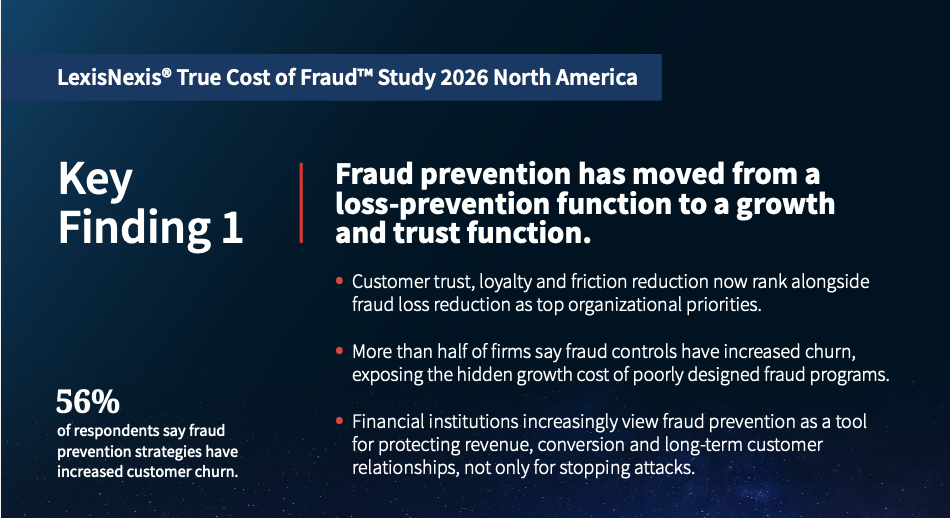
The company’s 2026 True Cost of Fraud Study for North America: Financial Services & Lending found that 56% of respondents said their fraud prevention strategies had increased customer churn. Meanwhile, digital channels accounted for nearly 70% of fraud losses, and institutions estimated that artificial intelligence-generated techniques were involved in roughly one-fifth of losses.
The findings underscore a challenge for credit unions, banks and other financial institutions: strengthening defenses against increasingly sophisticated attacks while making services easy for legitimate customers to use.
The study surveyed 319 risk and fraud professionals at U.S. and Canadian financial services and lending organizations, including credit unions. Its findings reflect respondents’ estimates and reported experiences.
Costs Extend Beyond the Stolen Dollar
LexisNexis’ fraud cost measure includes the original loss and additional expenses associated with fraud, including operational, compliance and customer-related costs.
For U.S. financial services organizations, the total cost per dollar of fraud rose to $5.47 from $4 in 2021. Among U.S. lending organizations, it increased to $4.84 from $4.16.
Canadian financial services firms reported costs of $4.09 per dollar of fraud, up from $3.65 in 2021. Canadian lenders were the exception, with costs declining to $3.89 from $4.
The consequences extended beyond financial losses. Among U.S. respondents:
- 50% said fraud significantly affected customer trust or their ability to build it.
- 45% reported a significant impact on compliance workloads or resource requirements.
- 44% cited fraud losses.
- 41% cited internal resource allocation, and another 41% cited regulatory response.
When asked to identify their top three priorities in balancing fraud prevention and customer experience, 51% of U.S. respondents selected improving trust and loyalty, and an equal share selected reducing customer friction. Minimizing fraud losses was selected by 43%.
Digital Channels Dominate Losses
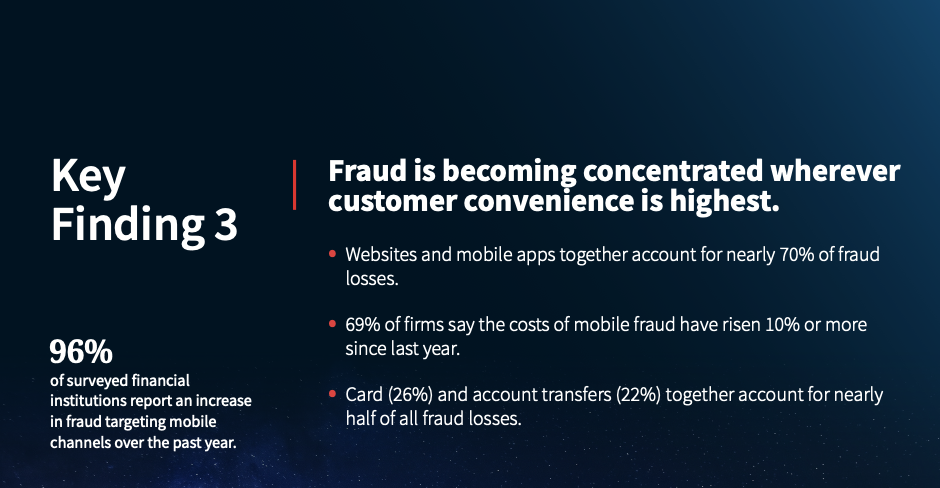
Websites and mobile applications together accounted for 69% of fraud losses, according to the report.
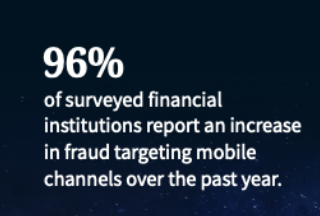
Nearly all surveyed institutions, 96%, reported increased fraud targeting mobile channels over the past year. Additionally, 69% said mobile fraud costs had risen at least 10%.
Respondents attributed losses to the following customer-facing channels:
- Online portals and websites: 39%.
- Mobile applications: 30%.
- Contact channels, such as telephone: 16%.
- In-person interactions, such as branch visits: 14%.
- Other channels: 1%.
By payment method, card transactions accounted for 26% of losses, followed by account transfers at 22% and digital wallets at 15%.
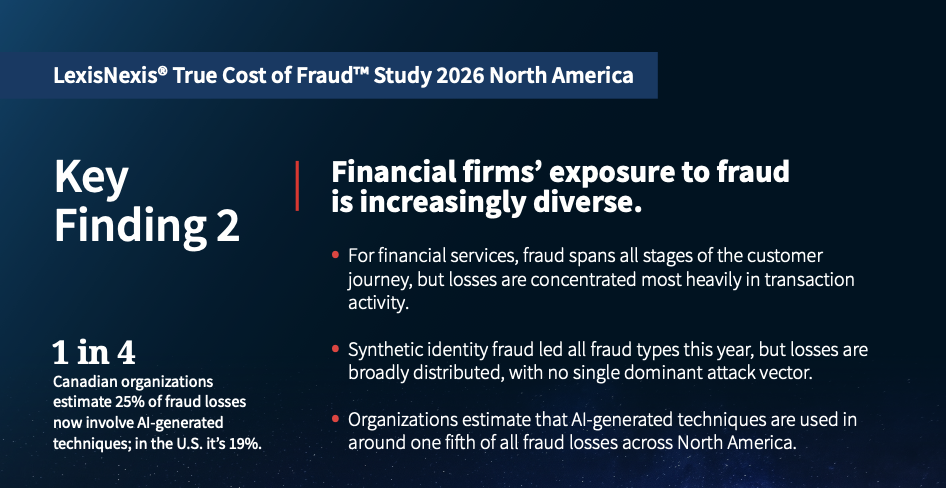
Fraud also appeared throughout the customer relationship. Transaction activity accounted for 39% of losses, new account creation for 33%, and account login or access for 28%.
Scams, Synthetic Identities and Bots
Synthetic identity fraud accounted for the largest individual share of losses among the fraud categories measured, at 19%. However, the report found losses spread across multiple threats, including account takeover, third-party identity fraud, first-party fraud, mule accounts and fraudulent claims or refund abuse.
Separately, respondents attributed approximately 32% of fraud losses to scams. Institutions reimbursed about one-third of scam losses across North America. U.S. respondents reported reimbursing 31.2%, compared with 38.9% among Canadian respondents.
Malicious automated activity presented another challenge. U.S. institutions estimated that bot attacks accounted for 14% of monthly transactions, compared with approximately 22% in Canada. Some 58% of U.S. respondents and 55% of Canadian respondents said malicious bot activity had increased over the past year.
Overall, institutions estimated they prevented approximately 65% of fraudulent transaction attempts.
To combat scams, half of respondents said they educated customers about information security. Other measures included using third-party risk data and email or phone risk signals, each cited by 47%, and combining risk signals across channels and systems, cited by 43%.
AI Is Both a Threat and a Defense
U.S. respondents estimated that AI-generated techniques were involved in 19% of fraud losses. Canadian respondents put that figure at 25%.
At the same time, institutions increasingly reported using AI in their defenses. Some 56% said they used it against synthetic identity fraud, and an equal share used it against third-party account takeover. Another 48% used AI against scams, while 46% deployed it against first-party fraud.
Respondents also identified substantial barriers to adopting AI-based fraud detection and prevention:
- Limited internal expertise or resources: 31%.
- Integration with existing fraud and risk systems: 26%.
- Data quality, availability or integration challenges: 25%.
- Difficulty explaining or validating AI-driven decisions: 24%.
- Model governance, risk management or compliance requirements: 21%.
Planned investments over the next 24 months included biometric authentication, cited by 53%; verifiable credentials or digital identity wallets, 48%; behavioral intelligence, 47%; and digital risk assessment, 45%.
More Automated Programs Report Better Results
Institutions with predominantly automated fraud programs reported stronger results than those relying primarily on manual processes, according to LexisNexis.
Among organizations with mostly or entirely automated programs, 79% reported improved fraud prevention performance, compared with 54% of primarily manual organizations.
Similarly, 29% of automated organizations reported reduced customer churn, compared with 10% of manual organizations. Automated organizations also were more likely to track fraud by both channel and payment method, at 59%, compared with 28%.
Automation was not associated with an absence of hiring. Some 55% of predominantly automated organizations reported hiring for at least three fraud-related roles during the past two years, compared with 29% of predominantly manual organizations.
Across the full survey, 73% expected their ability to detect and prevent fraud to improve in the coming year, while 17% expected it to deteriorate.
LexisNexis said the findings support combining identity information, behavioral analytics, device intelligence and AI-based decision-making to strengthen security while improving customer experiences.
About The Study
The research included 251 respondents in the United States and 68 in Canada. Approximately 45% represented financial services organizations and 55% represented lending organizations. Participants included credit unions, commercial banks, payment providers, fintechs, mortgage providers and other institutions.
LexisNexis cautioned that the findings rely on self-reported information and estimates that were not independently audited or verified. The reported relationships between fraud strategies and business outcomes do not establish causation.