
CHICAGO — U.S. lenders had an estimated $2.4 billion in credit exposure tied to synthetic identities at the end of June, while scams and fraud involving transactions authorized by victims emerged as the leading source of fraud losses for businesses, according to a new TransUnion report.
The credit reporting and information company’s H2 2026 Top Fraud Trends report argues that criminals are increasingly exploiting relationships and accounts that organizations already trust, often using artificial intelligence to create convincing identities, impersonate businesses and automate attacks.
Globally, business leaders estimated their organizations lost an average of 6.5% of revenue to fraud over the previous year. In the United States, 35% of surveyed business leaders identified scams and authorized fraud as their largest source of fraud losses, compared with 18% each citing first-party and synthetic identity fraud, TransUnion reported.
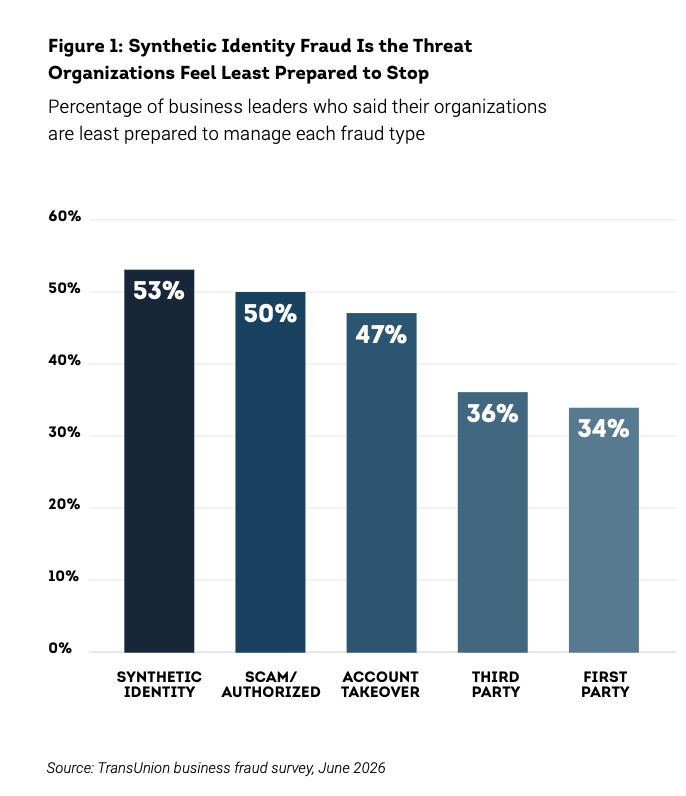
Among U.S. respondents, 51% said scam and authorized fraud had increased during the previous year, while 67% expected it to be among the fraud categories increasing most over the next two years.
Billions in Potential Lending Exposure
TransUnion estimated U.S. lender exposure to synthetic identity fraud at $2.4 billion across four credit categories as of June 30. That figure represents credit available to suspected synthetic identities, not confirmed fraud losses. The breakdown included
- Auto loans: $1.5 billion.
- Bank credit cards: $804 million.
- Retail credit cards: $97 million.
- Unsecured personal loans: $58 million.
Two-thirds of U.S. business leaders surveyed — 67% — expected synthetic identity fraud to increase significantly relative to other fraud types over the next two years, and 53% identified it as the fraud category their organizations were least prepared to manage.
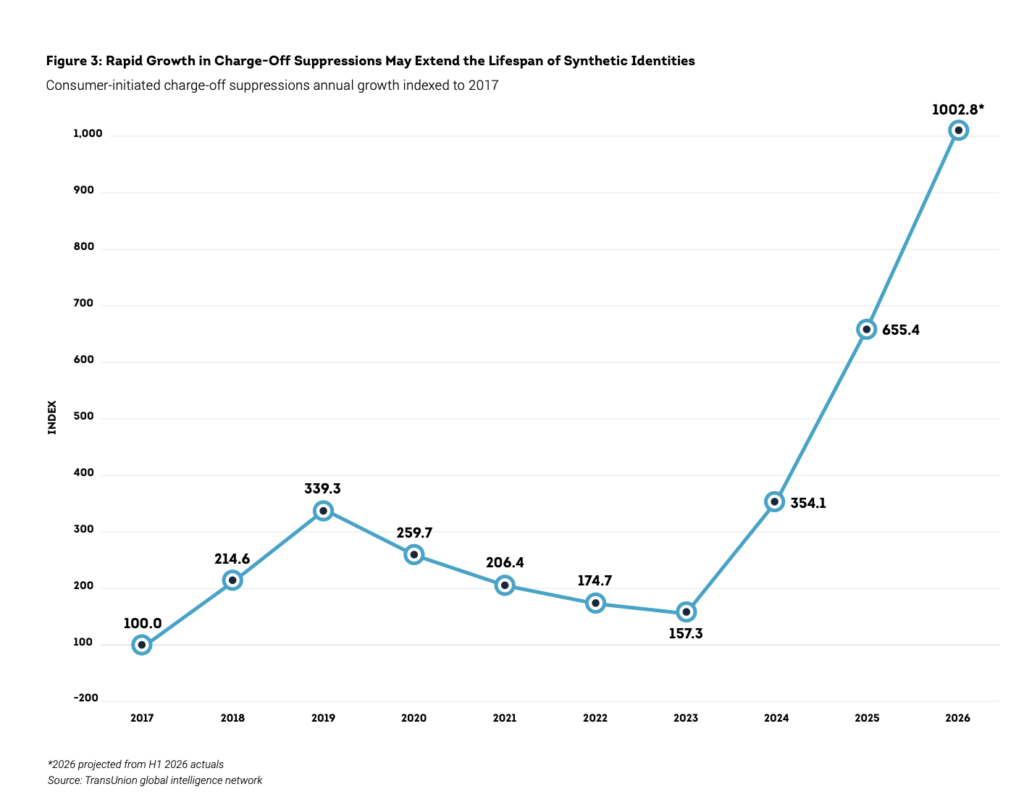
TransUnion also highlighted what it called “credit washing,” in which false identity theft claims are used to remove unfavorable information from credit records. Consumer-initiated charge-off suppressions, which the company said are closely associated with the practice, rose 595% from January 2024 through June 2026. That increase does not establish that every suppression was fraudulent.
The company estimated that $3.7 billion in historical charge-off losses could be suppressed from credit reports in 2026, based on first-half trends. Its analysis found a 12.5% early charge-off rate among accounts opened after suppressions, compared with 3.7% in a comparison group.
Fraud Risk Continues After Accounts are Opened
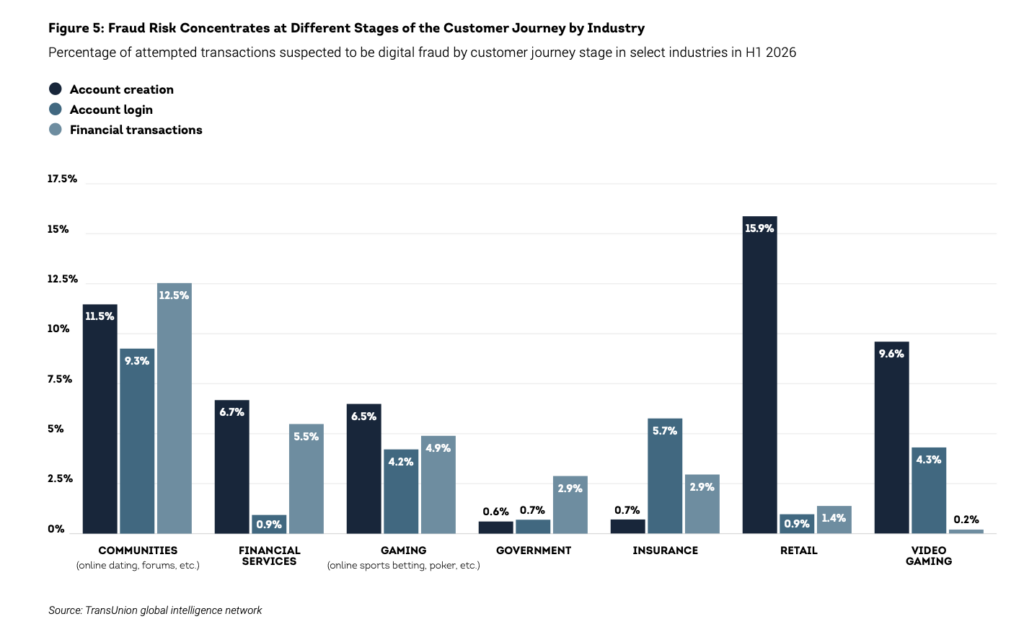
Across TransUnion’s global digital network, 81% of suspected digital fraud in the first half of 2026 occurred during ongoing customer interactions rather than account creation. Account logins accounted for 53% of suspected digital fraud, financial transactions for 27.9%, and account creation for 13.1%.
However, account creation had the highest suspected fraud rate within its category, at 7.1%, compared with 2.8% for financial transactions and 2.5% for account logins. In financial services specifically, 6.7% of account creation attempts and 5.5% of financial transactions were suspected of fraud, the report said.
TransUnion cautioned that its suspected digital fraud figures include transactions flagged by clients as fraudulent or violations of organizational policy, rather than solely confirmed criminal activity.
Spoofing and Stolen Information Fuel Attacks
The report found 19.4% of outbound business-to-consumer calls involving U.S. mobile carriers were spoofed in the first half of 2026. Among U.S. consumers who reported being targeted by digital fraud in a recent three-month period, 39% cited email phishing, 38% text-message phishing and 34% voice phishing.
TransUnion also reported that full Social Security numbers were exposed in 73% of U.S. data breaches in the first half of 2026 for which compromised credential details were disclosed. The company said the availability of authentic personal information makes synthetic identities and impersonation attacks more convincing.
Call for Continuous Fraud Monitoring
The report recommends that financial institutions and other businesses go beyond one-time identity checks at account opening and continuously assess identity, device, behavior and communications signals throughout the customer relationship. It also calls for stronger defenses against spoofed communications and more adaptive detection of AI-assisted attacks.
The findings draw on a June 2026 survey of 1,600 fraud and risk decision-makers at large organizations in eight markets, consumer surveys of more than 13,500 adults across 19 markets, and TransUnion’s proprietary transaction and fraud intelligence. The figures reflect differing populations and measurement methods and should not be treated as directly comparable.