

MEMPHIS– Credit unions do not need the largest balance sheets or technology budgets to become leaders in artificial intelligence, according to a new SRM report that argues leadership culture and the ability to redesign operations are stronger indicators of AI readiness than asset size.
In its October 2026 report, ‘The AI Imperative for Banking: From Adoption to Impact,’ the advisory firm points to research from PYMNTS and Velera indicating credit unions with $1 billion to $5 billion in assets outperform institutions with more than $5 billion on innovation readiness. SRM says the advantage stems less from spending power than from leadership willing to change how work gets done.
The report argues that installing AI tools without changing workflows, governance and employee responsibilities can produce productivity improvements without delivering corresponding gains in earnings or member value.
Smaller Institutions, Significant Results
SRM cites Metro Credit Union, a $3.2 billion-asset institution based in Chelsea, Mass., which has partnered with credit union service organization Traduality on an AI-powered multilingual memberexperience platform. Metro also is using AI administrative tools to help employees serve approximately 200,000 members.
It also highlights Commonwealth Credit Union in Kentucky, which the report identifies as having $2.57 billion in assets. According to SRM, Commonwealth achieved loan growth exceeding 14% in 2025 using AI-powered underwriting while maintaining strong delinquency and charge-off performance.
The report says such examples illustrate the importance of changing lending and service processes, rather than merely adding technology to existing systems.
Potential Savings — and Barriers
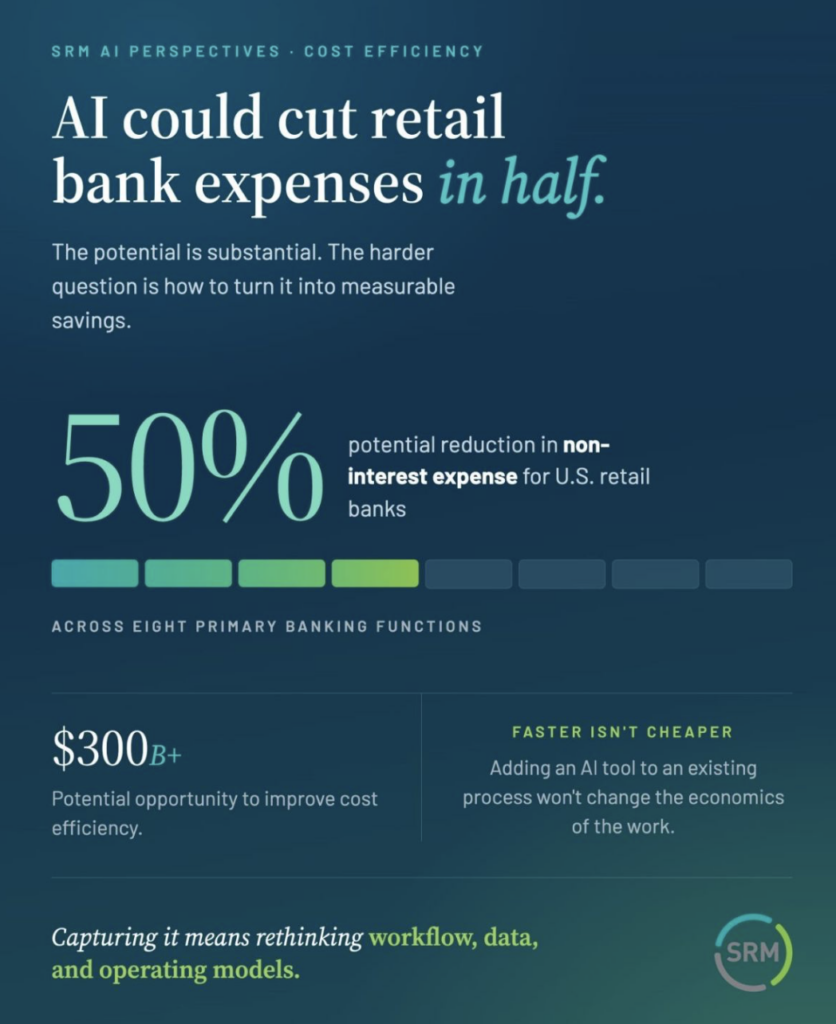
SRM estimates AI could reduce noninterest expenses by as much as 50% across eight primary banking functions, representing more than $300 billion in potential industry savings. The estimate is a modeled opportunity based on SRM’s analysis of industry spending data, not savings already realized.
The firm identifies three recurring barriers to implementation: policies that fail to account for vendors’ and subcontractors’ use of institutional data; fragmented data across legacy systems; and difficulty evaluating AI vendors in a rapidly changing market.
SRM also warns that employee concerns about job security, technology complexity and trust can undermine implementation. It recommends training workers for redesigned roles and giving them approved, governed ways to use AI rather than relying on blanket restrictions.
The report recommends that financial institutions measure outcomes such as shorter contact center handling times, improved member satisfaction and better financial performance, instead of counting AI pilots or tools deployed.
The Next Competitive Challenge
Looking ahead, SRM says AI agents that research and execute purchases could shift control of customer relationships away from banks and credit unions. Institutions that build payment authorization, data-access and consumer-permission systems could remain central to those transactions; others risk becoming largely invisible funding accounts behind third-party platforms.
To prepare, SRM recommends improving data quality, developing organization-wide AI fluency, adopting adaptable technology architectures and negotiating shorter vendor contracts with meaningful exit provisions. It also calls for oversight of third- and fourth-party data access and continuous monitoring of model performance.
The report’s central conclusion is that AI competitiveness will depend on institutions’ ability to keep learning and adapting as the technology changes — a capability SRM says is available to credit unions regardless of their size.