

By Steven Berkowitz

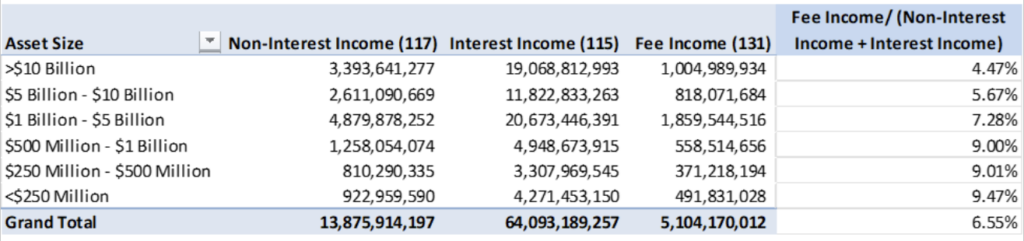
As of June 2026, fee income represented about 6.6% of total credit union income according to NCUA call report data. The top line numbers mask what may be a significant risk to smaller credit unions. Credit unions under $1 billion derived 9.0% to 9.47% of their total income from fees. I expect the incoming Congress to focus efforts on limiting fees: junk fees as populists refer to them.
While the stated initial focus may be on larger financial institutions, history suggests that the ripple down effect is real. This suggests a focused effort by credit unions to quantify the benefits members receive. Fee income represents fees for services and products members opt into; this needs a full court press to educate legislators with real data.
An important strategic issue is that a seemingly modest legislative or regulatory change affecting fee income could have a disproportionately large impact on smaller credit unions, their financial flexibility, and ultimately their ability to serve members.
The Disproportionate Impact on Smaller Credit Unions
The data reveal an important distinction that could easily be overlooked in discussions about financial institution fee regulation. While fee income represents approximately 6.55% of total industry income, that figure masks a significant disparity based on institutional size. Credit unions with more than $10 billion in assets derive approximately 4.47% of their income from fees. By comparison, credit unions with less than $250 million in assets derive 9.47%. In other words, the smallest credit unions are more than twice as dependent on fee income as the largest institutions. The $250 million to $1 billion category is similarly exposed, with fee income representing about 9.0% of total income.
This disparity has important implications for public policy. Legislation or regulation designed to address perceived excessive fees at the nation’s largest financial institutions could have unintended consequences for smaller, community-based credit unions.
Larger institutions generally have greater opportunities to diversify revenue, absorb regulatory costs, invest in alternative delivery channels, and spread operating expenses across a much larger membership base. Smaller credit unions have considerably less flexibility. For them, fee income can be an important component of the financial resources necessary to maintain operations, invest in technology, support member service, and remain competitive.
Not Just About Revenue
The issue is not simply how much revenue credit unions generate from fees. It is what happens when that revenue is restricted or eliminated without considering the underlying economics of the institution. A reduction in fee income does not automatically translate into lower expenses. The costs associated with maintaining accounts, processing transactions, providing payment services, and supporting members continue. If revenue disappears while expenses remain relatively constant, credit unions will eventually face difficult choices: reduce expenses, increase other sources of revenue, limit services, or accept lower earnings and reduced capital formation. Each of these alternatives could ultimately affect members.
The Problem With the ‘Junk Fee’ Narrative
The emerging political environment creates an additional challenge. The term “junk fees” has become an effective political message because it suggests that financial institutions are imposing unnecessary charges on consumers. Unfortunately, that characterization does not distinguish between fees that are excessive, hidden, or difficult to avoid and fees associated with services that members voluntarily choose to use.
Credit unions need to challenge the assumption that all fees are inherently harmful to consumers. Many fees represent the cost of providing optional services, specialized products, convenience, or access to financial services. The critical distinction should be whether a fee is transparent, reasonable, appropriately disclosed, and associated with a service that provides identifiable value to the member.
Credit unions should not assume that their cooperative structure will automatically protect them from broader financial services legislation. Political narratives are rarely constructed around the nuances of individual business models. If the public and policymakers begin viewing all financial institution fees as unnecessary charges, credit unions could find themselves defending revenue sources that are essential to their ability to deliver affordable financial services.
The Potential for Regulatory Creep
Another consideration is the potential for regulatory expansion. Initial legislative efforts may concentrate on the largest banks or the most visible consumer fees. However, once a regulatory framework is established, pressure to expand its application can develop. Credit unions should be particularly attentive to whether proposed legislation includes asset-size thresholds, exemptions for smaller institutions, or provisions that distinguish between different types of financial institutions and fee structures.
The history of financial services regulation provides reason for caution. Rules initially directed at a particular segment of the industry can eventually influence the broader competitive environment. Even when smaller institutions are exempted from direct requirements, indirect effects can emerge through changes in market pricing, consumer expectations, vendor relationships, and competitive behavior.
Consequently, credit unions should not wait until specific legislation is introduced before evaluating their exposure. The time to establish the economic and public policy arguments is before the debate becomes politically defined.
What Credit Unions Might Consider Doing Now
One priority should be to develop a much more granular understanding of fee income. The NCUA data establish that fee income represents a greater proportion of revenue at smaller institutions, but aggregate call report data do not explain which fees generate that revenue or the extent to which individual credit unions depend on particular fee categories. At a macro level, credit unions should begin distinguishing between overdraft and nonsufficient funds fees, ATM fees, account maintenance charges, transaction fees, and other service charges.
This analysis should examine the costs associated with providing the underlying services. A fee that generates revenue does not necessarily generate a comparable level of profit. Understanding the relationship between revenue, direct expenses, allocated operating costs, and member benefit will be essential to making a credible argument to policymakers.

Another Priority to Consider
Another priority for credit unions and their trade associations is to develop a common framework for quantifying member value. The industry needs to demonstrate not simply how much revenue fees generate, but what members receive in return. This could include access to payment systems, transaction processing, digital banking capabilities, account servicing, fraud prevention, and other services that members increasingly expect to receive as part of their financial relationship.
Also, the industry should develop economic impact scenarios. What would happen if fee income declined by 10%, 20%, or 30%? Which credit unions would be most vulnerable? How many institutions would experience a meaningful reduction in earnings? Would the impact be concentrated among smaller credit unions, rural institutions, or institutions serving lower-income membership groups? These questions would provide policymakers with a much more complete understanding of the potential consequences of fee restrictions.
Finally, credit unions should continue focusing on member value and unintended consequences of policies that fail to recognize the differences between large financial institutions and member-owned cooperatives. The objective should be to establish a clear distinction between abusive practices and legitimate charges associated with providing valuable financial services.
The Larger Strategic Question
Ultimately, this issue is about more than fee income. It raises a fundamental question about the future economics of the credit union business model. Credit unions face increasing technology, compliance, cybersecurity, personnel, and operating expenses. At the same time, they are expected to provide increasingly sophisticated services while maintaining competitive pricing and demonstrating measurable member value.
If policymakers restrict one of the industry’s revenue sources without addressing the underlying cost structure, the consequences could accelerate consolidation, weaken smaller institutions, and reduce financial services competition in communities that already have limited alternatives.
The irony is that policies intended to make financial services more affordable could unintentionally make it more difficult for smaller financial institutions to remain viable. That is a message the credit union industry needs to communicate clearly, consistently, and with credible supporting data.
Steven Berkowitz publishes the Credit Union Strategic Insights newsletter and serves as chairman NIH Federal Credit Union.