

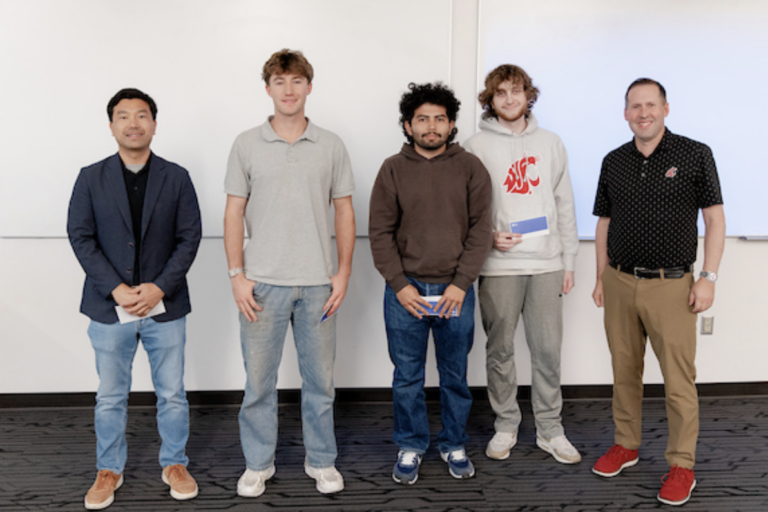
PULLMAN, Wash. — Gesa Credit Union partnered with Washington State University business students in an artificial intelligence hackathon that challenged nine teams to develop applications aimed at helping consumers manage spending, debt and savings.
According to WSU Insider, the credit union provided real-world financial challenges for the competition at WSU’s Pullman campus, giving students an opportunity to test AI tools while offering the $6.8-billion Gesa CU’s new perspectives on financial literacy and member needs.
Gesa Chief Information Officer Andrew Chung served as a judge. He said the students’ approaches, developed outside the financial services industry, produced impressive results in a short period.
“It was a very short amount of time, and the end products were fabulous,” Chung told WSU Insider. “I was amazed in terms of the level of the students, their knowledge, and the solutions they came up with.”
The Winning Team
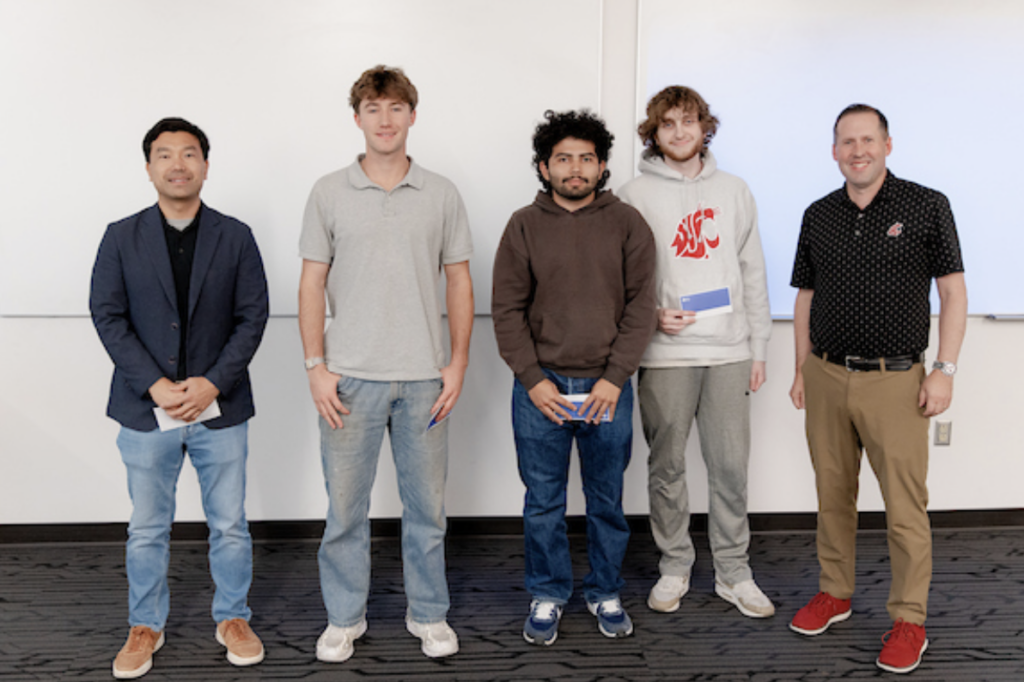
The winning team of Chase Callow, Carlos Escobar and Fletcher Olson created ClearPath, a budgeting prototype that analyzed transaction histories, categorized spending and monitored savings goals. An AI coach offered explanations and suggestions, including identifying possible duplicate charges for review.
Escobar said the team used Anthropic’s Claude to generate an initial version in about 45 minutes, leaving more time for testing, improvements and presentation preparation.
The second-place entry, Credit Quest, combined credit card repayment scenarios with personalized challenges and achievement awards. Third-place PathWise was designed to help users manage debt and revise plans when income or expenses changed.
Students also addressed limitations of their prototypes and situations in which consumers should seek professional financial advice, according to the university.
Objective of Event
Robert Crossler, a professor at WSU’s Carson College of Business who organized the event, said the competition was intended to show students how AI can help them solve business problems without years of specialized technical training.
“Industry partnerships also provide students with the opportunity to present their ideas and solutions to business executives, in this case, the CIO of Gesa Credit Union,” Crossler said.
Gesa also supported a similar event at WSU’s Vancouver campus. Crossler has organized other AI exercises, including an Oct. 23 event in Pullman involving the Management Information Systems Club and its advisory board, and expects more events in the spring.
Callow said collaborating on a financial institution’s practical challenge changed his view of AI as a tool used primarily by individuals. “Using it collectively as a team helped me understand all the different capabilities AI provides a business in solving their real-world problems,” he said.