ATLANTA—A new report offers extensive insights into the plans by credit union and bank executives for applying artificial intelligence.
Conducted by York Public Relations and commissioned by Agent IQ, the report focuses on a survey of 103 bank and credit union executives (51 banks, 53 CUs) on their plans for AI.
“The report provides a detailed, data-driven view of where the industry currently stands on artificial intelligence and where it is headed,” York Public Relations said. “The biggest finding is that AI is changing how bankers work, not eliminating the need for bankers. The largest share of respondents (35%) believe AI will significantly increase productivity while keeping humans central to the work. Another 27% believe AI will automate a meaningful portion of current tasks and 18% anticipate a shift toward more advisory and relationship-focused roles in response.”
York PR said those findings are consistent with what its bank clients are telling us. In fact, one bank recently recognized for its work towards AI and innovation has increased staff by 30%, the company said, adding that the idea that AI replaces bankers is no longer true.
Key Findings
Other key findings include:
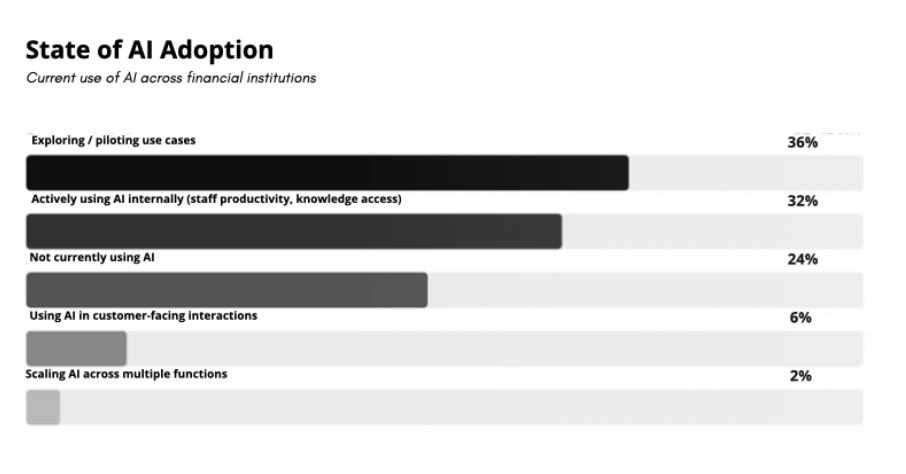
- Most financial institutions remain in early stages of AI adoption. The largest share of respondents (36%) describe their institutions as exploring or piloting AI use cases, while 32% report actively using AI internally for staff productivity. Just 6% have deployed AI in customer-facing interactions, and only 2% have scaled it across multiple functions.
- Operational efficiency is a priority over revenue growth. A striking 82% of respondents identified improving operational efficiency and reducing manual work as a primary goal driving AI investment, outpacing employee productivity (58%), customer experience (50%), risk management (42%), and revenue growth (16%) by a wide margin.
- Talent gaps and trust concerns are the defining constraints. Lack of internal expertise or resources led the list of adoption barriers at 62%, followed by data privacy and security concerns (58%) and trust in AI outputs and accuracy (44%). Notably, trust in AI accuracy ranked higher than regulatory and compliance risk (32%), signaling that institutions are less concerned about whether AI can be used and more focused on whether it can be trusted at scale.
- The future of AI adoption in financial services is partner-led. Fifty-seven percent of respondents are pursuing partnership-based implementation models, with 29% combining internal strategy with outsourced technology partners and 20% relying on AI embedded within existing banking platforms. Only 6% are building AI capabilities primarily in-house.
The full report can be viewed here: 2026 The State of AI