TORRANCE, Calif. — Americans remain broadly confident about meeting their financial obligations, but financial security is increasingly diverging by income and generation as credit card debt and high interest rates continue to weigh on households, according to a new survey from Happy Money.
Happy Money’s second annual Credit Check-In found 73% of respondents said they were at least somewhat confident in their ability to meet financial obligations. But 34% said they feel less financially secure than they did a year ago, compared with 31% who said they feel more secure.
The findings are based on an online survey of 2,000 U.S. adults commissioned by Happy Money and conducted by OnePoll. The survey was nationally representative by age, gender and region, according to the company.
Higher-Income Households Report More Progress
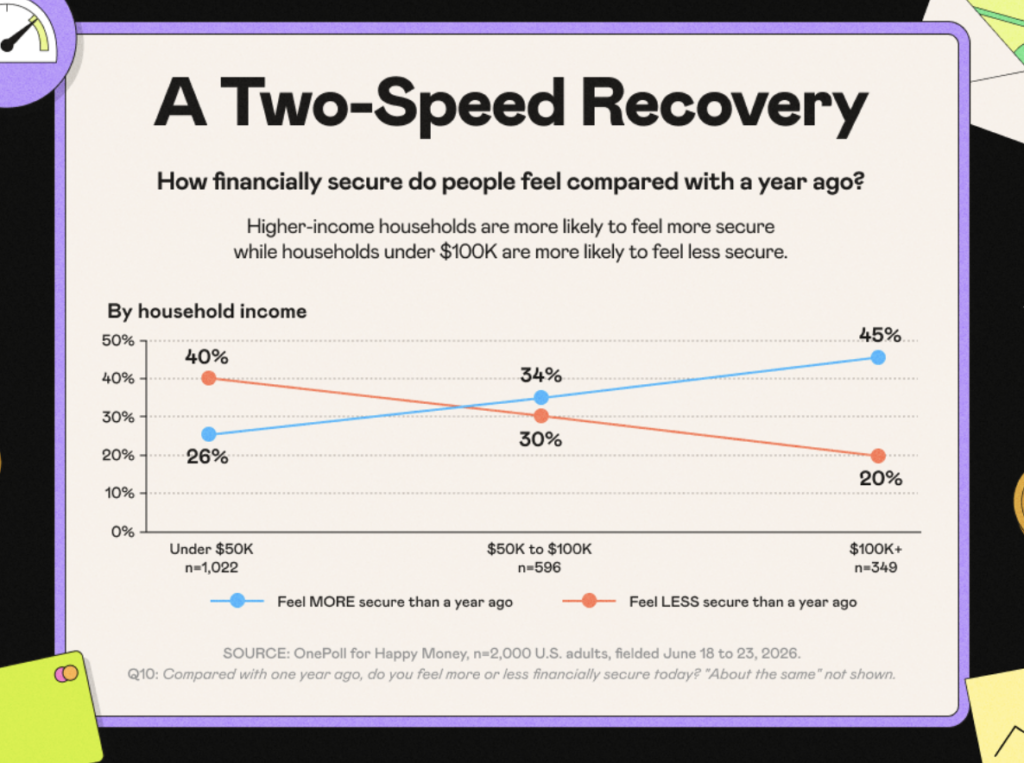
Happy Money said the results show a widening divide in perceptions of financial progress.
Among households earning at least $100,000 annually, 45% said they feel more financially secure than a year ago. Among households earning less than $100,000, 29% said they feel more secure, while 36% said they feel less secure.
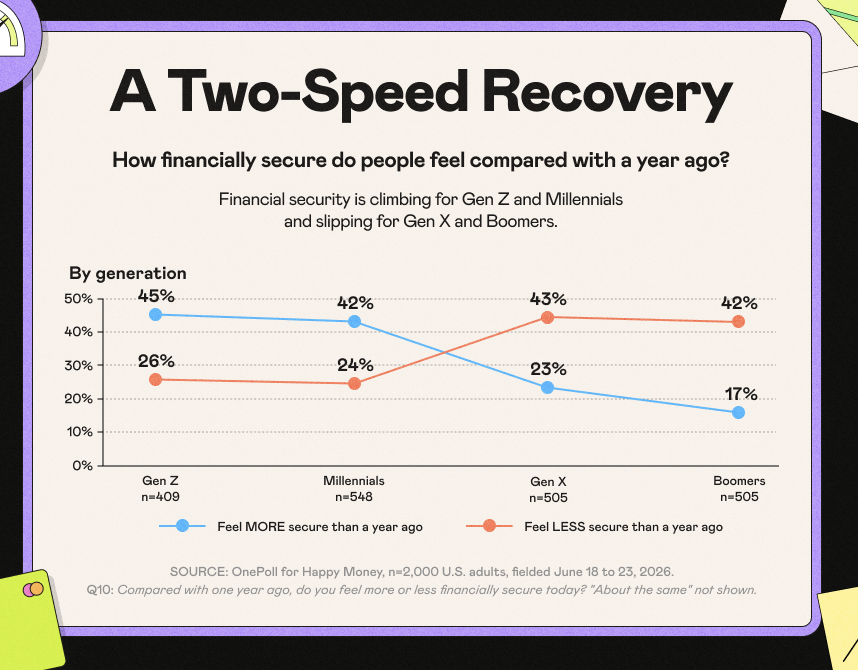
Differences also emerged by generation. Gen Z respondents were the most likely to report improving financial security, with 45% saying they feel more secure and 26% saying they feel less secure.
By comparison, 43% of Gen X respondents and 42% of baby boomers said they feel less financially secure than a year ago.
“The American consumer continues to show tremendous resilience, but financial progress is becoming more uneven,” Happy Money CEO Matt Potere said. “While many households continue to move toward their goals, others are working harder just to stay in place.”
Credit Card Debt Remains Concern
The survey found 41% of respondents carry credit card debt, making it the most common type of debt reported. Among those with credit card debt, 75% said they are concerned about their interest rates, including 36% who said they are extremely concerned.
Paying down debt was cited as a top financial goal by 33% of respondents, behind covering daily expenses at 38% and building savings at 35%.
But Happy Money found consumers seeking to reduce debt were more likely to cut spending than restructure what they owe. Among respondents prioritizing debt reduction, 55% said they cut spending or postponed a major purchase, while 10% consolidated or refinanced debt.
Across all respondents, 25% said they had taken no action during the previous six months to manage debt or reduce financial stress.
The consequences of debt also extended beyond household spending. Among respondents carrying debt, 27% said it caused them to delay building savings, 26% postponed major purchases and 20% delayed health or dental care.
“This isn’t just a debt problem, it’s a life-postponement problem,” Potere said.
Emotional Barriers Also Affect Debt Decisions
Happy Money said its research indicates that financial limitations are not the only factors preventing consumers from addressing debt.
Among respondents with debt, 35% said they were too overwhelmed, found dealing with debt too stressful or believed taking action required too much effort.
The company said 25% of respondents with debt identified one of those emotional barriers, rather than a cash-flow problem, as the reason they had not acted.
Happy Money characterized the findings as an “action gap” between consumers’ financial goals and the steps they are taking to reach them.
AI Emerging as Source of Financial Guidance
The survey also found artificial intelligence is beginning to play a role in how Americans seek financial advice.
Happy Money said 13% of respondents identified AI tools as among the sources they trust most for financial advice. The figure increased to 17% among Gen Z and millennial respondents.
But most consumers who trust AI are not relying on it exclusively.
Among respondents who said they trust AI for financial guidance, 54% also seek advice from a person, including financial advisers, friends or family members, employer programs or nonprofit debt counselors. Just 14% said they rely on AI alone.
“AI is a great place to start when you want a quick gut check or you don’t want to ask a person the embarrassing question, but it’s not the finish line,” said Matt Tomko, Happy Money’s chief revenue officer.
Tomko said consumers can benefit from combining technology with a financial plan and other trusted sources of guidance.
Happy Money Cites Role for Financial Institutions
Happy Money said the findings create opportunities for credit unions and other financial institutions to help borrowers manage high-interest debt through financial guidance and debt-consolidation products.
The company partners with credit unions, banks and asset managers to offer fixed-rate personal loans that consumers can use to consolidate credit card debt into predictable monthly payments.
Happy Money said it recently surpassed $7 billion in cumulative loan originations and has helped more than 350,000 consumers consolidate credit card debt. The company estimates those borrowers have saved about $1 billion in interest.
Happy Money said its Credit Check-In is intended to track changes in consumer financial sentiment and behavior, including attitudes toward debt, financial security and emerging sources of financial guidance.