NEW YORK — Americans’ short-term inflation expectations eased slightly in May, but consumers grew more pessimistic about job prospects, access to credit and their personal finances, according to the latest Survey of Consumer Expectations released by the Federal Reserve Bank of New York.
The survey found median one-year-ahead inflation expectations fell 0.1 percentage point to 3.5% in May, while expectations remained unchanged at 3.1% over the three-year horizon and 3.0% over the five-year horizon.
At the same time, households became more concerned about their financial outlook, with expectations for future credit availability, personal finances and debt repayment all deteriorating, according to the New York Fed.
Key Findings
Among the survey’s key findings:
Inflation and Prices
- Median one-year-ahead inflation expectations declined to 3.5% from 3.6%.
- Three-year-ahead inflation expectations held steady at 3.1%.
- Five-year-ahead inflation expectations remained unchanged at 3.0%.
- Disagreement among respondents over future inflation declined across all time horizons.
- Median home price growth expectations increased 0.5 percentage point to 3.5%, the highest level since July 2022. The increase was strongest in the Midwest and West.
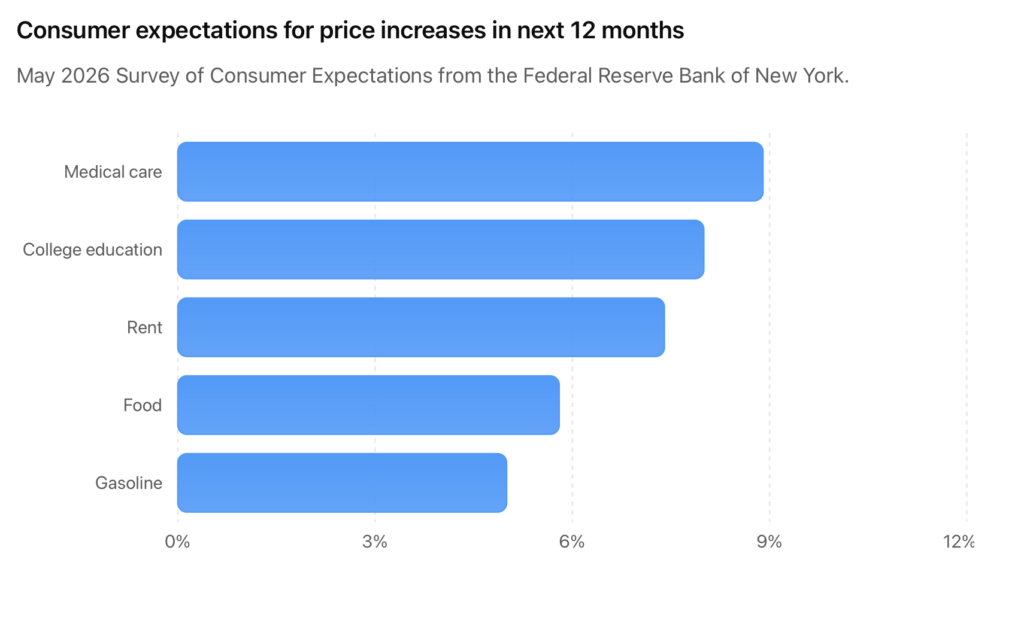
- Expected gasoline price increases fell 0.1 percentage point to 5.0%.
- Expected food price growth rose 0.6 percentage point to 5.8%.
- Expected rent increases climbed 1.4 percentage points to 7.4%.
- Expected medical care cost increases declined 0.7 percentage point to 8.9%.
- Expected college education cost increases fell 0.8 percentage point to 8.0%.
Labor Market Expectations
Consumers expressed mixed views about the labor market.
Median expected earnings growth remained unchanged at 2.7%, slightly above the 12-month average of 2.6%.
The mean probability that the national unemployment rate will be higher one year from now declined 0.4 percentage point to 43.2%, though it remained above its 12-month average of 41.1%.
However, workers grew more concerned about job security and less confident about finding new employment.
- The perceived probability of losing a job within the next year increased 0.5 percentage point to 15.1%.
- The expected quit rate rose 2.6 percentage points to 20.8%, its highest level since February 2023.
- The perceived probability of finding a new job after losing a current position fell 2.3 percentage points to 43.7%, the lowest level since December 2025.
The increase in expected voluntary job departures was broad-based across age, education and income groups, according to the New York Fed.
Household Finances
Median expected household income growth remained unchanged at 2.8%.
Expected household spending growth over the next year declined 0.4 percentage point to 5.0%, though it remained slightly above the 12-month average of 4.9%. The decline was concentrated among consumers age 60 and older, those with a high school education or less, and households earning less than $50,000 annually.
Consumers also reported worsening views of credit conditions.
While perceptions of current credit availability compared with a year ago were largely unchanged, expectations for future access to credit deteriorated, with fewer respondents expecting borrowing conditions to improve over the next year.
The average perceived probability of missing a minimum debt payment within the next three months increased 1.2 percentage points to 12.6%, driven largely by lower-income households and respondents with a high school education or less.
Additional Findings
Additional findings included:
- Expected tax increases at current income levels declined 0.3 percentage point to 3.1%.
- Expected growth in federal government debt fell 0.1 percentage point to 9.9%.
- The perceived probability that savings account interest rates will be higher in one year dropped 2.1 percentage points to 24.6%.
- The perceived probability that stock prices will be higher one year from now increased 0.4 percentage point to 38.0%.
The survey also found a growing share of households reported being worse off financially than they were a year ago, reaching the highest level since January 2023. Expectations for future finances weakened as well, with the net share of respondents expecting their financial situation to improve over the next year falling to its lowest level since October 2022.
The May Survey of Consumer Expectations was conducted between May 1 and May 31. The monthly survey is based on responses from approximately 1,300 household heads nationwide and is designed to measure consumer expectations regarding inflation, employment, income, spending, credit access and other economic conditions, according to the Federal Reserve Bank of New York.