BOSTON — Americans remain relatively confident about their personal finances and current jobs, but their views of the broader economy are deteriorating as higher costs erode savings cushions and workers become less confident they could find another job paying what they need, according to a new analysis.
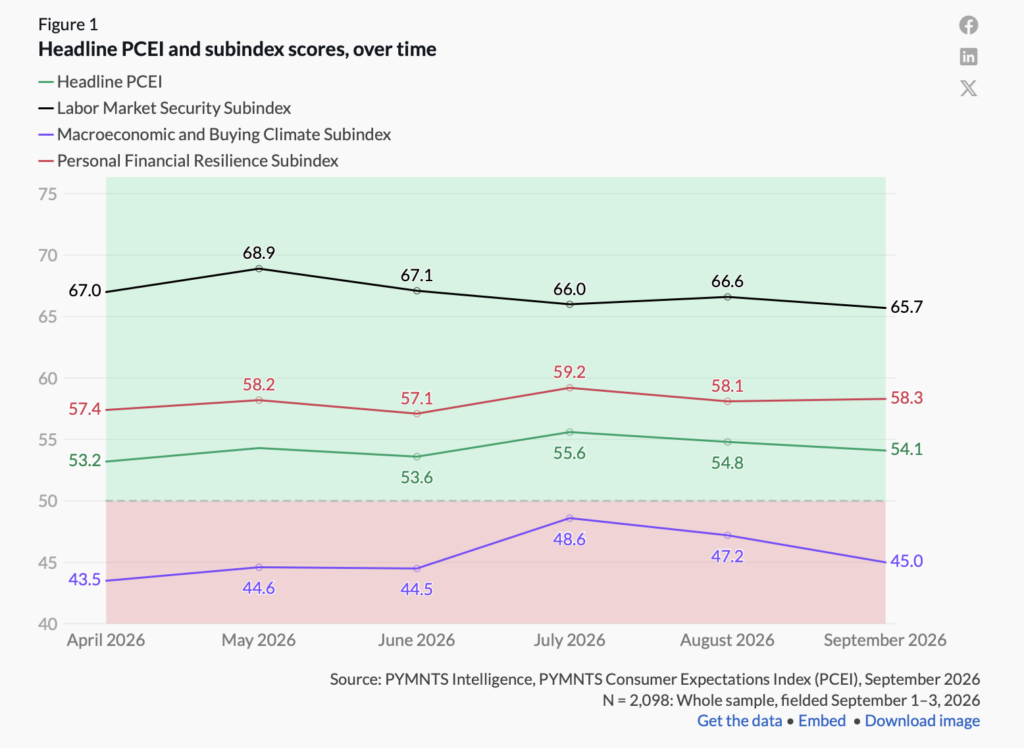
The PYMNTS Consumer Expectations Index fell 0.7 point in September to 54.1, marking its second consecutive monthly decline. A reading above 50 indicates consumers are generally optimistic, while a reading below 50 signals a more pessimistic outlook.
PYMNTS said the overall results suggest consumers remain financially stable for now but have less capacity to withstand higher costs, a job disruption or another unexpected financial shock.
The sharpest deterioration was in the Macroeconomic and Buying Climate subindex, which measures consumers’ views of the economy and whether they believe it is a good time to make major purchases. That index dropped 2.2 points to 45.0.

By comparison, the Personal Financial Resilience subindex, covering savings, debt and household money management, was essentially unchanged at 58.3. The Labor Market Security subindex declined 0.9 point to 65.7.
Pricing a Major Factor
PYMNTS said higher prices appear to be a major factor in consumers’ worsening economic outlook. Energy costs increased between July and September, while 85% of consumers reported their essential expenses had risen during the past year.
The decline in economic confidence was broad-based. PYMNTS said its Macroeconomic and Buying Climate measure declined by more than one point across every demographic group it tracks, including consumers living paycheck to paycheck and those with money left after paying their monthly expenses.
Short-Term Business Conditions recorded the largest decline among the 11 components of the index, falling 2.6 points. Long-Term Business Conditions dropped 2 points, while the Buying Conditions measure fell 1.8 points.
Generation Z and Generation X consumers posted the largest overall declines in sentiment. Among consumers living paycheck to paycheck and having difficulty paying bills, the Short-Term Business Conditions measure fell 3.4 points.
Generation Z was the only generation to report an improvement in its long-term business outlook, with its score increasing 0.7 point.
Job Mobility Strong, Mobility Weakens
Consumers continue to feel relatively secure in their current jobs, but PYMNTS found growing doubts about their ability to move to another position.
The Personal Job Security measure was nearly unchanged at 80.4, while consumers’ perceived protection from layoffs increased 1.3 points to 71.9.
But the Job Mobility measure, which gauges whether consumers believe they could find a new job paying what they need, declined 2.2 points to 46.9. Every household income group tracked by PYMNTS was below the neutral 50 level.
The decline ranged from 1.8 points among households earning between $100,000 and $150,000 annually to 2.6 points among households earning $150,000 or more.
Consumers not living paycheck to paycheck reported a 3.2-point decline in job mobility. Millennials’ score fell 3.4 points to 48.9, while Generation X declined 3.9 points to 43.1.
Moving in Opposite Direction
Generation Z moved in the opposite direction, rising 1.1 points to 49.8. Baby boomers and seniors increased 0.5 point to 44.5.
PYMNTS cited federal labor market data that also point to reduced worker mobility. The U.S. Bureau of Labor Statistics reported the share of workers voluntarily quitting their jobs fell to a post-pandemic low of 1.9% in July, while the hiring rate of 3.2% was the weakest since February.
At the same time, the Federal Reserve Bank of New York reported the average minimum wage job seekers said they would need to accept a new position reached a record $88,387 in July, more than $10,000 higher than in March 2025.
Savings Providing Less of a Cushion
Although consumers’ overall assessment of their financial resilience changed little during September, PYMNTS found evidence that household savings are providing less protection against a financial disruption.
The share of consumers who said their savings would support their current lifestyle for three months or less if their income stopped rose to 51.8%. That was up 2.4 percentage points from August and 4 percentage points since April.
Meanwhile, 15.1% said their savings could support them for more than a year, the lowest share in 12 months. That figure has declined 3.7 percentage points over the past six months.
The percentage of consumers with no more than three months of savings increased for the third consecutive month.
PYMNTS said the findings indicate rising living costs can reduce how long existing savings will last even when consumers remain confident about their ability to continue putting money aside.
Differences by Generation
Its Savings Capacity measure, which gauges consumers’ confidence in their ability to save during the next year, showed significant differences by generation. Confidence among baby boomers and seniors increased 3.6 points, while Generation Z’s score declined 1.3 points.
The September Consumer Expectations Index was based on a survey of 2,098 U.S. consumers conducted Sept. 1-3. PYMNTS describes the monthly index as a survey-based measure of U.S. consumer sentiment.