SANDWICH, Mass. — Financial institutions are embracing artificial intelligence at an accelerating pace, but many credit union and community bank employees remain more concerned about its risks than its potential benefits, according to a new analysis and survey by data analytics firm Gemineye.
Gemineye said the financial services industry is facing competing pressures as organizations push to integrate AI into operations while employees question whether the technology will deliver meaningful results.
Citing remarks made by Gartner Vice President Analyst Carlie Idoine during the Gartner Data & Analytics Summit in June, Gemineye said organizations are rapidly moving toward an AI-first operating model in which artificial intelligence is becoming central to business decisions, workflows and investments. Without an enterprise-wide strategy, organizations may struggle to realize AI’s full value, Idoine said, according to Gemineye.
Broader Trends
The report also pointed to broader industry adoption trends, citing MIT Technology Review Insights, which found that 70% of financial institutions are using agentic AI in some capacity. Gemineye also referenced Filene research showing that 66% of credit unions plan to use AI in credit decision-making.
Despite those trends, Gemineye said many financial institutions lack the governance, technology, skills and operational processes needed to fully capitalize on AI.
To gauge industry sentiment, Gemineye surveyed 30 employees at credit unions and community banks in May 2026, including executives and managers representing institutions with assets ranging from $250 million to $8 billion.
Respondents included CEOs, CFOs, operations executives, human resources leaders, IT directors, marketing executives and data analysts.
What’s Important to Exec Teams
The survey found executive teams place a high priority on organizational AI adoption, with respondents rating its importance an average of 8 on a 10-point scale. No respondent rated AI adoption below a 4.
However, actual implementation remains limited. Half of respondents said their institution has integrated just one or two AI processes, while 20% reported three to five implementations. Thirteen percent said they had not implemented any AI processes, 10% reported more than 10 implementations and 7% said they had integrated between six and nine.
Gap Cited
Gemineye said the results illustrate a gap between executive expectations and operational readiness.
The survey also found employees remain overwhelmingly cautious about AI. Eighty-seven percent of respondents identified concerns rather than opportunities when asked about the technology’s biggest impact.
The most common concerns centered on data accuracy and security.
Among the comments cited in the report, one data analyst at a $2 billion credit union warned against relying too heavily on AI without verifying information or understanding the business context. Another respondent, the president of an $800 million credit union, expressed concern that excessive reliance on AI could erode critical thinking. A business applications manager at a $1.6 billion bank cited security, privacy and customer information protection as primary concerns.
Where Opportunity is Seen
Other respondents highlighted operational efficiencies as AI’s greatest opportunity.
Israel Spence, business intelligence strategy manager at Service 1st Credit Union, said AI can help automate repetitive tasks, summarize information for briefings and enable natural-language data queries for business units, according to the report.
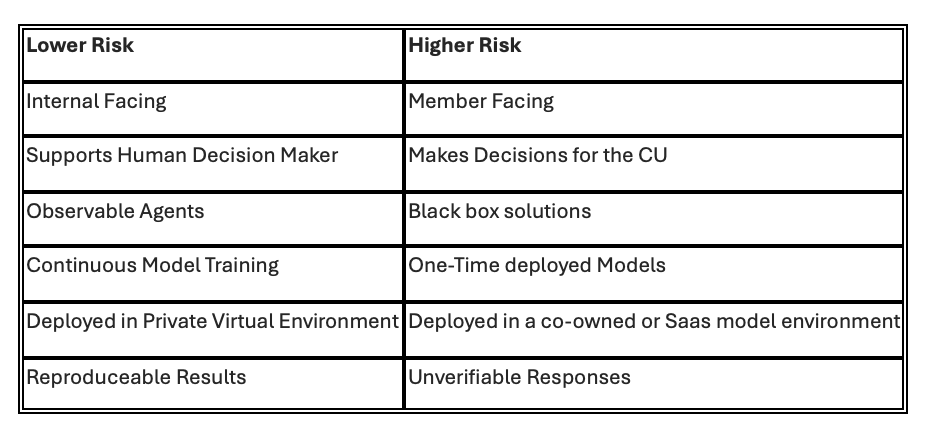
Gemineye recommended that risk-averse financial institutions begin with internal AI applications that support, rather than replace, human decision-making and produce transparent, repeatable results.
The report also cited Qualtrics’ 2026 Consumer Experience Trends study, which surveyed 20,000 consumers in 14 countries. According to Gemineye, the study found only 29% of consumers trust organizations to use AI responsibly, with misuse of personal data ranking as consumers’ top concern.
Gemineye concluded that financial institutions will need to balance innovation with risk management by adopting AI tools designed with strong security and accuracy controls while establishing governance frameworks that support responsible implementation.